

Boston Scientific Spent $523M to Take Control of This Chinese MedTech. What Did It Do Right to Go Global?

Acotec
Manufacturer of Endovascular Interventional Products

Boston Scientific
Medical Device Manufacturer
In the sixth batch of centralized procurement at the end of 2025, the lowest price for drug-coated balloons above the knee dropped to RMB 2,468. Acotec won the bid under Rule 3 with a quoted price of RMB 4,613.
As a listed company in the field of domestically produced high-value medical consumables, Acotec received strategic investment from Boston Scientific in 2022, and consecutively signed cooperation agreements with Boston Scientific in 2023 and 2025, creating a new model for Chinese-made innovative medical devices to go global.
How did Acotec perform in this round of centralized procurement? How does the company strategize its product portfolio and diversification? How can it leverage Boston Scientific's global distribution channels? To address these questions, VCBeat conducted an in-depth conversation with Li Chen, Vice President of Business Development and Board Secretary of Acotec, exploring Acotec's performance in centralized procurement, product planning principles, and overseas expansion strategy.

(Li Chen, Vice President of Business Development and Board Secretary at Acotec)
Let's first get to know Acotec and the market in which it operates.
Peripheral Drug-Coated Balloons (Peripheral DCBs) are core consumables for peripheral arterial interventional therapy, suitable for various scenarios such as lower extremity vascular stenosis, in-stent restenosis, and arteriovenous fistula lesions. Compared with traditional stents, peripheral DCBs offer advantages including no foreign body residue post-procedure, lower risk of inflammation, and better long-term prognosis.
Leveraging clinical advantages and embracing the "intervention without implantation" philosophy, peripheral drug-coated balloons have become one of the fastest-growing niche segments in the cardiovascular intervention field in recent years.
The flip side of rapid market growth is a significant intensification of competition. To date, peripheral drug-coated balloon products from more than 17 companies have been approved for market launch in China over the past two years, with additional companies' products currently in the registration application phase.
The sixth round of national centralized procurement for high-value medical consumables, launched at the end of 2025, included peripheral drug-coated balloons in its scope, further reshaping the market landscape.
This round of centralized procurement introduced an "anchor price" mechanism and established a "revival mechanism," emphasizing clinical value and therapeutic efficacy. At the regulatory level, it clearly set a policy direction to "curb cutthroat competition, prevent malicious low-price bidding, and shift from price wars to value-based competition." In the procurement process, Acotec adhered to the rules and refrained from engaging in price wars, successfully winning bids in most cases under Rule 3. This selection result has made it a focal point of industry attention and market analysis.
For a long period prior to this, Acotec leveraged its "China's first peripheral drug-coated balloon and the world's first below-the-knee drug-coated balloon" to account for over 80% of the market share in China's peripheral drug-coated balloon market. This is further evidenced by the procurement volumes reported by medical institutions for Acotec's peripheral drug-coated balloon products in the current procurement round. For instance, the annual procurement demand for below-the-knee peripheral drug-coated balloons under the centralized procurement was 7,002 units, with medical institutions reporting a demand of 5,568 units for Acotec's products, representing a 79.5% share.
The bid results for above-knee drug-coated balloons show that most companies were selected under Rule 1, while companies such as Acotec, Medtronic, Biotronik, Lepu Medical, Jianyuan Medical, and DK Medtech adhered to the anti-involution principle by not submitting low bids and were selected under Rule 3.
Selection under Rule 1 means that these enterprises will receive 100% to 70% of the base procurement volume (reported volume) according to their rankings, and qualify for the allocation of the remaining volume. Under Rule 3, 40% of the base procurement demand is allocated, with no participation in the allocation of the remaining volume.
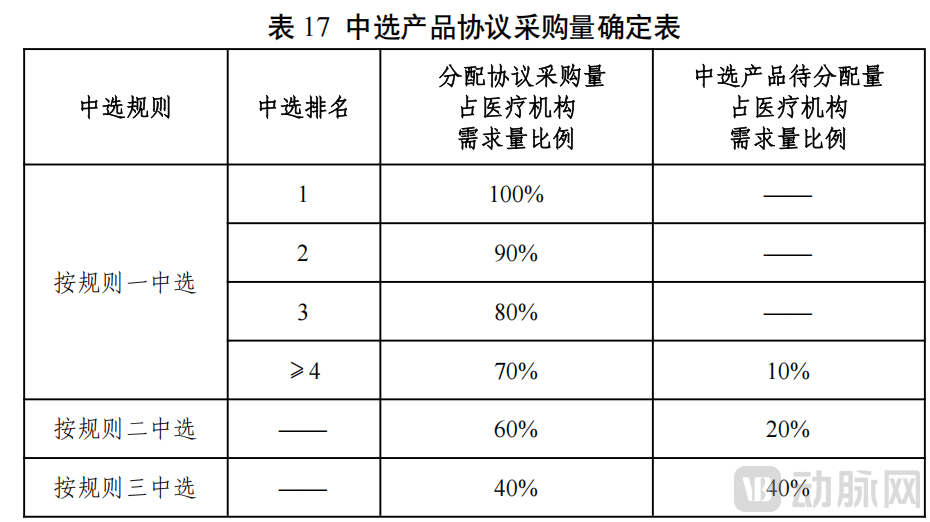
The remaining volume is based on the reported demand by medical institutions for non-selected products. It consists of 80% of the volume reported by medical institutions, 80% of the product demand volume for which enterprises failed to declare despite reporting by medical institutions, and the pending allocation volume of selected products. The remaining volume shall be allocated at the discretion of medical institutions from the products offered by winning enterprises under Rule 1 and Rule 2.
It appears that the companies selected under Rule 1 and Rule 2 will emerge as the winners in this round of centralized procurement. However, VCBeat believes that being selected for revival under Rule 3 does not mean that these companies have lost the majority of their market share.
First, in this volume-based procurement, the quota for peripheral drug-coated balloons was set at 61,434 units, which still shows a significant gap in penetration rate compared to developed countries such as the United States. In the future, the incremental market for peripheral drug-coated balloons will become an important sector that cannot be overlooked.
Second, in the competition for incremental market growth, companies with reasonable pricing may hold a competitive advantage. This is because, in a free-market competitive environment, companies need to invest substantial capital in academic promotion, market expansion, channel development, brand building, and other initiatives. Reasonable pricing allows companies to maintain adequate profit margins and allocate sufficient funds to compete for incremental market share.
Third, reasonable pricing will enable these enterprises to gain sustainable competitiveness. Stable profits enable companies with higher quotations to sustain their investment in technological innovation and product optimization and upgrades. As economist Joseph Schumpeter said, "Without profit, there is no incentive for innovation."
Li Chen stated: "In the past, the medical device industry favored a traditional development model characterized by 'small yet specialized, small yet refined,' with companies focusing on meticulous innovation around a single product. For instance, Invatec, where the founding team of Acotec had previously worked, sold an innovative drug-coated balloon product to Medtronic for $500 million, generating substantial returns. However, as market competition intensifies, companies relying on a single product face a significant risk of having their revenues halved. These market shifts are driving medical device enterprises to transition from a 'small yet refined' model toward diversification."
Acotec is also a representative enterprise that has been driven by market changes to undergo a diversified transformation and upgrade. For a long period previously, Acotec focused exclusively on peripheral drug-coated balloons, with all its revenue derived from two pioneering peripheral drug-coated balloon products. Prior to 2020, Acotec had already begun to establish its presence in the fields of venous intervention and coronary drug-coated balloons, along with related products such as radiofrequency ablation systems and peripheral thrombus aspiration systems.
The 2025 annual report shows that Acotec's venous intervention and access product line generated RMB 323 million in revenue, accounting for 50.1% of total revenue, becoming another revenue engine beyond peripheral drug-coated balloons. To date, Acotec has laid out more than 30 products across vascular surgery, cardiology, nephrology, neurology, and interventional oncology, forming a diversified portfolio.
Notably, among the products in Acotec's portfolio, first-in-class products account for a remarkably high proportion. For example:
China's First Peripheral Drug-Coated Balloon: Approved for market launch in China in 2016, four years ahead of the second similar product.
The World's First Below-the-Knee Drug-Coated Balloon: Approved for market launch in China in 2020, it is the world's first clinically validated below-the-knee drug-coated balloon product.
China's First Endovenous Radiofrequency Ablation System: Approved for market launch in China in 2022, it is an innovative product for the treatment of varicose veins. Its market introduction broke the monopoly of imported products and achieved significant commercial success.
China's First Domestically Produced Peripheral Thrombus Aspiration System: Approved for market launch in China in 2021. It surpasses international standards in flexibility, torsional control, support strength, negative pressure resistance, and diverse specifications, offering fewer side effects and enhanced safety. Leveraging its innovation and clinical value, this product has broken the monopoly of imported alternatives and gained recognition among clinicians.
China's First Drug-Coated Balloon Dilatation Catheter for the Vertebral Artery: Approved for market launch in China in 2025, this is an innovative solution from Acotec for vertebral artery ostial stenosis (VAOS). Previously, VAOS was primarily treated with stents; however, the post-stenting restenosis rate ranged from 20% to 50%, representing a significant clinical challenge. Compared with stents, this product significantly reduces the rate of target lesion restenosis at 12 months post-procedure. According to clinical trials, from a statistical perspective, the trial results meet the non-inferiority hypothesis, and the statistical inference for superiority is established.
Acotec's enthusiasm for innovation and first-in-class products stems from its belief in the value of innovation and the substantial returns it reaped from such efforts early on.
Li Chen stated: "Improved products typically have a development cycle of around five years, with relatively low risk and a mature pathway. In contrast, first-in-class products require 8–10 years to complete the entire process—from needs identification, technological breakthroughs, and establishment of clinical standards, to regulatory approval, market education, and clinical promotion. Moreover, they face the constant risk of failure due to unknown factors at any stage, resulting in extremely high sunk costs."
Compared to improved products, first-in-class products offer greater clinical and market value. Taking Acotec's global first below-the-knee drug-coated balloon as an example, this product was initiated in 2011 and approved in 2020. It is the world's first clinically validated product in this field, thereby earning the U.S. FDA's "Breakthrough Device" designation.
With the innovation of this product and its superior clinical data, Acotec has gained recognition from Boston Scientific. In 2022, Boston Scientific announced the acquisition of approximately 65% equity interest in Acotec for $523 million (completed in early 2023).
Given the value and returns of first-in-class products, as well as the need for corporate diversification, Li Chen stated: "Acotec will continue to invest in innovative R&D. In terms of product planning, Acotec plans to expand its portfolio to include other ancillary devices for vascular interventional procedures."
Acotec's diversification, to some extent, was driven by market pressures. However, its global expansion was naturally achieved following its collaboration with Boston Scientific.
Boston Scientific is a global leader in medical devices, with business spanning cardiac intervention, peripheral intervention, endoscopy, urology, and neuromodulation. It has offices in approximately 127 countries and regions, a workforce of 53,000 employees, and sales channels spanning the globe.
Following strategic investment from Boston Scientific, Acotec signed a cooperation agreement with it in 2023. The terms of the partnership indicate that from 2023 to 2025, Boston Scientific will promote and sell multiple innovative products from Acotec globally. This positions Acotec as one of the few domestic companies in China endorsed by a multinational giant, successfully achieving the global expansion of its high-end products.
Leveraging Boston Scientific's global sales network, Acotec's semi-compliant PTCA balloons, paclitaxel-eluting coronary balloons, above-the-knee drug-coated balloons, below-the-knee drug-coated balloons, and radiofrequency ablation systems have been sold to 17 countries and 5 regions worldwide.
By the end of 2025, Acotec and Boston Scientific signed another three-year cooperation agreement (2026–2028) to deepen their strategic partnership. The agreement stipulates that Boston Scientific will procure products from Acotec, including above-the-knee drug-coated balloons, below-the-knee drug-coated balloons, and radiofrequency ablation systems, for distribution in markets such as Europe and the United States. From 2026 to 2028, the annual procurement caps for Acotec's products by Boston Scientific are set at $30 million, $62 million, and $78 million, respectively, totaling $170 million (RMB 1.15 billion).
Among them, Acotec's radiofrequency ablation system was approved for marketing in the United States in October 2025. The overseas commercialization of this product is also handled by Boston Scientific. Currently, driven by Boston Scientific's robust distribution channels, the product completed its first radiofrequency ablation procedure in the U.S. in January 2026, performed by a team led by internationally renowned vascular surgery expert Dr. Steve Elias.
Following its partnership with Boston Scientific, Acotec has seen rapid growth in its overseas business. However, notably, Boston Scientific also has peripheral drug-coated balloon products. Why, then, does it continue to market Acotec's comparable offerings? Will the two products compete head-to-head?
Li Chen stated: "Acotec and Boston Scientific's products are primarily complementary. For instance, Acotec provides Boston Scientific with radiofrequency ablation systems that fall outside its current portfolio, as well as 35-system peripheral drug-coated balloons that it does not offer, thereby enriching its product mix to meet clinical needs and serve a broader patient population."
This is also attributable to Acotec's focus on original innovation and the development of first-in-class products. With a high proportion of first-in-class offerings, Acotec can provide Boston Scientific with products outside its current portfolio, thereby complementing its product lineup and enhancing its market competitiveness. A win-win outcome is the foundation of any successful partnership.
In addition to commercial collaboration, the two parties have also reached agreements on cooperation in research and development and manufacturing.
In terms of R&D, Acotec and Boston Scientific provide mutual R&D support and share R&D and innovation resources. Acotec will gain access to global R&D support, while Boston Scientific will leverage local innovation expertise. For the years 2026–2028, the annual caps on transaction amounts for R&D support and CSO services provided by Acotec to Boston Scientific are $4 million, $2 million, and $2.5 million, respectively.
Currently, Acotec is collaborating with Boston Scientific to co-develop three new peripheral intervention products. Li Chen stated: "In the future, these products will be sold in North America and the Asia-Pacific region, with potential for expansion into Europe and Latin America."
The normalization of centralized procurement, the standardization of the market, and the trend toward high-end industry competition have become irreversible trends in the development of the high-value medical consumables industry.
Amid industry consolidation, Acotec proactively broke through the status quo by shifting from reliance on a single product to a diversified multi-pipeline portfolio. Leveraging Boston Scientific's global distribution channels to accelerate its international expansion, the company jointly established a risk-resilience framework featuring multiple hedges across products, markets, and innovation. This strategy has enabled Acotec to gain a firm foothold and achieve high-quality development amidst the industry's competitive evolution.
In the future, competition in the peripheral intervention sector and the broader high-value consumables industry will ultimately revolve around the clinical value of products and the comprehensive strength of enterprises. At that time, innovative companies represented by Acotec will need to continue consolidating their innovation advantages and drive the industry toward sustained advancement in quality, standardization, and internationalization.