

Sogou Mingyi Launches as a Dedicated Medical Search Platform to Deliver Authoritative Health Information
On May 8, Sogou announced the launch of “Sogou Mingyi,” a vertical search engine dedicated to healthcare, with the aim of providing users with authoritative, accurate, and reliable medical information. According to VCBeat, “Sogou Mingyi” is a healthcare-focused vertical channel under Sogou Search. This channel aggregates content from authoritative knowledge, medical, and academic websites, offering users access to credible resources such as Wikipedia, Zhihu Q&A, and cutting-edge international academic papers.
In an open letter published by Wang Xiaochuan, CEO of Sogou, he stated: “Medical information is highly specialized; not only is it difficult to distinguish fact from fiction, but certain diagnoses and treatments themselves are subject to significant controversy. With this initiative, we are concretely advancing improvements in healthcare-related search services, making authentic and authoritative medical information readily accessible to truly benefit users.”
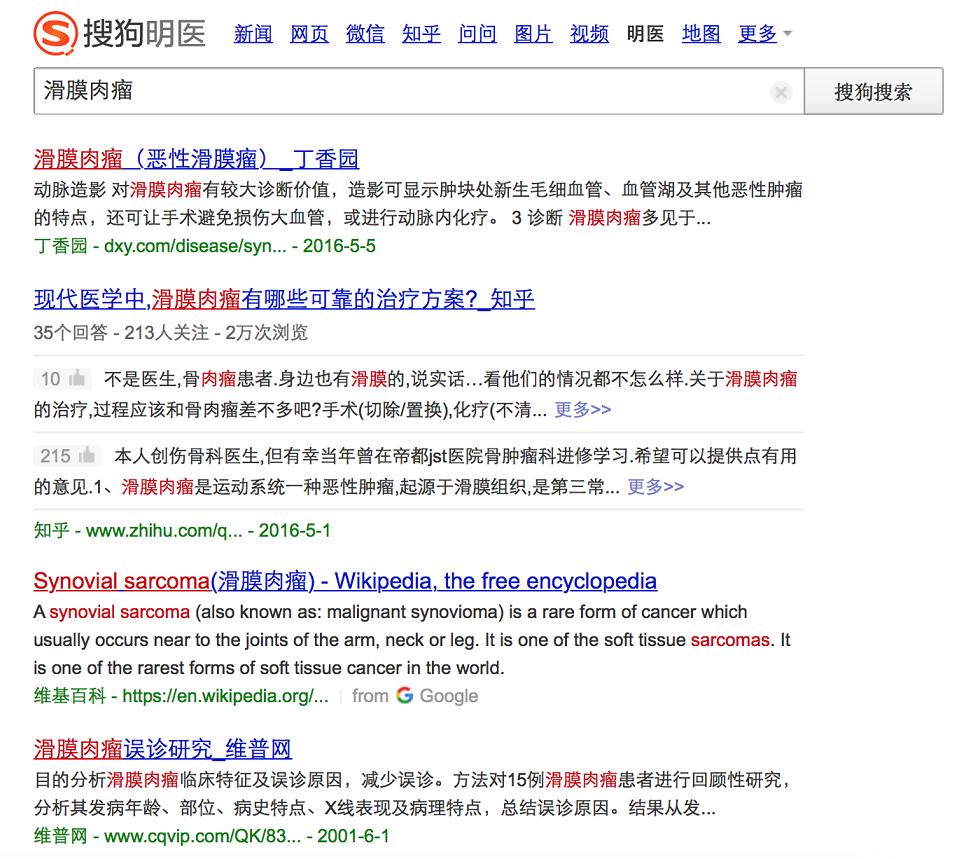
Based on the actual search results from Sogou Mingyi, priority is given to authoritative content from websites such as Wikipedia, Zhihu, academic journals, and DXY, as well as professional content sourced from “whitelist institutions,” including reputable large hospitals, centers for disease control and prevention, the World Health Organization, and scientific research organizations. Given that foreign research still dominates certain medical fields, Sogou provides access to more cutting-edge international English-language academic papers. This content is presented through a collaboration between Sogou Academic Search and leading international search companies, ensuring authority and accuracy.
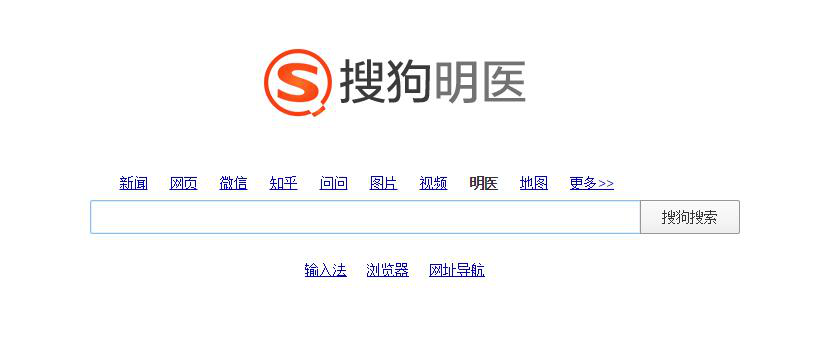
Furthermore, VCBeat has found that when users search for disease- or healthcare-related keywords directly on the Sogou homepage, the search results page prominently features aggregated content from Sogou Mingyi, allowing users to jump to the Sogou Mingyi channel with a single click.
The following is the full text of Wang Xiaochuan’s open letter:
In recent days, the Wei Zexi incident has continued to escalate, deeply concerning people across China. Friends and netizens, filled with anger and disappointment toward another search engine company, are looking to Sogou to speak out and take action.
We apologize for the long wait. Today, Sogou Search has launched a new product feature: Sogou Mingyi (Sogou Clear Medicine). We prefer to present Sogou’s response in this manner and invite your review. Effective today, when users initiate medical-related search queries, Sogou Search will prioritize displaying non-commercial, authentic, and authoritative medical information, and direct them to the Sogou Mingyi channel. This channel provides authoritative content from sources such as Wikipedia, the Zhihu community, academic journals, and DXY.cn, as well as professional content from reputable large hospitals, centers for disease control and prevention, the World Health Organization, and research institutions. Additionally, through collaboration with renowned international search companies, it offers access to cutting-edge English-language academic papers.
Medical information is highly specialized, making it difficult to distinguish truth from falsehood; moreover, certain diagnoses and treatments themselves are subject to significant controversy. Last month, Professor Rao Yi, former Dean of the School of Life Sciences at Peking University, told me that, in his estimation, the majority of health-related information on Chinese websites and in mass media is erroneous or even fabricated. Although we are well aware that medical search holds a unique position within general search services, being closely tied to users’ lives and health, we feel ashamed that we have not done enough in the face of such hard-to-verify information and have failed to assume greater social responsibility.
Following the Wei Zexi incident, a search engine company announced that it would discontinue its paid medical promotion services, drawing considerable public attention. However, upon calm reflection, it becomes evident that this measure cannot, as claimed, “eliminate the harm caused to users by false medical information.” Even in the absence of paid promotions, organic search results remain of uneven quality. For users urgently seeking authoritative knowledge and assistance, the outcome is equally helpless, and may even lead to misinformation and greater harm.
For instance, with the recent “cellular immunotherapy,” I had previously encountered this concept due to my family member’s cancer diagnosis. Not only was it strongly recommended by fellow patients, but it was also a service offered by the most reputable hospital in Chengdu, which initially sounded quite credible. Online searches revealed that the vast majority of Chinese-language sources described this treatment positively. As a patient’s family member, I naturally felt a sense of hope. It was not until I consulted a friend at Harvard Medical School that I learned this therapy had been largely discontinued due to its negligible efficacy.
Only by making authentic and authoritative medical information readily accessible can we truly help users; this was the original intention behind the launch of Sogou Mingyi. Acknowledging our shortcomings and rising to the challenge, the Wei Zexi incident accelerated the release of Sogou Mingyi. The team demonstrated remarkable unity, prioritizing this project above all other R&D efforts. They voluntarily worked overnight shifts, displaying exceptional initiative and self-discipline. In the face of critical ethical issues, they fully exhibited their conscience and technical expertise. I am deeply proud of and moved by Sogou’s technology and product teams.
As a technology-driven company, Sogou has always adhered to the principles of “do no evil” and “no grandstanding.” We have now taken concrete steps to improve healthcare-related search services. The initial version of our product may still have some shortcomings, but we have taken a solid first step. We will continue to refine and enhance its features, aiming to alleviate users’ anxiety when dealing with medical information and truly empower them to consult doctors with clarity and confidence.
With exclusive indexing of content from WeChat and Zhihu, Sogou has won greater favor among users, driving rapid growth in mobile search volume. Early this year, it reclaimed its position as the second-largest player in the search engine market, becoming the sole challenger to the industry’s monopolist. Sogou will continue to roll out new features throughout the year, injecting fresh momentum into China’s search industry. Fostering competition and delivering better services to users is the very reason for Sogou’s existence. We welcome everyone to use Sogou and share your feedback.
Let us believe in beauty and move forward with determination.
Wang Xiaochuan, CEO of SogouMay 8, 2016, Beijing
VCBeat Analysis: In the aftermath of the Wei Zexi-Baidu incident, Sogou’s decisive and rapid launch of “Sogou Mingyi” (Sogou Doctor) was highly timely. Currently, search engines remain the primary online healthcare entry point for the vast majority of patients. The Wei Zexi incident has served as a powerful catalyst for innovation within the search engine industry. However, at present, search engines can only fulfill the role of an entry point centered on result presentation and content display. If they were to engage in deeper collaborations with internet healthcare companies such as Dingxiang Yuan (DXY)—for instance, in areas like tiered diagnosis and treatment and medical big data—this could hold greater significance for the future position of search engines within the healthcare industry.
Note: VCBeat will publish a more detailed exclusive interview tomorrow, and will release an in-depth report on the Wei Zexi incident in the near future.