

A New Perspective on the Wei Zexi Incident: An Opportunity for Emerging Internet Healthcare Platforms
Wei Zexi, aged 21, has passed away forever. Amidst criticism from the media and the public, Baidu and the Putian medical consortium have become the focal point of widespread condemnation. Gustave Le Bon once stated in *The Crowd: A Study of the Popular Mind*: “We inherit savage and destructive behavioral instincts from primitive times, which lie dormant within each of us.” Although reason exists, the driving force behind the advancement of civilization remains various emotions—irrational factors such as dignity, self-sacrifice, religious faith, and patriotism.
Perhaps this is the reality: humanity grows through criticism and vilification, and gains insight amidst lows and the vicissitudes of joy and sorrow. This pattern has permeated the entire trajectory of human social development, and experience tells us that this is how problems are resolved.
Humanity’s progression from cognition to understanding and finally to mastery in any field is an evolutionary process within the framework of methodology. What is the definition of society? It is the sum of existential relationships among individuals formed under specific circumstances. Production, consumption, entertainment, politics, and education, as elements closely intertwined with human life, are all components of society; the healthcare system is no exception. The human endeavor to discover, understand, and master it continues to follow methodological principles. Different stages yield different types of outcomes: the favorable ones are passed down, while the unfavorable ones are submerged by the tides of evolution.
The evolutionary history of society shares strong commonalities with that of humanity. We evolved from ape-men to Homo sapiens, and from Homo sapiens to modern humans, progressing from an initial state of “eating raw meat and drinking blood” to using stone tools to tame animals and hunt, until we eventually mastered fire. As humans became more familiar with nature, they began to harness it to improve production and daily life, passing through three distinct stages: “what to eat,” “what utensils to use for eating,” and “how to eat better.”
From this perspective, let us re-examine the Wei Zexi incident. It was by no means merely an individual tragedy, nor simply a moral dichotomy of good versus evil. What it reflected extends beyond the profit-driven harms lurking in gray areas to encompass broader societal issues. This incident exemplifies the immaturity of a society in its primary stage of development, while also pointing the way for the transition to the next phase.
Alternating Labor Pains
China’s internet healthcare sector is undergoing a transition from “what to eat” to “how to eat.” This transitional process is by no means an overnight achievement.
Take Baidu as an example. Setting aside paid ranking, the service it provides fundamentally addresses the question of where to seek medical care, which is analogous to deciding “what to eat.” If we regard search engines as the entry point to internet-based healthcare, this can be termed the first stage of its development. In this stage, the information accessible to individuals is disordered, uncontrollable, and opaque. Much like the Dark Forest Law depicted in *The Three-Body Problem*, constrained by inadequate institutions, knowledge, and tools, the unknowns of nature posed significant dangers to primitive humans; every quest for food was tantamount to gambling with one’s life.
During this period, the main issues were as follows:
1. Policy Level: Loopholes and Blind Spots in the Supervision of Military Hospitals. Government oversight of internet-based healthcare has failed to keep pace. Both platforms offering online consultations and those facilitating “flying knife” surgical services (where external surgeons are invited to perform operations) exhibit inconsistent service quality and pose the risk of directing patients to hospitals engaged in non-compliant practices.
2. Medical Perspective: The research and development of new treatment modalities is a protracted and high-risk endeavor. No experimental therapy should be administered for clinical treatment without prior approval from the National Health and Family Planning Commission (NHFPC); however, numerous hospitals have been found engaging in substantial regulatory violations.
3. Internet Level: Information asymmetry and opacity are the flaws of old-form internet medical entry points like Baidu. In the process of providing information traffic, users are in a completely uncontrollable state, making it difficult to determine whether the service provider is reliable, and they can only judge based on their own subjective will.
4. Hospital Level: Public hospitals have blindly expanded their scale in pursuit of economic benefits, leading to stagnant service quality. Private hospitals have exploited policy loopholes and leveraged the massive traffic from internet companies to amass substantial profits. Amidst the uneven distribution of medical resources, private hospitals struggle to establish a strong reputation.
It is difficult to define and predict the duration of this transitional period, or when dangers may arise. Like an ark navigating the open sea, we are all passengers on board, sailing toward an idealized utopia. You never know where sharks may lurk, when storms will strike, or when the rain will give way to clear skies. Unfortunately, in the course of this journey, Wei Zexi became one of its victims.
Opportunities for Development
Every social formation requires an epoch-making catalyst to transition from one stage to another, much like stone tools and fire did. The same holds true for internet healthcare, where the “Internet Plus” initiative serves as this pivotal catalyst.
In 2015, after Premier Li Keqiang proposed the formulation of the “Internet Plus” action plan, “Internet Plus” became one of China’s national strategies. On the one hand, the state has encouraged “mass entrepreneurship and innovation,” providing startups with various forms of support ranging from policy incentives to hardware and software resources. On the other hand, within the broader framework of “Internet Plus Healthcare,” medical service models characterized by high security, high transparency, and clear, traceable processes have emerged as the direction for development.
In a short span of time, internet healthcare companies with diverse forms and business models have sprung up like mushrooms after rain. Among them are several pre-unicorn companies with considerable strength, such as Chunyu Doctor and WeDoctor. It is precisely these companies, born and nurtured under the new “opportunity,” that constitute the essential tools for the phased leap forward in internet healthcare.
In the new stage of development, it is the processes and role definitions across the entire healthcare industry that are being restructured. From registration to consultation to treatment, and from patients to doctors to hospitals, every procedure and every stakeholder has become a focal point of this restructuring. Just as early humans evolved from their initial stages to gradually learning how to craft and use stone tools—changing not merely their methods of obtaining food but, more fundamentally, transforming themselves from passive foragers into active hunters—this demonstrates the power of new “tools.”
The Opposition Between the New and the Old
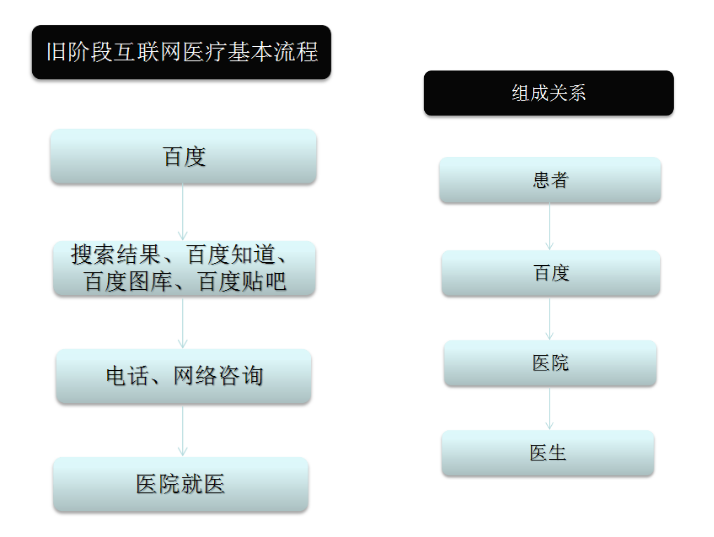
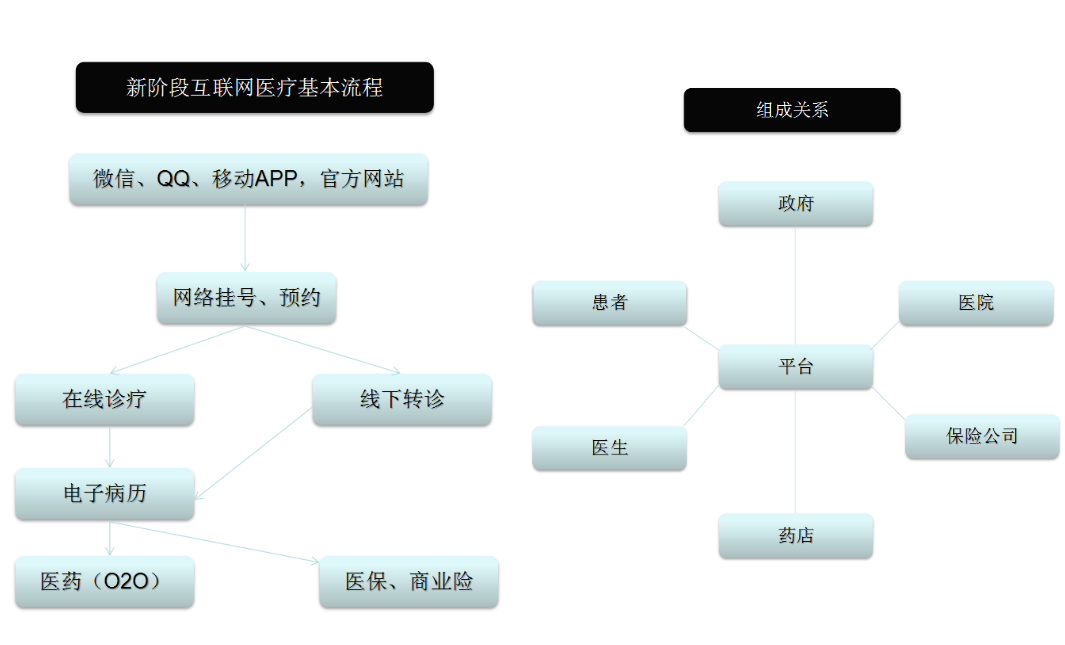
Entrance:
Previous Stage: Baidu and its search-based ecosystem products constituted virtually the sole online gateway to healthcare services.
New Phase: WeDoctor, Chunyu Doctor, Haoyayi, and WeChat-like social platforms, along with various mobile and web-based applications, have established their own vertical healthcare entry points.
Comparison: In contrast to the single-entry model of the previous phase, the new phase resembles a decentralized structure, offering users greater choice, more granular and vertical specialization, enhanced professionalism, and a more user-friendly interface.
Process:
Previous Stage: Through Baidu’s portal, patients initiated contact via phone or online consultations before proceeding to offline hospital visits. Throughout this process, Baidu served solely as a traffic driver, with hospitals remaining the final point of contact for users.
New Stage: The scope covers appointment registration, diagnosis and treatment, electronic medical records, pharmaceuticals, and medical insurance. At each stage, users can freely choose to connect with one or multiple platforms, enabling them to complete the entire medical consultation process online.
Comparison: In the previous phase, consultation methods were relatively singular and opaque, with no guarantee of user information security and no visibility into the qualifications of doctors and hospitals. The new phase offers a wider range of online medical services, enhanced security for user data, and deeper integration with offline services, covering multiple areas such as medical insurance and pharmaceuticals.
Composition Relationship:
Previous Stage: Patients, Baidu, hospitals, and doctors constituted the entire online healthcare system.
New Phase: Government, patients, hospitals, physicians, insurers, and pharmacies are interconnected in a platform-centric manner, forming a networked structure. The diversity of platforms has given rise to various types of network configurations.
Comparison: The more singular and simple the participating entities are, the easier it is to form a monopolistic economy. The most significant difference between the new phase and the old one lies in the diversity of participants and more market-oriented operational combinations, which provide users with a wide variety of products to meet diverse needs. The emergence of new technologies and rules has enhanced the transparency of information regarding hospitals and physicians, while government regulatory intervention has ensured the security and reliability of the entire network system.
Composition:
In the old system, patients were in an absolutely disadvantaged position, with nearly all information closed off to them. In this many-to-one relationship, Baidu served as a key structural hole within the architecture, becoming the core of the chain and the central hub connecting information between the other two ends. Hospitals and doctors, as service providers downstream in the chain, also maintained a many-to-one relationship with Baidu.
If we view this as a simple prisoner’s dilemma, achieving strategic optimality—commonly referred to as the “Nash equilibrium”—requires ensuring that all three parties in the game maximize their benefits. Clearly, in the aforementioned system, only two parties achieve strategic optimality, which fundamentally determines that this structural combination is unstable.
In the new system, whether patients, hospitals, doctors, or platforms, all parties are freely combined under the guidance of new technologies and new rules. The transparency of information allows each party to maintain a strong independent choice, and each party can obtain the maximum benefit in the system structure, which forms the "Nash equilibrium" that can be achieved by multi-party games. This structure is also theoretically the most stable.
The new phase has shattered the original organizational structures, and the reconfiguration of social forms has given rise to a continuous stream of business opportunities, where every process and structure can become a target for disruption and innovation. The vast user base of the old system will be gradually diverted by new platforms and business models built by startups.
A Few Thoughts
Our analysis of the Wei Zexi incident is not intended to incite public criticism or condemnation. Nor do we wish for readers to focus solely on the dark side exposed by vested interest groups within the existing system. As stated at the beginning of this article, our continuous exploration and pursuit of a better life process stem from our desire to enjoy an improved lifestyle. This is fundamentally a manifestation of benefit-seeking behavior, driven by the selfish instincts of genes and the profit-driven nature of capital. Throughout human history—from the Renaissance and the Industrial Revolution to wars and epidemics—each stage of development has been accompanied by both growing pains and gains. These are merely byproducts of our relentless progress.
The wheels of history continue to roll forward. With less hostility and more anticipation, let us view every development through a progressive lens and transform opportunities into wealth through innovative thinking. We are on the verge of ushering in a new era of internet healthcare.