

CTOP Launches Lung Cancer Genetic Testing Program in Collaboration with Nanfang Gene, Files IPO Prospectus
Recently, CTOP and Southern Gene jointly launched a lung cancer genetic testing program. Targeting lung cancer patients and their first-degree relatives, the program collects mucosal cells via oral swabs to analyze susceptibility gene loci associated with lung adenocarcinoma, squamous cell carcinoma, and small cell lung cancer. Based on the test results, personalized risk assessments and prevention and treatment recommendations are provided.
This project originated from the Shanghai Clinical Medical Center for Lung Tumors. It aims to build a cross-regional, cross-hospital, and cross-departmental database-sharing platform covering lung cancer prevention, screening, treatment, and rehabilitation follow-up, leveraging mobile health technologies in the context of China’s healthcare landscape. Similar to the U.S. SEER (Surveillance, Epidemiology, and End Results) database, it is intended to be a truly public-welfare-oriented large-scale thoracic tumor database openly accessible to physicians.
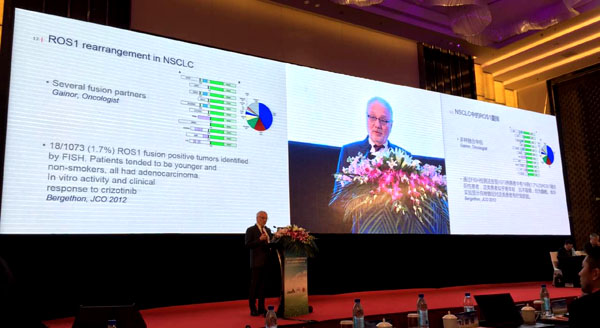
One of the organizers, CTOP (China Thoracic Oncology Platform), was launched at the 7th CSCO Shanghai International Lung Cancer Forum and the 3rd China-Sweden International Lung Cancer Forum. The official launch of this platform marks a landmark development stage for collaboration in translational medicine for thoracic oncology in China.
At the 7th CSCO Shanghai International Lung Cancer Forum and the 3rd China-Switzerland International Lung Cancer Forum, Professor Rolf Stahel, Head of the European Thoracic Oncology Platform (ETOP), stated that in the seven years since its establishment in 2009, ETOP has broken down barriers to collaboration among clinical medicine and medical research institutions across European countries, playing an extremely important role in promoting exchange and research in the field of thoracic oncology in Europe. Therefore, to better promote basic lung cancer research in China and facilitate its effective translation into clinical practice, thereby benefiting more Chinese patients, the China Thoracic Oncology Platform (CTOP), initiated by Professor Lu Shun and Professor Luo Qingquan, has attracted extensive attention from lung cancer researchers and specialist physicians both domestically and internationally since its inception.
CTOP will fully, scientifically, and rationally leverage mobile health technologies to construct an open, large-scale lung tumor database that spans regions, hospitals, and departments, covering prevention, screening, treatment, rehabilitation, and follow-up. This initiative aims to promote exchange and collaboration between basic research institutions and clinical units in lung cancer research, conduct multi-center studies across China, establish a comprehensive database of Chinese lung cancer patients along with a tissue sample biobank, and perform scientific analysis and summarization of basic research and clinical translation related to lung cancer in the Chinese population.
At that time, CTOP member physicians across China will be able to access the Chinese lung cancer patient database established by CTOP, providing a substantial data foundation for writing medical papers; they can also participate in nationwide clinical studies initiated by CTOP on the platform and share research data and experimental results.
Expert physicians from across China have expressed their hope that, through exchange and collaboration on the CTOP platform, more practical and effective treatment regimens for lung cancer can be optimized and developed, thereby alleviating patient suffering, improving prognostic survival rates, and enhancing quality of life.
It is understood that the data for CTOP mainly comes from three sources, namely:
1. Patient Upload: Patients scan their CTOP business cards, and the case images they upload are aggregated and organized by CTOP, effectively reducing physicians’ workload. Real-time mobile data presentation enables physicians to work with ease and efficiency.
2. Batch Import: CTOP’s follow-up protocols incorporate multiple patient-centered scales, such as nutritional assessments, postoperative pain scales, and the Self-Rating Depression Scale (SDS). These tools enable physicians to obtain more comprehensive and timely patient data.
3. Clinical Projects: CTOP members may apply for CTOP’s research crowdfunding to conduct basic research on lung cancer in China across regions.
The CTOP project was jointly initiated by Lu Shun, Chief Physician, Professor, and Doctoral Supervisor at Shanghai Chest Hospital, and Director of the Shanghai Clinical Medical Center for Lung Tumors; and Luo Qingquan, Chief Physician at Shanghai Chest Hospital, and Director of the Clinical Medical Center for Lung Tumors at Shanghai Chest Hospital.