

Phoenix Healthcare: Regional Tiered Diagnosis System Takes Shape, Insurance Expansion Likely Next Focus
Phoenix Healthcare Group, which listed on the Main Board of the Hong Kong Stock Exchange in November 2013, remained relatively unknown within the medical community until recently. Since April 2016, with Phoenix Healthcare’s successive announcements of capital cooperation with two major healthcare industry groups—China Resources Medical and CITIC Medical—the company is set to operate more than 12,000 hospital beds, positioning it to become one of the largest healthcare service groups in Asia by number of operational beds.
VCBeat has reviewed the development history, strategy, and tactics of Phoenix Medical, revealing that its core value lies not merely in its large number of hospital beds, but more importantly in its initial establishment of a regional healthcare service collaboration system covering grassroots community clinics, municipal tertiary hospitals, and elderly care and rehabilitation institutions in Shunyi District of Beijing, Baoding City of Hebei Province, and other areas through the PPP-IOT model. The tiered diagnosis and treatment system vigorously promoted by the state appears to be taking shape here.
Looking back on the development trajectory of Phoenix Healthcare, while the internet healthcare sector was marked by widespread hype and volatility in recent years, Phoenix Healthcare had already quietly achieved a successful public listing and embarked on an expansion path centered on the Beijing-Tianjin-Hebei region:
December 2007: Beijing Phoenix acquired a 66.00% equity stake in Jiangong Hospital (the first public hospital in Beijing to undergo reform).
December 2007 Beijing Phoenix acquired Beijing Jiayi to operate the Group’s medical device and medical consumable supply chain business
February 2008 Beijing Phoenix obtained the rights to manage and operate Yanhua Hospital Group under the IOT agreement, making Yanhua Hospital the first reformed tertiary public hospital in Beijing.
April 2008 Beijing Phoenix acquired Beijing Wanrong to operate the Group’s pharmaceutical supply chain business.
April 2008 Beijing Phoenix acquired Beijing Yisheng to provide premium medical services at Jiangong Hospital.
July 2010 Beijing Phoenix began to manage and operate the Mentougou District Hospital under the IOT agreement.
May 2011 Beijing Phoenix began managing and operating Jingmei Hospital under the IOT agreement.
June 2012 Beijing Phoenix began managing and operating the Mentougou District Hospital of Traditional Chinese Medicine under the IOT agreement.
November 2013: Phoenix Healthcare Group Co., Ltd. was listed on the Main Board of the Hong Kong Stock Exchange.
January 2015 Phoenix Healthcare partnered with the State Administration of Work Safety and CITIC Trust to establish a “medical-nursing-care” healthcare network.
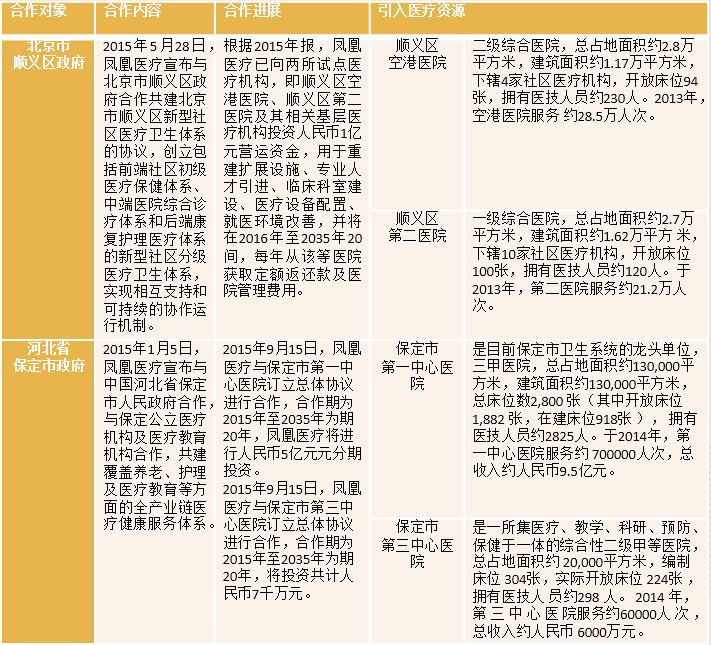
January 2015 Phoenix Healthcare announced a partnership with the People's Government of Baoding City, Hebei Province, China, to jointly build a comprehensive, full-industry-chain healthcare service system covering elderly care, nursing, and medical education.
May 2015 Phoenix Healthcare announced an agreement to collaborate with the Shunyi District Government of Beijing Municipality in jointly establishing a new model of community-based medical and healthcare system.
July 2015 Phoenix Healthcare announced the acquisition of a 20% equity stake in Hong Kong United Medical Group.
April 2016 China Resources Medical Holdings Company Limited proposed to acquire no less than 35.7% equity interest in Phoenix Healthcare for HK$3.72 billion.
May 2016 Phoenix Healthcare announced the acquisition of a controlling stake in a tertiary hospital with approximately 700 beds from CITIC Medical for no less than RMB 1.24 billion.
Strategic Vision: Regional Tiered Diagnosis and Treatment Service System in the Beijing-Tianjin-Hebei Region
Based on the cooperation agreements signed by Phoenix Medical with the Baoding Municipal Government of Hebei Province and the Shunyi District Government of Beijing Municipality since 2015, as well as the progress of these collaborations, Phoenix Medical’s strategic outlook has become clear:
Centered on the Beijing-Tianjin-Hebei region, the outward expansion encompasses a hospital management network that includes tertiary Grade A hospitals, low-end and high-end clinics, elderly care institutions, and rehabilitation facilities.
A healthcare system integrating primary care, emergency diagnosis and treatment, critical care, and rehabilitative nursing to form a regionally collaborative, integrated delivery system (RIDS). By collaborating with external entities such as local governments, UMPs, insurance companies, and healthcare institutions, it aims to establish a national benchmark for tiered diagnosis and treatment.
Phoenix Healthcare will also focus on exploring the integration of medical care with elderly care and health insurance, gradually extending into the eldercare and insurance sectors to achieve full industry chain integration; meanwhile, it will actively explore the potential of physician partnership models and digital healthcare services.
For example, in the cooperation agreement signed between Phoenix Medical and the Baoding Municipal People's Government, both parties agreed:
From 2015 to 2019, the scope of proposed cooperative co-construction will be gradually expanded to medical institutions of all levels and types in the districts and counties of Baoding City, with the goal of establishing an integrated collaborative medical service system with a scale of approximately 5,000 beds;
Prior to 2021, the investment company will establish, through planned cooperative co-construction, a preliminary health services industry cluster in Baoding City that covers the entire value chain, including elderly care, nursing, and medical education.
Expanding the Medical Network to Build Competitiveness in High-End Healthcare
In addition to co-establishing regional healthcare service systems with local governments, Phoenix Medical has also actively participated in the restructuring of state-owned enterprises and ministry-affiliated hospitals. For instance, on January 6, 2015, Phoenix Medical announced a collaboration with the State Administration of Work Safety (SAWS) and CITIC Trust Co., Ltd. The partnership aims to leverage medical institutions and sanatorium facilities within the SAWS system to establish an “integrated medical, elderly care, and nursing” healthcare network in Beijing and other regions across China. This network is designed to provide general medical services, integrated medical and elderly care, and emergency rescue services to SAWS employees as well as urban and rural residents.
This collaboration has successfully added new hospital resources to Phoenix Medical and secured the opportunity to establish a new branch hospital in Chaoyang District, a core area of Beijing. Both parties have agreed to renovate and expand the Coal General Hospital, increasing its operational bed capacity to 700 within two years. Additionally, a new branch of Coal General Hospital will be constructed in Chaoyang District, Beijing, China, within three years, providing approximately 800 operational beds. Further discussions will also be held regarding collaborative opportunities for the joint development of other medical institutions and sanatorium facilities affiliated with the State Administration of Work Safety.
Since 2016, Phoenix Healthcare has significantly accelerated its efforts to integrate high-end medical resources, as evidenced by its capital collaborations with China Resources Medical and CITIC Medical.
On April 8, 2016, Phoenix Healthcare announced that China Resources Medical intended to acquire no less than 35.7% of its equity for HK$3.72 billion. On May 5, 2016, Phoenix Healthcare further announced the acquisition of a controlling interest in a tertiary hospital from CITIC Medical for no less than RMB 1.24 billion, while not ruling out the possibility of deeper cooperation in the future.
According to VCBeat, China Resources Medical Holdings Company Limited was established in Hong Kong in 2011 as a wholly-owned subsidiary of China Resources (Holdings) Company Limited. Currently, the group operates 48 medical institutions, including five tertiary hospitals, six secondary hospitals, 25 primary hospitals, and 12 community hospitals, with nearly 7,300 actual open beds. It also owns three elderly care facilities with an approved capacity of 300 beds. Among these, Guangdong Sanjiu Brain Hospital is a modern large-scale Grade A tertiary specialized hospital; Kunming Children’s Hospital is the only large-scale Grade A tertiary children’s hospital in Yunnan Province; China Resources Wugang General Hospital is a large-scale comprehensive Grade A tertiary hospital; Huaibei Miner’s General Hospital is the earliest-established and largest comprehensive Grade A tertiary hospital in Huaibei City; and the Department of Nuclear Medicine at Xuzhou Mining Group Hospital holds significant influence in the Huaihai Economic Zone.
CITIC Medical was established in June 2011 as a wholly-owned first-tier subsidiary of CITIC Group. Its business scope covers medical services, elderly care, health management, pharmaceutical distribution, and medical logistics support services. Under its umbrella, CITIC Huizhou Hospital is a state-owned hospital directly affiliated with central state-owned enterprises. CITIC Hangzhou Plastic Surgery Hospital (formerly Hangzhou Plastic Surgery Hospital) is one of the earliest specialized plastic surgery hospitals in China and the largest of its kind in East China. CITIC-Xiangya Reproductive and Genetic Hospital, founded in 2002, is the first modern large-scale specialized hospital for reproductive medicine and genetics in China.
In addition to integrating domestic healthcare resources, Phoenix Healthcare acquired a 20% stake in Hong Kong United Doctors Medical Group in 2015 (with its equity ratio to be adjusted to 15% after the group’s listing). The two parties collaborated to establish a network of general practice clinics in Beijing, initially launching three clinics and expanding the network to no fewer than ten general practice clinics within three years (including both self-operated and affiliated clinics).
United Family Healthcare Group’s background is quite intriguing. Its core business involves providing healthcare plans to corporate and insurance clients in Hong Kong and Macau. The company was listed on the Main Board of the Hong Kong Stock Exchange in November 2015. It currently operates more than 600 network service points, including over 30 self-operated medical centers (mostly located in Hong Kong and Macau), and is actively expanding into the mainland China market.
Revenue Growth Driven Primarily by External Expansion; Supply Chain Business Contributes Over Half of Revenue and Gross Profit
Phoenix Healthcare’s growth in recent years has primarily relied on inorganic expansion, expanding its managed medical network through acquisitions or contractual agreements, thereby establishing three major revenue streams: comprehensive hospital services, hospital management services, and supply chain operations. In 2015, Phoenix Healthcare reported revenue of RMB 1.573 billion, representing a year-on-year growth rate of 13.82%, a significant slowdown compared to the 39.46% growth rate recorded in 2014.
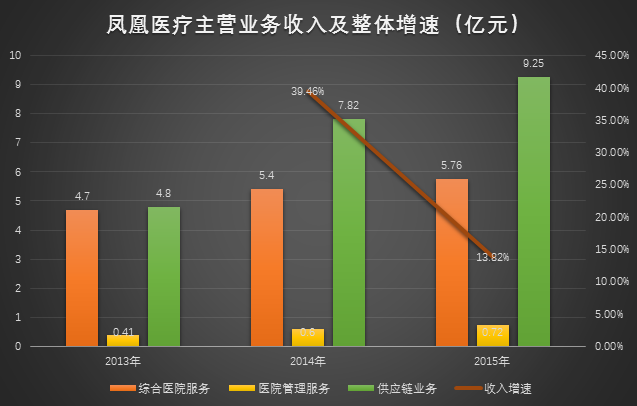
Among Phoenix Healthcare’s three major business segments, comprehensive hospital services refer to the revenue generated from such services provided by its subsidiary Jian Gong Hospital and Beijing Yisheng, which has shown relatively stable growth. Hospital management services primarily refer to the revenue derived from managing IOT hospitals and clinics and collecting management fees; although this segment accounts for a smaller proportion of total revenue, it boasts high gross margins.
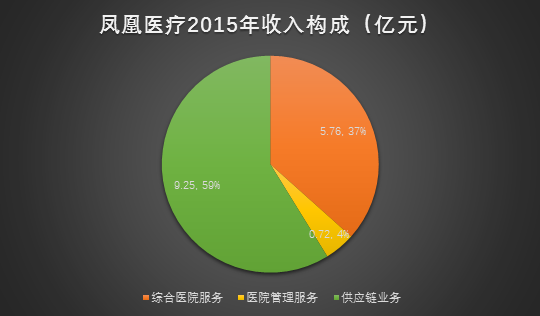
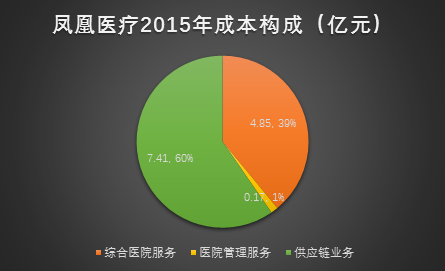
The supply chain business remained the largest contributor to Phoenix Healthcare’s revenue and gross profit, primarily generating income from the provision of pharmaceuticals, medical devices, medical consumables, and ancillary services to its network of hospitals and clinics. In 2015, revenue from the supply chain business reached RMB 925 million, accounting for 59% of total revenue, while gross profit from this segment amounted to RMB 184 million, representing 56% of total gross profit.
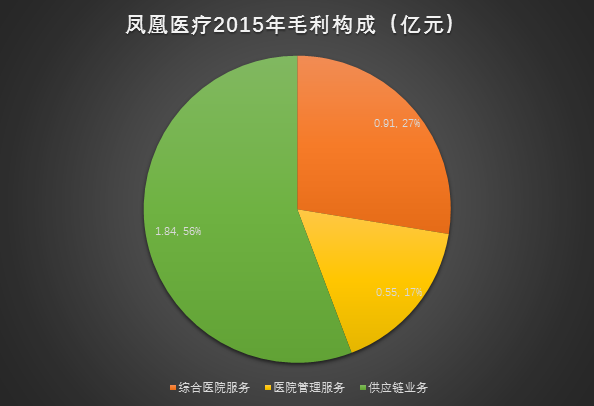
Previous viewpoints have argued that Phoenix Healthcare’s profit model, which relies on supply chain operations, is unsustainable. This is because national policy is steering toward the separation of pharmaceuticals from medical services, whereas the supply chain model implicitly encourages drug use and may increase the financial burden on patients. From the perspective of the supply chain business itself, revenues from 2013 to 2015 were RMB 480 million, RMB 782 million, and RMB 925 million, respectively, with a noticeable slowdown in growth rate.
However, given Phoenix Healthcare’s active development of a regional healthcare service system, it is more likely to forge close collaborations with commercial insurance companies in the future. The internet-based medical insurance products that have long been hyped within the digital health sector may well find their realization through “traditional companies” like Phoenix Healthcare, which boast abundant offline medical resources and a comprehensive business architecture.
Industry professionals are welcome to add the author on WeChat (ID: yeyurenlei) to jointly discuss development trends in the healthcare industry.