Exclusive Interview with Chen Xiaofeng, CEO of U-Tang: How to Build a Differentiated Chronic Disease Management Service?

Chen Xiaofeng, Founder of U-Tang
[Editor's Note]Hundreds of millions of people in China suffer from chronic diseases. It has long become a consensus among industry professionals and patients that chronic conditions require scientific management, yet the field of chronic disease management has consistently lacked effective solutions. As an expert in chronic disease management, U Tang has proposed the concept of remote chronic disease care management, which has garnered widespread attention in the mobile health sector. Recently, VCBeat conducted an exclusive interview with Mr. Chen Xiaofeng, founder of U Tang, to explore the story behind U Tang and its approach to chronic disease management.
VCBeat: Mr. Chen, as a seasoned veteran who has been engaged in the medical industry for many years, why did you choose to start a business in the field of chronic disease management?
Chen Xiaofeng:First, the chronic disease market boasts a substantial existing base, with the population of patients growing at an annual rate of 4%. As diabetes is a lifelong condition, it exhibits strong user stickiness. Second, diabetes is incurable and can lead to multiple complications, necessitating that patients adopt scientific self-management models for effective blood glucose and overall health management. Third, the ecosystem for chronic disease management within the mobile health sector has significant long-term potential, capable of driving numerous value-added services such as medication for chronic conditions, insurance, health supplements, medical check-ups, and convalescent care, thereby facilitating the formation of a robust industry chain. Beyond market considerations, we are also motivated by social responsibility. Having witnessed family members suffer from diabetes, I believe that had they access to scientific chronic disease management models at the time, their outcomes might have been significantly better. Therefore, I consider it highly valuable to assist diabetes patients in better controlling their blood glucose levels. Over the past two years, we have continuously refined our approach to identify the most optimal and effective ways to serve our patients and deliver maximum value.
VCBeat: With the mobile healthcare sector witnessing such fierce competition, resembling a "bloodbath" akin to the "Hundred Glucose Wars," what advantages do U-Tang’s products and services hold over its competitors?
Chen Xiaofeng:First, current diabetes management does not involve any cutthroat competition.
Our hardware, remote hosting services, and offline implementation services are our strengths and distinctive features.
U Tang was the first in China to propose the concept of diabetes care management. Regarding market competition, I would say there is “no competition.” China has a vast population of patients with diabetes, which also represents a huge market. Currently, no single company can capture the entire patient population or dominate the whole market. We do not define our goal as capturing 100% of the market; even if we wholeheartedly serve just 1% of this population, it still constitutes a substantial group and market, making for a successful enterprise. Our motto is “effectiveness.” In the future, many companies will be involved in chronic disease management, and each will need to leverage its unique strengths.
VCBeat: As the mobile healthcare industry heats up, skepticism has also emerged. Many people question the necessity of mobile healthcare at its current stage and its future development prospects. How do you view this? What are U-Tang’s future plans?
Chen Xiaofeng:Mobile healthcare is better described as the mobilization of healthcare. The mobile internet is merely a tool; the outcomes depend on how this tool is utilized. When used effectively, it can reduce both the time and financial costs associated with seeking medical care. Regardless, the core remains healthcare itself, with an emphasis on practical implementation. We aim to deliver genuine value to those we serve. By defining the internet as a tool and healthcare as the substantive service, the industry can achieve significant growth. Currently, many investment institutions are flocking to mobile healthcare, but it is crucial to identify the pain points in this sector. Mobile healthcare serves as an efficient tool to address medical challenges. For instance, tiered diagnosis and treatment do not simply involve separating patients; rather, effective patient triage requires a thorough understanding of users’ medical needs. Therefore, a deeper understanding of patients is essential to providing effective, high-quality services. Although mobile healthcare is in its early stages with many unknowns and considerable room for future development, many chronic disease management initiatives have yet to be practically implemented and fail to address users’ pain points.
In the future, we will remain dedicated to serving patients and focus wholeheartedly on the task at hand, shaping U-Tang into a chronic disease management platform that diabetic patients can trust with confidence.
VCBeat: As the industry develops and matures, an increasing number of mobile health companies are seeking partnerships. Recently, U-Tang has also entered into a collaboration with Ali Health. Could you please introduce the cooperation model between U-Tang and Ali Health?
Chen Xiaofeng:Alibaba Health has been committed to promoting its family doctor program. U Tang is honored to partner with Alibaba Health, leveraging a strategic integration of online and offline services to enhance chronic disease management, thereby achieving a win-win outcome. This collaboration represents an exploration of new models in internet healthcare and reflects the corporate social responsibility of both enterprises. It also responds to the national call for healthcare reform by alleviating the burden on traditional hospitals and integrating telemedicine into public health management, enabling physicians to provide higher-quality medical services to patients. For U Tang, Alibaba Health provides a platform and opportunities to serve a broader patient base. Under the innovative model of Alibaba Health’s open family doctor service platform, U Tang has also expanded the scope of its service offerings. As an expert in diabetes management, U Tang brings its core remote managed care services for chronic diseases to this partnership, which will further facilitate Alibaba Health’s implementation and growth in the chronic disease sector. Naturally, more in-depth cooperation across various areas is expected in the future.
VCBeat: At the beginning of this year, U-Tang launched its remote managed care service for chronic diseases. How is this service specifically implemented?
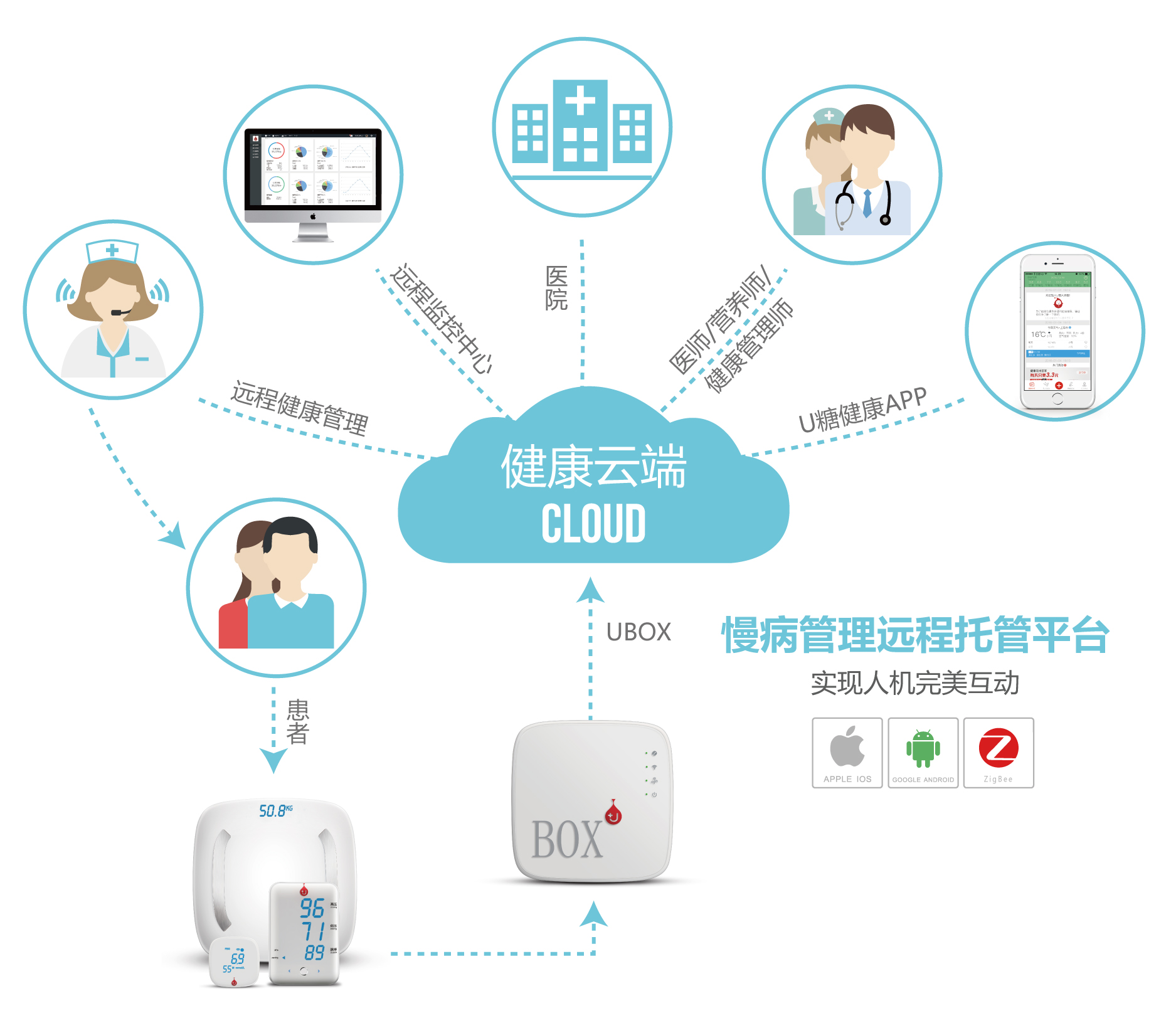
Chen Xiaofeng:In early 2016, U Tang launched its chronic disease management custody service, formulating scientific health management plans tailored to the specific conditions of each patient. The chronic disease management custody service primarily consists of four components: smart hardware, a mobile app, a monitoring center, and offline experience centers. This system enables intelligent data collection and real-time monitoring of data fluctuations. In addition to automated real-time follow-ups, U Tang’s custody service conducts regular check-ins, leveraging a team of U Tang physicians, nutritionists, and health managers to assess, analyze, and provide recommendations on patients’ health status. From the launch of U Tang 1.0 in 2014 to the release of version 4.0, the company underwent extensive trial and error, exploration, and transformation over two years. The remote custody service is a refined product distilled from years of accumulated experience. “Custody” essentially means entrusting one’s care and management. Beneath this seemingly simple remote custody service lie four supporting systems: (1) Smart hardware—a system for data collection with separated software and hardware architectures; (2) Remote real-time monitoring; (3) Software—featuring top-level remote data visualization and bottom-level data analytics; and (4) Offline experience centers. To date, we have established multiple offline experience centers across China. These four systems—spanning hardware, real-time monitoring, software, and offline management—collectively support the entire custody service.
ArteryNet: How does U-Tang ensure the effectiveness of its remote chronic disease management platform, and how does it translate this effectiveness into practical implementation?
Chen Xiaofeng:The key challenges in chronic disease management lie in whether users develop reliance on your services, whether your health services are valuable, and whether they can deliver tangible value to users. U-Tang’s offline management experience centers will initially cover areas surrounding first-tier cities, followed by a comprehensive rollout organized around family units. Our model functions as centralized diabetes management, assisting hospitals in serving patients already diagnosed with diabetes. However, in the field of chronic disease management, service remains the most critical factor for users. Service is a long-term process, during which users gradually develop dependence on the management services provided.