

ConYun Health Connect Files IPO Prospectus: Pioneering an Internet-Based In Vitro Diagnostics Platform

Kangyun Interconnected Technology Co., Ltd. was established in March 2016, dedicated to the research and development as well as production of medical diagnostic products. Kangyun Interconnected aims to provide users with health screening, basic diagnostics, and intelligent healthcare solutions.“Internet+”Solution.
The IVD Market Is Rapidly Expanding, and Kangyun Hulian’s Technology Shortens Diagnostic Time
In vitro diagnostics (IVD) refers to products and services that obtain clinical diagnostic information by testing human samples, such as blood, body fluids, and tissues, outside the human body, thereby aiding in the assessment of diseases or physiological functions. In 2012, the global IVD market size (excluding diabetes monitoring) was approximately USD 43.6 billion, and it was projected to reach USD 58.8 billion by 2018, representing a compound annual growth rate (CAGR) of approximately 5.1%. Meanwhile, China’s IVD market size was approximately RMB 16.7 billion in 2012 and reached RMB 35.0 billion in 2015, a year-on-year increase of 16.8%. The market is expected to maintain a growth rate of 15%–20% in the coming years.
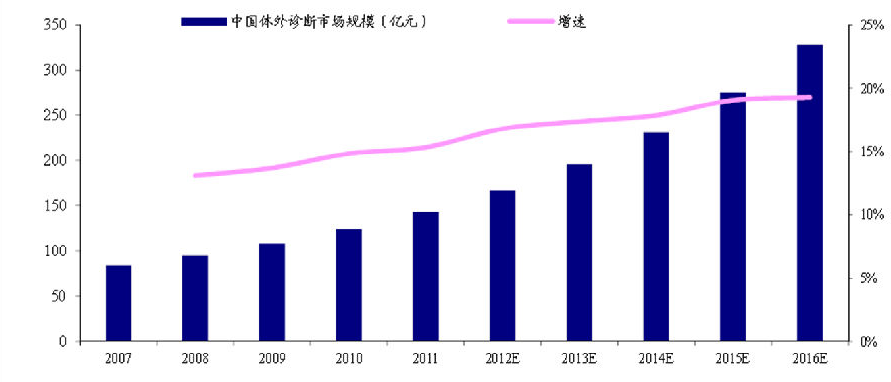
Market Size of China's In Vitro Diagnostics (IVD) Industry
Kangyun Huilian’s first product is an in vitro diagnostic chip. When the test sample comes into contact with the sensors on the chip, a chemical reaction occurs. After the user takes a photo of the chip containing the test sample and uploads it to the server, the test results are displayed in real time on the mobile device. Kangyun Huilian’sThe testing services include physical examination, nucleic acid testing, routine biochemical tests, routine immunological tests, protein assays, and routine urinalysis. Currently, Kangyun Interconnect has launched a WeChat-based testing platform. Users can upload photos of their test chips to the Kangyun Interconnect official WeChat account, which will automatically return the test results. The time elapsed from data upload to report generation and delivery depends on real-time internet speed; with a stable connection, test reports can be generated within five seconds, significantly reducing the typical waiting time for results. By integrating in vitro diagnostics (IVD) with internet technology, Kangyun Interconnect is committed to becoming an essential technology provider in the IVD sector.
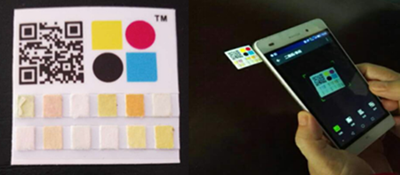
Kangyun Interconnect Product Physical Image
The company has developed lightweight testing methods, using internet-based simulated diagnostic devices to replace traditional diagnostic instruments.
Diagnosis is a critical segment of the healthcare value chain. Currently, the in vitro diagnostics (IVD) market is dominated by the development and manufacturing of diagnostic instruments. Rather than entering this competitive landscape, Kangyun Interconnect has taken an alternative path by pursuing “instrument-free” diagnostics. Wu Fan, Founder and CEO of Kangyun Interconnect, stated, “By eliminating the need for diagnostic instruments, we can avoid inconsistencies in data standards caused by varying brands and batches of diagnostic devices and consumables. Kangyun Interconnect leverages internet-based technologies to simulate the operation of diagnostic devices and obtain test results. This purely internet-driven approach to in vitro diagnostics can be regarded as a biological ‘black technology.’ In the future, our products will cover the majority of IVD test items, potentially turning every smartphone into a ‘clinical laboratory’ comparable to those in top-tier (Grade A tertiary) hospitals.” Wu Fan further highlighted another advantage of Kangyun Interconnect’s products: being “app-free.” This approach frees users from reliance on mobile applications, eliminating the need to download numerous apps. As long as there is internet access, users can obtain their in vitro diagnostic results. Meanwhile, the company is committed to research and technological innovation. Currently, Kangyun Interconnect’s patent portfolio covers biochemistry, immunology, specific protein analysis, and molecular testing.

Upholding Its Original Entrepreneurial Vision, Kangyun Interconnect Will Continue to Enhance Its Technology Platform to Support the Deployment of Tiered Diagnosis and Treatment
Reflecting on the challenges of entrepreneurship, Wu Fan stated that staying true to his original aspirations helped him overcome difficulties, as he and his team aspire to contribute to society through technology. Wu Fan, CEO of Kangyun Interconnect, has dedicated many years to the fields of protein technology and biomacromolecule technology. He previously worked at a key laboratory under the Chinese Academy of Sciences and later established a laboratory to conduct cross-disciplinary innovation projects in new materials and food science. Wu Fan jokingly remarked that he enjoys keeping abreast of the latest scientific and technological advancements. Co-founder Qin Tao formerly served as the Director of the Pharmacy Department at a Grade 3A hospital. Co-founder Bi Zhenyu was the founder of the largest crowdfunding platform in Liuzhou City, Guangxi Zhuang Autonomous Region, and is a seasoned advertising professional. Co-founder Long Kaihua is a senior materials science expert who founded a materials company. The technical team includes two postdoctoral researchers who returned to China after studying abroad. Additionally, a former scientist from the U.S. Surgeon General’s office has joined the Kangyun Interconnect team. Wu Fan said, “It is this project that has brought us together; only a sufficiently compelling project can attract talent to join.”
Currently, Kangyun Interconnect has secured two rounds of financing. Moving forward, the company will collaborate with health management firms to provide diagnostic solutions for enterprises, and partner with primary healthcare institutions to enhance testing capabilities in towns and villages, thereby facilitating the implementation of tiered diagnosis and treatment. In terms of platform development, the company plans to expand its internet-based simulated diagnostic platforms by integrating testing functionalities into mobile terminal software systems or other applications, enabling one-click analysis and testing for in vitro diagnostics (IVD). Additionally, the financing proceeds will be utilized for product upgrades and new product R&D, aiming to establish a new lightweight model for in vitro diagnostics.