

Yao Ge Li Halts Operations: What's Next for Medicine O2O?
On May 18, Yaogivei, a pharmaceutical O2O company featuring “one-hour home delivery of medications,” announced the suspension of its related business operations.
The two core reasons behind this situation are: failed fundraising and disagreements within the founding team regarding the company’s development and positioning. In fact, these are also the two most common reasons for the ultimate failure of many startups. How can startups avoid such pitfalls? Lian Jiaxing, Marketing Director at Yaogeili, mentioned in an article published on his personal WeChat account: Do not place undue trust in a Term Sheet (TS), and do not pin all your hopes of securing investment on a single institution; additionally, avoid losing your strategic direction.
Stepping outside the existing logic to examine the development of “Yao Geili,” VCBeat aims to raise questions from a rational and constructive perspective, while attempting to answer and resolve them: At what stage has the pharmaceutical O2O model, represented by “Yao Geili,” developed? What difficulties and challenges do they face? What are the pathways to solutions?
Overview of the Pharmaceutical O2O Market
First, let us examine the development overview of the pharmaceutical O2O market.
VCBeat has compiled statistics on 14 companies in the pharmaceutical O2O market that prioritize rapid medication delivery. Among them, six are backed by publicly listed corporations. Of the remaining nine startups with grassroots origins, four have secured financing ranging from tens of millions to hundreds of millions of yuan. Regardless of their backgrounds, these pharmaceutical O2O companies employ similar business models centered on “rapid medication delivery.” However, differences in operational capabilities lead to variations in delivery times: the slowest, Ping An Good Doctor’s app, takes two hours, while the fastest, Dingdang Kuaiyao, delivers medications to customers’ doors within 28 minutes.
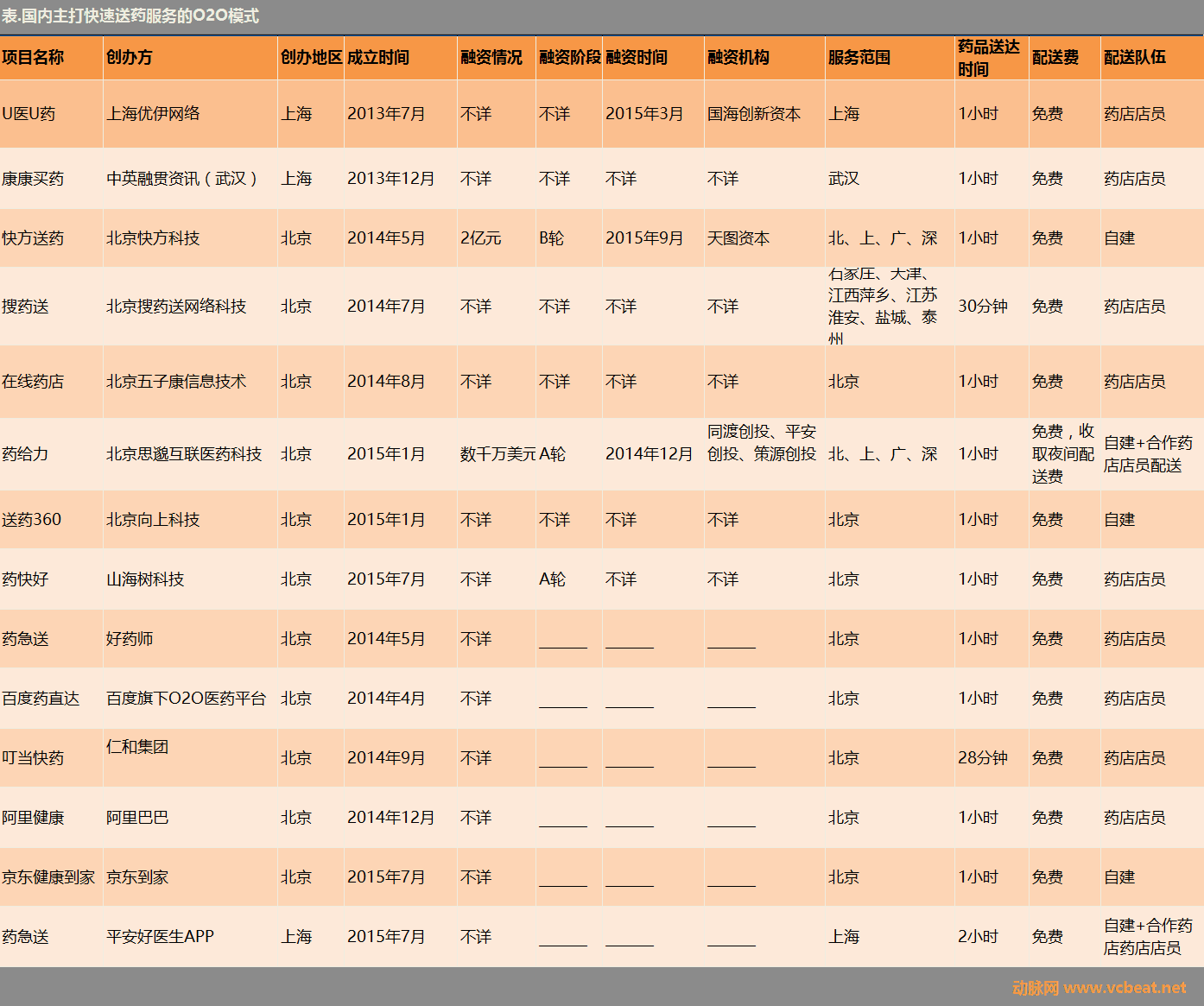
It is reported that traditional pharmacy chains such as Yixintang and Yifeng have invested heavily in building their pharmaceutical O2O ecosystems. Clearly, as more players enter the pharmaceutical O2O sector, even more new business models are expected to emerge in the future.
Three Major Challenges in Pharmaceutical O2O
The pharmaceutical O2O model faces three major challenges.
First, insufficient purchasing power.
Neither pharmaceutical O2O nor B2C models can escape the fact that medication purchasing is a relatively low-frequency activity. This is especially true for urgent medication needs. In line with objective demand, when patients experience particularly acute symptoms, their primary choice is undoubtedly to visit a hospital rather than place an order on an app-based platform. Admittedly, this does not exclude some users suffering from common ailments such as colds or fever from opting for app-based medication purchases. This trend is particularly relevant among today’s single, young homebodies. However, this potential consumer segment remains largely untapped.
Second, high distribution costs.
It is not difficult to observe that most O2O platforms rely on offline brick-and-mortar pharmacies to fulfill deliveries. Orders requiring delivery within one hour typically have a low average transaction value, primarily consisting of products priced under RMB 50.
An industry insider has crunched the numbers: a pharmacy can turn a profit if each staff member handles 15 transactions per day, with an average transaction value of around RMB 60. Based on the average gross profit margin of 30% for brick-and-mortar stores, each staff member generates RMB 270 in daily sales revenue. After deducting management and other costs, the net profit amounts to at least RMB 150.
However, under the mounting pressure of rapidly rising costs such as rent and labor, nearly all pharmacies are stretched thin and simply cannot spare personnel to handle home delivery services. This explains why companies like Kuai Fang Song Yao, Yaofang Wang, and Yao Geili have chosen to establish their own logistics and delivery teams.
To reduce drug costs, Yaogeli has made several attempts and efforts. In October 2015, Yaogeli partnered with China Resources Sanjiu to launch a B2B pilot program, primarily aiming to consolidate the scale of partner pharmacies and centrally provide them with low-cost procurement channels from upstream suppliers. This initiative enabled pharmacies to source products from higher-tier wholesalers, thereby reducing their purchasing costs.
Third, inventory pressure. If online pharmaceutical offerings are limited to products already available at partnered physical stores, order volumes will remain constrained, keeping costs within a manageable range. However, achieving full integration between online and offline channels requires corresponding renovations of brick-and-mortar stores, leading to increased costs. In the future, if physical stores adopt a layout featuring traditional retail pharmacy counters at the front and warehouses at the back, they can significantly expand the variety of O2O product offerings.
Industry Leaders Are Making Strategic Moves: Which Model Holds the Most Potential?
Overall, the current pharmaceutical O2O sector can be divided into the following two major categories:
The first model: self-built delivery team + partnered pharmacies.
The core of the JD Daojia model lies in its possession of China’s largest and most professional logistics and delivery team, with another major advantage being its traffic volume. Building on this foundation, JD also offers a wide range of non-pharmaceutical products, which helps effectively balance labor costs.
JD Health at Home primarily provides technology platforms, traffic platforms, and logistics services to chain pharmacies. JD Health at Home will integrate a portion of community-based traffic for chain pharmacies and plans to offer marketing services in the future. Merchants are responsible for supplying pharmaceuticals, professional commercial services, and pharmaceutical care services. To ensure service quality, JD Health at Home partners exclusively with large pharmacy chains.
For pharmacies receiving priority support, JD Health Home will first launch large-scale advertising campaigns via its app, EDM, and order-based channels; second, it will leverage JD’s proprietary big data to identify and target precise consumer segments for promotional pushes.
According to public information, JD Health’s home delivery service has covered 13 cities, partnered with 110 chain pharmacy operators, and provided delivery services through more than 2,000 pharmacy outlets. Meanwhile, JD Daojia can drive an 8%–9% incremental sales lift for chain pharmacies. During its recent promotional campaign supporting key merchants, JD Daojia collaborated with Tongrentang, delivering a three- to fourfold increase in sales. The integration of Dada has further strengthened logistics capabilities.
As planned, JD Health At Home will integrate more service offerings in the future. For instance, JD Health At Home will partner with Meinian Onehealth to develop a public platform for general health checkups; provide 24-hour nighttime medication delivery services in areas such as Wangjing and Tiantongyuan; and launch at-home services including optometry refraction, pharmacist consultations, and family doctor visits.
After securing RMB 200 million in financing last September, Kuai Fang Song Yao began establishing its own warehousing centers and delivery teams. Notably, Yao Gei Li proposed building an in-house delivery team from the outset and provided specialized training for its delivery personnel; prior to this incident, Yao Gei Li’s delivery team comprised 60 members. The long-term development of this model, which relies on self-built warehousing centers and delivery teams, must be underpinned by sufficient funding.
The second model: in-house delivery team + self-operated pharmacies.
Dingdang Kuaiyao, under the Renhe Group, possesses inherent industry resource advantages.
First, Dingdang Medicine has joined forces with 200 well-known pharmaceutical companies to establish the “FSC (Factory Service Customer) Pharmaceutical Alliance Health Services Initiative.” By partnering with traditional pharmaceutical enterprises and integrating industry resources, the alliance leverages centralized procurement of raw materials, packaging materials, excipients, and other inputs from its members to reduce drug manufacturing costs at the upstream end of the supply chain, thereby lowering drug prices.
Secondly, Dingdang Kuaiyao has developed “geofencing” technology to plan the ground network of its offline partner pharmacies. By taking into account factors such as urban topography and traffic conditions, it determines the coverage area for each pharmacy, ensuring that every point within the geofence is within a 28-minute delivery range.
VCBeat has learned that Renhe initially intended to partner with third-party pharmacies to launch Dingdang Kuaiyao, but these pharmacies showed limited enthusiasm due to conflicts between their online and offline pricing systems. Ultimately, Renhe chose to fully acquire 50 pharmacies. Under its plan, Renhe aims to acquire 3,000 offline brick-and-mortar stores nationwide to support its pharmaceutical O2O model. Currently, Dingdang Kuaiyao has surpassed 5 million users and covers 26 cities across China.
However, as a pharmaceutical company venturing into the O2O sector, Renhe faces external skepticism that it may leverage its existing platforms to prioritize the sales of its own products. This poses a significant challenge to its ability to continue scaling up in the future.
Between the two aforementioned models, which is superior depends on the specific circumstances of the enterprise. Establishing an in-house delivery fleet and operating proprietary pharmacies both require substantial financial backing. Compared to building a delivery network, acquiring pharmacies clearly entails higher capital expenditure and represents a relatively asset-heavy model. If opting for collaboration with pharmacies, the profit-sharing mechanism with partner pharmacies becomes critically important.
Current Status: Homogenized Competition; Price Wars to Persist
Open any pharmaceutical O2O app, and you will find little difference in the product categories displayed by each platform; at most, the order of different categories varies. Nearly all of them are comprehensive platforms. From medications for colds and fever, respiratory conditions, and gastrointestinal issues to various health supplements and medical devices, they essentially function as mobile versions of online pharmacies.
Whether drug delivery takes one hour or 30 minutes, most providers are currently operating at a loss to gain market visibility. There are three publicly known profit models for major pharmaceutical O2O platforms: charging commissions and sharing delivery fees through partnerships with offline pharmacies; earning price differentials by streamlining the pharmaceutical distribution chain; and generating revenue from advertising fees.
Moreover, all medication apps offer prices that are 10%–20% lower than those at brick-and-mortar pharmacies. Kuai Fang Song Yao claims to source directly from manufacturers, offering prices 30%–40% lower than those at physical retail pharmacies.
Similar to the subsidy war between Didi Chuxing and Kuaidi Dache, Ali Health initially launched a period of aggressive subsidies when it entered the pharmaceutical O2O market. Subsidies were provided not only to users but also to pharmacy staff for promoting app downloads. However, this momentum was short-lived; following the departure of Ali Health’s COO, Zhang Shouchuan, the company suspended its nationwide subsidy campaign. Consequently, a significant portion of the user base acquired during this period is estimated to have churned due to various issues, including poor user experience. Last year, Ping An Good Doctor planned to invest in subsidies for users, comprising medicines worth RMB 30 million and logistics costs of RMB 20 million.
In the early stages, domestic internet companies in China inevitably resorted to common tactics such as subsidy wars and price wars to acquire users, and the pharmaceutical e-commerce sector is no exception. Moreover, for pharmaceutical e-commerce, which is still in its nascent stage of development, price wars are expected to persist for some time. However, subsidies are not a sustainable long-term strategy; how to maintain high user engagement after subsidies cease remains a challenge faced by all pharmaceutical O2O platforms.
Future: Competition in Medical Service Capabilities
Existing pharmaceutical O2O platforms all offer pharmacist consultation services, providing 24-hour free advisory support for medication purchases and usage. Dingdang Kuaiyao has partnered with Chunyu Yisheng to create a closed-loop service that integrates medication consultation with delivery. Currently, pharmaceutical O2O platforms primarily feature over-the-counter (OTC) products, resulting in relatively low demand for medication consultation services. However, if the online sale of prescription drugs is deregulated, the competitiveness of pharmaceutical O2O platforms will be determined by the quality of their medical service capabilities.
It is worth acknowledging that over the past year or so, Yaogeli has accumulated approximately 1 million registered users and nearly 400,000 transacting users. Although these figures are not particularly impressive, the platform’s operational and service capabilities have gained recognition from industry insiders and approval from numerous users. The current temporary suspension of operations has indeed dealt a heavy blow to Yaogeli; however, for the pharmaceutical O2O e-commerce model, which is still in an exploratory phase, it is premature to declare winners or losers. Entrepreneurship is arduous, and we wish Yaogeli a smooth transition in its strategic pivot.