MedInfoLink Launches 'Online Grand Classroom' to Empower Tiered Diagnosis and Treatment System

As a key component of the 13th Five-Year Plan, tiered diagnosis and treatment has been identified as one of the core elements of healthcare reform, with hospitals at all levels bearing significant responsibilities. The Guiding Opinions on Promoting the Construction of a Tiered Diagnosis and Treatment System proposed that by 2020, the service capacity for tiered diagnosis and treatment would be comprehensively enhanced, and a model featuring initial consultation at primary care institutions, two-way referral, separate management of acute and chronic conditions, and coordination between upper- and lower-level medical institutions would gradually take shape.
However, in the promotion of China’s tiered diagnosis and treatment system, the uneven distribution of high-quality medical resources and the shortage of talent at primary healthcare institutions have consistently been significant factors constraining its progress, posing the greatest challenge for many hospitals in effectively implementing tiered care. The reality we cannot avoid is that in many regions, the professional competence and technical skills of primary care physicians are far from satisfactory, and the phenomenon whereby outstanding medical professionals “cannot be deployed to grassroots levels nor retained there” is particularly pronounced. These issues will become key determinants of whether the tiered diagnosis and treatment system can be fully implemented.
In reality, the professional skill gaps among primary care physicians are not confined to impoverished areas; they are widespread and representative across many regions. In May this year, an official from the National Health and Family Planning Commission candidly stated in an interview, “48% of practicing physicians in China do not hold a bachelor’s degree, and the number of physicians per 1,000 population remains at the level typical of developing countries, lagging significantly behind that of developed nations. This disparity is particularly pronounced at the primary care level, which is extremely weak.” Therefore, before piloting the “first-contact care at the primary level” policy nationwide, it is imperative to take urgent measures to improve the competence of primary care physicians as much as possible.
In this context, strengthening the training of primary care physicians is particularly urgent. Increasing the intensity of in-service training is, of course, the most direct approach.
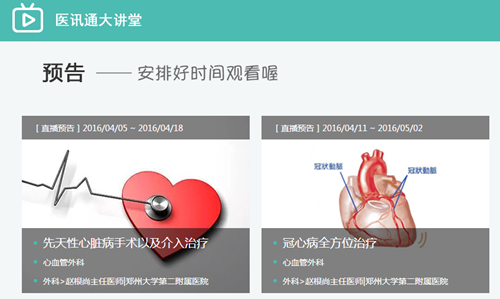
The “Air Classroom” section of “Yi Xun Tong” is designed to respond to the national healthcare reform policies that emphasize strengthening primary care and prioritizing patient education. As an online training and education platform for doctors and patients, Yi Xun Tong previews thematic courses targeted at either physicians or patients in advance, and opens online video classroom portals at scheduled times. Learners can freely select courses based on the announced schedule and topics, enter the classroom portal on time, and begin learning via live-streamed sessions. Furthermore, during the courses, Yi Xun Tong introduces online micro-classes to foster interaction circles among learners as well as between learners and instructors. Participants can engage in collective learning within the micro-classrooms and interact with the instructors after class.
The mentors of Yixuntong’s “Air Lecture Hall” are all hands-on practitioners from Henan’s local healthcare industry. Although teaching may not be their primary profession in daily life, they possess a deep understanding of the current dynamics between doctors and patients in Henan. Their lectures draw entirely on personal experiences and practical insights, focusing on the dissemination of applicable knowledge to help grassroots physicians enhance their professional competencies through learning.
Strengthening the training of primary-care physicians is only one aspect of implementing tiered diagnosis and treatment. Another critical factor for its successful adoption is guiding patients to develop proper health awareness. Therefore, Yixuntong’s “Air Lecture Hall” also serves as a school for patient education. Through regular presentations by professional physicians in the “Air Lecture Hall,” Yixuntong continuously enhances patients’ knowledge of disease prevention and control, guides them to cultivate appropriate healthcare-seeking behaviors, and reinforces their concepts of health management.

Mr. Cai Junfang, Founder of Henan "Yixuntong"
Cai Junfang, founder of the “Yixuntong” project in Henan Province, stated: “As the official doctor-patient communication platform under the Health and Family Planning Commission of Henan Province, Yixuntong has been committed to establishing the first medical information service platform featuring tiered triage and integrating online and offline services. In addition to providing doctors and patients with convenient medical information services, we are more dedicated to growing together with our users. We aspire to serve as a knowledge hub for enhancing doctors’ professional expertise and as a guardian for patients in disease prevention and control.”
Doctor Portal:

Patient Portal: