

QLK Healthcare Launches 'Integrated' Internet Hospital Model with Full Medical-Pharma Ecosystem
On May 24, Qilekang, a long-standing leader in online pharmaceutical e-commerce sales across China, announced its entry into the internet hospital sector. The Guangzhou Liwan District Government authorized and approved the collaboration between Guangzhou Liwan District Central Hospital and Qilekang to jointly establish the “Liwan Qilekang Internet Hospital,” which was officially launched.
Previously, numerous internet hospitals have made high-profile debuts, such as the Wuzhen Internet Hospital, Guangdong Provincial Network Hospital, Guizhou Internet Hospital, and the Internet Hospital of the First Affiliated Hospital of Zhejiang University. Additionally, the Yinchuan Municipal Government and Haodf Online announced a partnership to jointly establish the Yinchuan Smart Internet Hospital. Earlier, the listed company Shentiandi A announced its intention to acquire Youdeyi and Yingyitong, the technical platforms of the Internet Hospital of the Second People's Hospital of Guangdong Province, for the staggering sum of RMB 5.5 billion.
These internet hospitals have different entry points. Some are proactive expansions from within public hospitals, such as the Internet Hospital of The First Affiliated Hospital, Zhejiang University School of Medicine; Wuzhen Internet Hospital represents a deep integration by WeDoctor Group, leveraging its massive user base and physician resources accumulated through appointment registration services to achieve monetization.
Compared with existing internet hospital models, Shi Zhenyang, Chairman of Qilekang, believes that its internet hospital adopts a completely different model.
"Hybrid" New Model
7LeKang started out as a pharmaceutical B2C e-commerce platform. After securing its latest funding round of over $100 million, the company announced the launch of “Da Bai Yun Zhen” to create a closed-loop ecosystem integrating healthcare and pharmaceutical services. Reportedly, “Da Bai Yun Zhen” has recently been renamed “7LeKang Doctor.”
Clearly, what Qilekang aims to achieve is more than just a closed loop of “e-commerce + mobile healthcare.”
Comparison of Differentiated Models Across Internet Hospitals
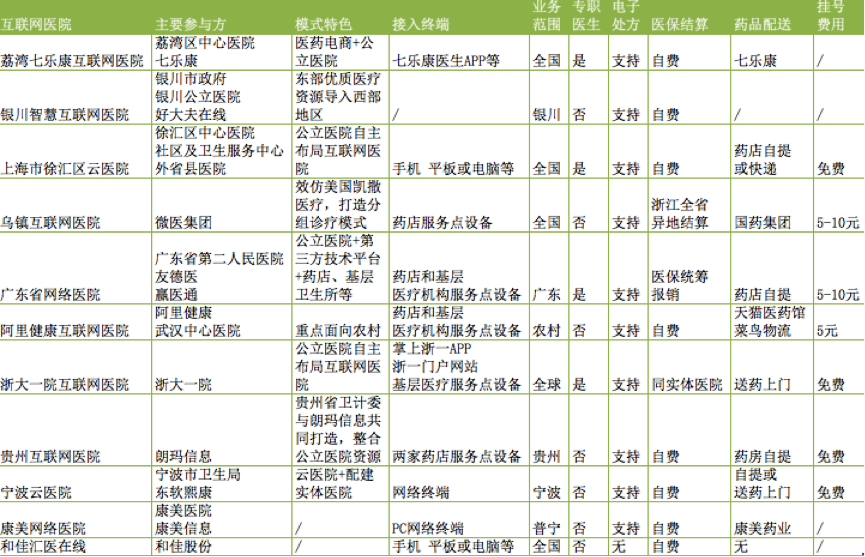
The table above outlines the major internet hospital models currently prevalent in the industry. In terms of the initiator’s role, Qilekang is the only player that originated as a pharmaceutical e-commerce platform, with its sales volume ranking among the industry leaders.
Although the pharmaceutical e-commerce sector has previously experienced rapid growth, policies governing the online sale of prescription drugs have yet to be fully implemented. Rather than waiting for prescriptions to become available, companies should proactively generate prescription demand by establishing internet hospitals.
Of course, pharmaceutical e-commerce is merely one segment of the broader health industry, and it represents a business area that can be integrated with internet hospitals in the near term. However, from a long-term strategic perspective, the internet hospital platform can eventually incorporate services such as insurance, health check-ups, and even surgical scheduling. For instance, Qilekang’s specialized pharmaceutical logistics platform could be opened up as a shared platform, thereby building a comprehensive healthcare ecosystem that is more open, integrates diverse business lines, and includes numerous third-party health industry suppliers.
Compared with the existing internet hospital model, Qilekang considers its internet hospital a “hybrid” new model and is confident that this will represent version 2.0 of internet hospitals.
Shi Zhenyang stated that Qilekang Internet Hospital has established Liwan District Central Hospital as its offline physical partner to build a medical consortium in Liwan District. By integrating its proprietary resources of physicians and patients, the platform connects high-quality medical resources across China with users nationwide, thereby streamlining the entire industry chain encompassing hospitals, doctors, patients, pharmaceuticals, logistics, and medical insurance payments. Among these initiatives, the “Qilekang Doctor” APP will serve as the sole official application for this project and currently boasts 100,000 physicians registered through compliant channels.
Qilekang Internet Hospital currently focuses primarily on the management of chronic diseases, rehabilitation, and follow-up consultations. During the launch ceremony, Shi Zhenyang illustrated the application scenario with a real-world example: A patient from Shantou previously had to travel periodically to Guangzhou for follow-up visits with a specialist. These visits essentially involved blood tests to check for normal indicators and prescription renewals, incurring round-trip costs of over RMB 1,000. However, through the Internet Hospital platform, the patient can now undergo blood testing at a local hospital, upload the results to a physician in Guangzhou (currently staffed by dedicated physicians from Liwan Central Hospital to ensure accessibility for both patients and doctors) for diagnosis, and obtain a prescription at the local hospital. Medications can then be purchased online, with options for home delivery or pickup at designated pharmacies.
Shi Zhenyang further stated that the so-called "composite" new pathway emphasizes the maximum integration and utilization of medical resources at all levels. The implementation will proceed in three steps: first, Liwan District Central Hospital will serve as the pilot site this year; second, coverage will gradually extend to community health service centers and community hospitals in Liwan District, establishing a "hospital + community health service center" medical resource framework; third, within three years, a "medical consortium + community health service center" structure will be formed to break down information barriers between hospitals, thereby facilitating more rational flow of bidirectional referrals and high-quality medical resources across different hospitals.
Of course, big medical data and health clouds have clearly become standard features for various internet hospitals. Qilekang Internet Hospital has also stated that in the future, all medical activities and health data will be incorporated into electronic health records, enabling the sharing of medical histories and data through the health cloud.
Local Governments Proactively Facilitate Matchmaking
Although there remain many divergences regarding the implementation pathways for tiered diagnosis and treatment, the overarching trend toward such a system has become a national-level reform direction. The Government Work Report has also set a mandatory target to launch pilot programs in approximately 70% of prefecture-level cities.
Gu Xiang, Director of the Liwan District Health and Family Planning Bureau, stated that the facilitation of cooperation between Liwan District Central Hospital and 7lekan was primarily based on the following considerations: First, the partnership and business model must be established in strict accordance with laws and regulations. Second, the internet hospital project must be supported by a comprehensive regulatory framework to ensure safety and quality in the healthcare sector and prevent a recurrence of incidents such as the “Wei Zexi case.” Third, space and channels should be provided for private capital to enter the healthcare field, thereby supporting enterprise development. Fourth, public hospitals should be assisted in leveraging social resources to achieve complementary advantages and foster growth, while also enabling physicians to earn legitimate, transparent income.
At the launch ceremony of Liwan Qilekang Internet Hospital, Liao Xinbo, an inspector from the Guangdong Provincial Health and Family Planning Commission, called for more proactive dialogue between medical insurance authorities and internet hospitals. “This is beneficial for medical insurance,” Liao stated. Internet hospitals can help reduce medical insurance costs in various scenarios. Taking the common cold as an example, the average cost per prescription is 200 yuan; however, in certain cases, physicians can manage patients through telemedicine interventions without prescribing medication. Therefore, medical insurance could establish a baseline payment amount. If a physician does not prescribe medication, a portion of the saved costs could be used to compensate the physician for their diagnostic and treatment services, thereby incentivizing doctors to refocus on their core professional value.
Furthermore, internet hospitals must also differentiate between basic public healthcare needs and specialized, customized demands. The government should play a guiding role in pricing medical services that address basic needs, while granting internet hospitals greater pricing flexibility for specialized services. This approach will better stimulate and unleash the vitality of this model.