

Overseas Digital Health Sector Sees $4.3B in Investment and M&A Activity in First Four Months of 2016
The digital health sector has garnered significant attention over the past two years. By tracking data on overseas digital health companies, VCBeat has compiled and analyzed financing and transaction data in the global digital health field for the first four months of 2016. The total transaction volume during this period exceeded $4.3 billion. The digital health sector continues to attract strong investor interest, with entrepreneurial activity in this field remaining robust.
Digital Health Remains Hot
Corporate financing status for the first four months of 2014 is shown in the figure below:
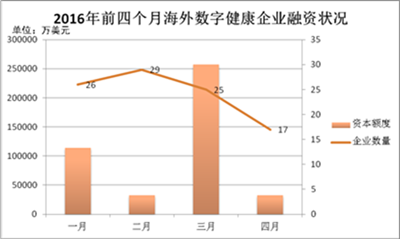
As shown in the figure, investment and financing activities in the digital health sector were substantial in total during the first four months of 2016; however, there were significant monthly variations in funding amounts. It is worth noting that the exceptionally high financing volume in March was driven by several large-scale transactions, such as U.S. healthcare services and information technology company McKesson’s agreement to acquire the Canadian private company Rexall Health from Katz Group for $2.2 billion. Furthermore, specific transaction values for certain mergers and acquisitions in February, involving companies such as MyRounding and Sproutling, were not disclosed and were therefore excluded from the calculations, resulting in a lower reported total for that month.
As can be seen from the chart, the number of companies in the digital health sector that secured financing has declined over the past two months. Compared with March, data for April show decreases in both financing amounts and the number of financed companies. However, this does not necessarily indicate an overall downward trend or a cooling of investment; specific changes will require further follow-up and statistical analysis by VCBeat.
M&A, angel rounds, and Series A financing account for the majority.
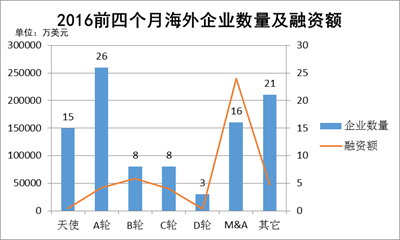
Statistical analysis of 2016 data reveals that capital has shown a stronger preference for acquiring startups or companies in early-stage financing rounds, such as angel and Series A rounds. The combined number of companies at the angel and Series A stages accounted for 42.3% of the total, representing a significant proportion. Furthermore, there were also a notable number of M&A transactions, totaling 16 deals.
In terms of transaction value, the mergers and acquisitions (M&A) segment stands out most prominently. A key reason for this is that M&A activities typically occur when companies are in a relatively mature stage, characterized by higher valuations and larger transaction volumes. For instance, U.S.-based McKesson acquired Canada’s Rexall Health for $2.2 billion.
In the “Other” category, this includes financing rounds after Series D, initial public offerings (IPOs), and undisclosed information.
The United States Is a Hub for Digital Health Startups
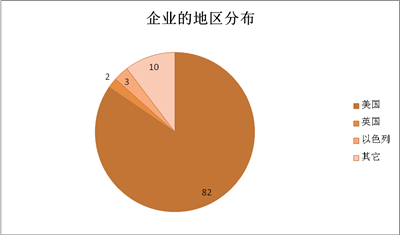
In terms of the location of startups, the United States is undoubtedly the most concentrated hub, with a total of 82 companies, accounting for 84.5%. Other countries include the United Kingdom and Israel, but their number of enterprises is significantly smaller compared to the U.S. The “Other” category includes Australia, Germany, India, and others, but each has very few companies.
From the perspective of funding volume, the United States accounted for nearly half, reaching 44.3%. Therefore, whether in terms of the number of companies or funding volume, the United States is the absolute leader in the overseas digital health sector.
Diverse Product Types
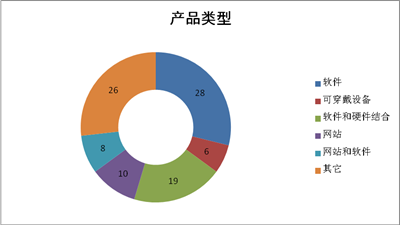
In terms of product types, the offerings are diverse, including software, hardware, and wearable devices. Among these, software-related solutions—such as standalone apps and integrated software-hardware systems—account for approximately half of the total, indicating that software products like apps are the primary choice for startups.
In addition, wearable devices have begun to emerge and are gradually being applied in the medical field. Research firm ABI notes that if 2013 is marked as the inaugural year for smart wearables, the coming years will witness rapid development. As entrepreneurial teams continue to flock into this sector, it remains to be seen whether truly revolutionary products will emerge. It is projected that by 2017, nearly 170 million wearable devices worldwide will be used solely for sports and health purposes. Currently, this field remains a blue ocean market, with commentators suggesting that future healthcare consumer spending will become the primary driver behind the development of wearable devices.