Vast Market Potential in Gene Sequencing Industry, Yet Domestic Sector Remains Underdeveloped
In early 2015, the Obama administration in the United States launched the “Precision Medicine Initiative.” This March, China’s Ministry of Science and Technology also included precision medicine in its key national research and development programs, underscoring the high priority attached to precision medicine by both the Chinese and U.S. governments. Policy-level support for precision medicine has further fueled industry enthusiasm, with gene sequencing—as the vanguard of precision medicine—drawing significant attention from academia, capital markets, and the industrial sector.
The Global Gene Sequencing Market Offers Vast Opportunities, with a Market Size Exceeding $11 Billion
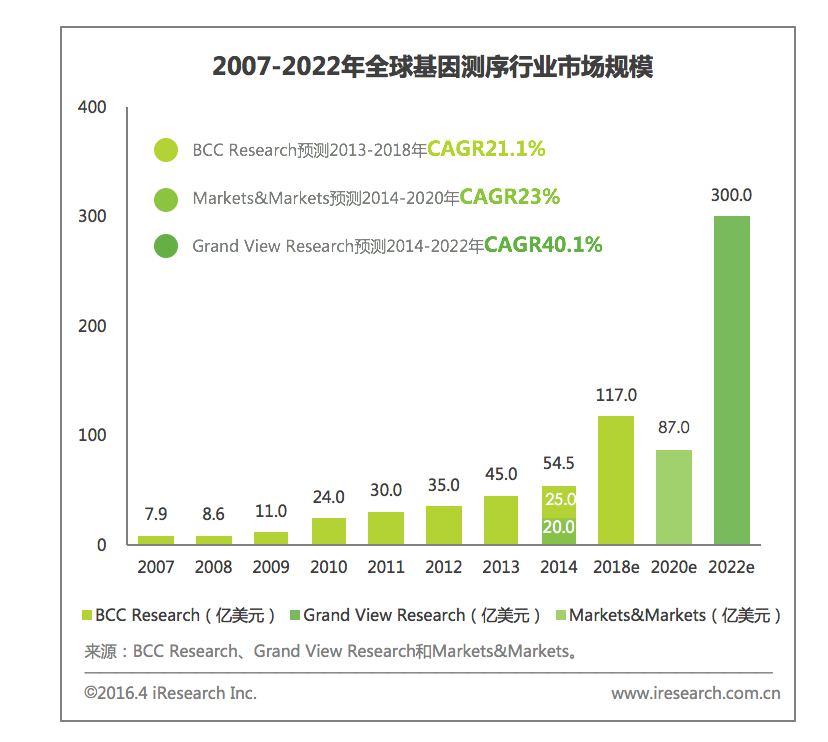
Public data show that the global gene sequencing market has been growing year by year. In 2007, the market size was $790 million, rising to $5.45 billion in 2014. It is projected to exceed $11 billion in 2018, with a compound annual growth rate (CAGR) of 21.1%.
The author’s analysis suggests that gene sequencing services, along with upstream consumables and reagents, are the primary drivers of market size growth. As gene sequencing technology matures, sequencing costs have been declining year by year. This reduction in cost will increase the penetration rate of gene sequencing services, thereby promoting market development. Concurrently, the rising demand for gene sequencing has also increased the demand for sequencing consumables and reagents; thus, the growth in gene sequencing services has simultaneously driven the growth of the consumables and reagents sector.
China's Gene Sequencing Industry Is Far from Experiencing an Explosion
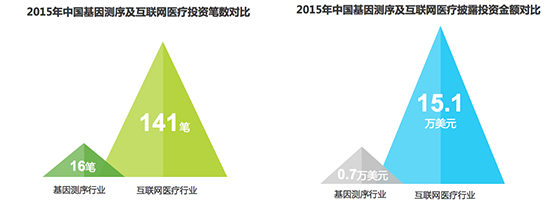
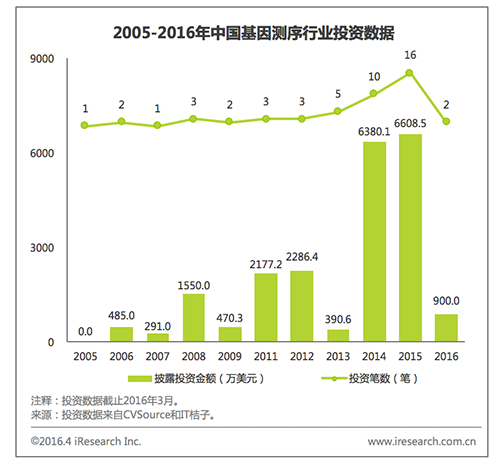
Public data shows that the internet healthcare industry received a total of 141 investments in 2015, with disclosed investment amounts totaling $151,000. In contrast, China’s gene sequencing industry secured only 16 investments in 2015, with disclosed investment amounts totaling just $7,000. The number of investments in the gene sequencing sector was approximately one-tenth of that in the internet healthcare industry, while the disclosed investment amount was roughly one-twentieth.
Whether measured by the number of investment deals or the disclosed investment amounts, the gene sequencing industry is far less heated than the internet healthcare sector at this stage. The author’s analysis suggests that the primary reasons why China’s gene sequencing industry has not yet garnered widespread enthusiasm from the capital market are as follows: 1) The cost of gene sequencing remains higher than that of alternative testing methods. For example, in prenatal screening, non-invasive prenatal genetic testing costs between RMB 2,000 and 3,000, whereas amniocentesis costs approximately RMB 700; 2) Application scenarios are not yet sufficiently diverse. Currently, gene sequencing technologies are mainly applied in two areas: scientific research (targeting business-to-business, or B-end clients) and clinical medicine (targeting consumer-to-consumer, or C-end clients). C-end applications are primarily concentrated in reproductive health and tumor diagnosis and treatment, indicating substantial room for future expansion in consumer-oriented applications.
Source: Investment data from CVSource and IT Juzi
China's Gene Sequencing Industry Has Secured a Cumulative Total of 48 Investments, Primarily at Series A
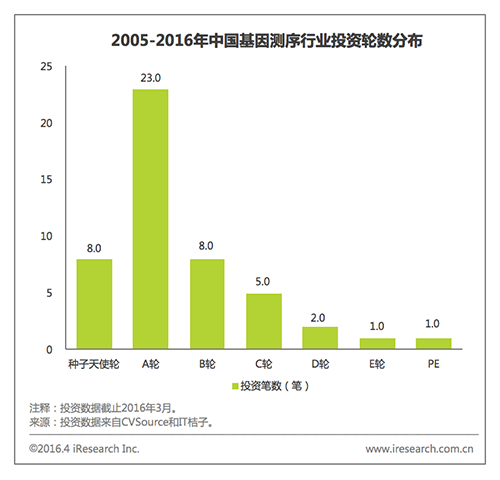
Public data shows that from 2005 to March 2016, China's gene sequencing industry received a total of 48 financing rounds, with the total disclosed investment amounting to USD 220 million. In 2015 alone, the industry secured 16 investments, with a disclosed total of USD 66.085 million, marking the highest annual figure over the 11-year period. In terms of investment stages, the vast majority were seed/angel and Series A rounds, which together accounted for 31 deals, or 64.6% of the total.
The author’s analysis suggests that the gene sequencing industry boasts a vast market potential, with the applications of gene sequencing services continuously expanding, thereby further broadening the market landscape.
The U.S. gene sequencing industry has seen a cumulative total of 42 investments, predominantly in seed and angel rounds.
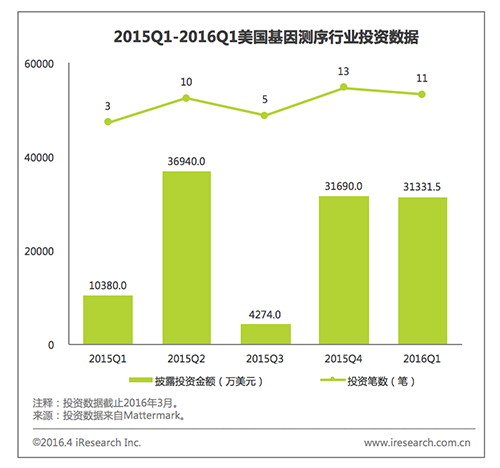
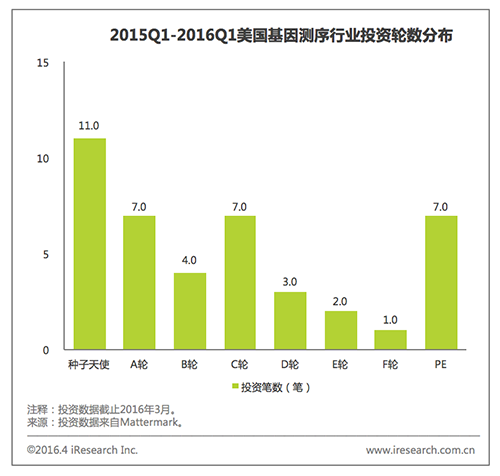
Public data shows that from Q1 2015 to March 2016, the U.S. gene sequencing industry secured a total of 42 financing rounds, with disclosed investment amounts totaling $1.15 billion. In 2015 alone, the gene sequencing industry received 31 investments, with disclosed amounts reaching $830 million. In terms of investment stages, the vast majority were seed/angel and Series A rounds, which together accounted for 18 deals, or 42.9% of the total.
The author’s analysis suggests that U.S. startups are currently concentrated in the field of genetic sequencing and treatment for complex diseases, with investment rounds predominantly at the seed/angel and Series A stages. Looking ahead, the U.S. genetic sequencing industry will continue to attract strong interest from capital markets, and investment figures are expected to keep growing. Meanwhile, due to the earlier industrialization of genetic sequencing technology in the United States, there is also a significant proportion of financing events occurring at Series C and beyond, including private equity (PE) investments.
Gene Sequencing Services Attract Capital from Both China and the US, but with a Significant Gap in Investment Volume
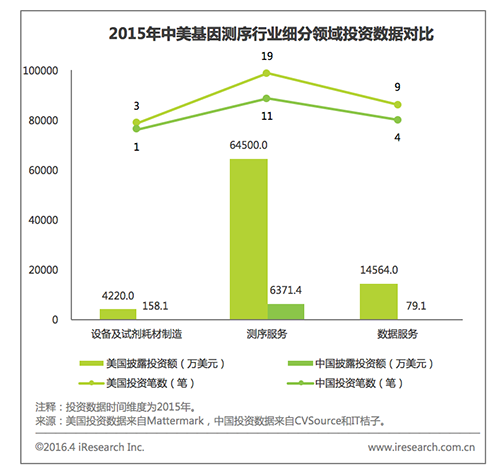
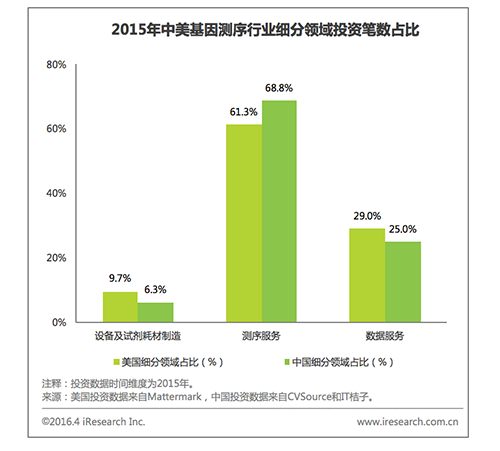
Publicly available data shows that in 2015, the upstream segment of China’s gene sequencing industry, encompassing equipment and reagent/consumable manufacturing, received only one investment deal, with a disclosed amount of $1.581 million. Compared with the United States, this represented two fewer deals and a $40.619 million lower disclosed investment amount. The midstream sequencing services segment secured 11 investment deals, with a disclosed total of $63.714 million, reflecting eight fewer deals and a $58.126 million lower disclosed amount than in the United States. The midstream data services segment attracted four investment deals, with a disclosed amount of $791,000, which was five fewer deals and $144.849 million less in disclosed funding compared to the United States. In terms of the proportion of investment deals, the sequencing services segment attracted the most investments. This indicates that while gene sequencing services are favored by capital markets in both China and the United States, there remains a substantial gap in disclosed investment amounts between the two countries.