

2016: The Dawn of the Internet Hospital Boom Year
Although the model of online hospitals remains highly controversial, this has not dampened the enthusiasm of entrepreneurs, investors, or even hospitals for it. Over the past year, more than a dozen (perhaps even more) “online hospitals” have sprung up like mushrooms after rain, though they are more commonly referred to as internet hospitals or cloud hospitals.
As can be clearly seen from the “Development Map of Online Hospitals” below, there are two major trends in its development. The most obvious one is the explosive growth over the past year, with nearly one or two new “online hospitals” emerging every month. Secondly, we have also observed the involvement of non-medical institutions, which represents a significant breakthrough in the healthcare industry and is largely attributable to favorable national policies.
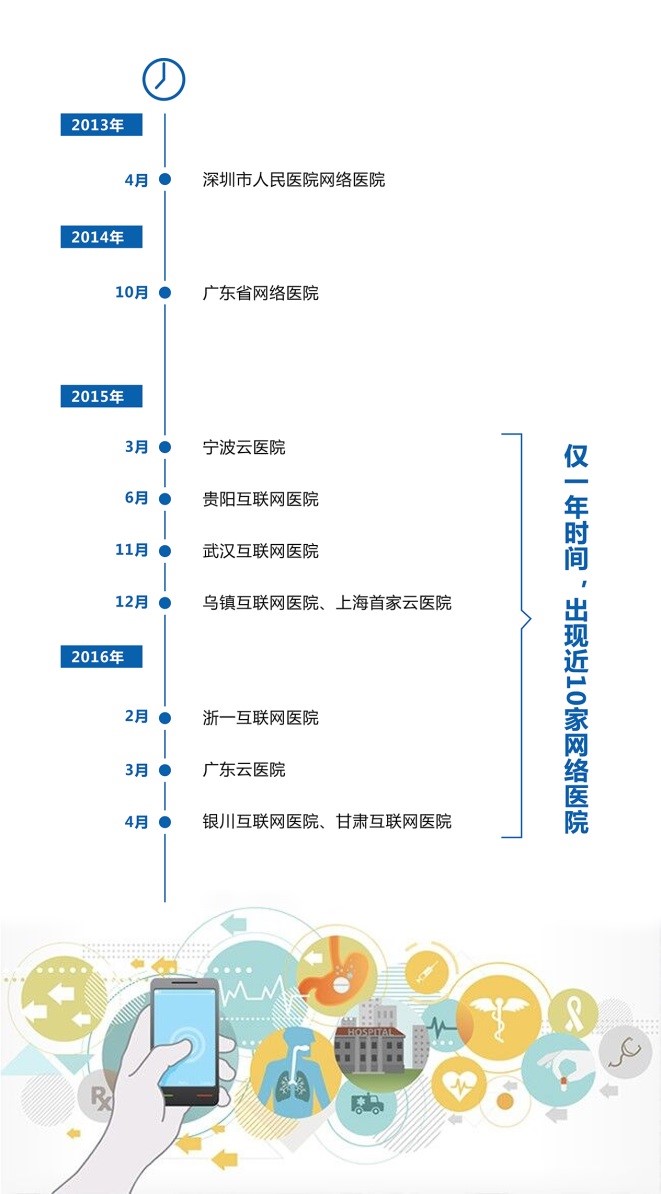
Some industry insiders believe that whether they are called Internet Hospitals, Cloud Hospitals, or Web Hospitals, they are essentially the same; these three terms are more like “triplets,” with different names but identical appearances. At their core, they are nothing more than “online consultations plus pharmaceutical O2O services.” In fact, this characterization is not inaccurate, as the differences among them do not lie in their homogenized names and services.
Peeling back the “packaging” for a true interpretation reveals that these “hospitals” differ fundamentally in their operational models. With distinct patient intake approaches and fierce competition for hospital and physician resources, online hospitals are employing diverse strategies to thrive in the increasingly saturated mobile healthcare market.
Two Patient Reception Models Clash Head-On, With the Outcome Still Undecided
In terms of consultation models, two major approaches operate under the umbrella of “Internet Hospitals”: one is the “online + offline” model represented by Guangdong Provincial Internet Hospital, and the other is the purely “online” model represented by Guangdong Cloud Hospital.
Let us first examine the first cohort, taking the Guangdong Provincial Internet Hospital as an example. The Second People’s Hospital of Guangdong Province collaborated with community health centers, rural clinics, “health huts,” and large chain pharmacies to establish online consultation points. Patients can complete their medical consultations directly with online physicians via video calls through these points. This model arguably enables patients to access diagnostic and treatment services from renowned Grade 3A hospitals in their local vicinity. However, after one year of operation, this offline deployment model appears somewhat “heavy,” and its development seems slightly “stagnant.” According to a report by National Business Daily: “Data compiled in October 2015 showed that the Guangdong Provincial Internet Hospital had over 1,000 consultation points across the province. To date, there has been virtually no further expansion, with little change in the number of patients served or available physician resources. This falls far short of the goal to establish 10,000 consultation points by the end of 2015.”
In fact, the above report appears somewhat one-sided. After all, “online hospitals” are still in the early stages of market education, with relatively low patient acceptance. Coupled with patients’ caution in selecting healthcare providers, establishing offline presence can help alleviate patient concerns to a certain extent, boost their confidence in seeking medical care, and better guide them in using these services. Future development is merely a matter of time; once patients embrace the model, expansion will naturally accelerate.
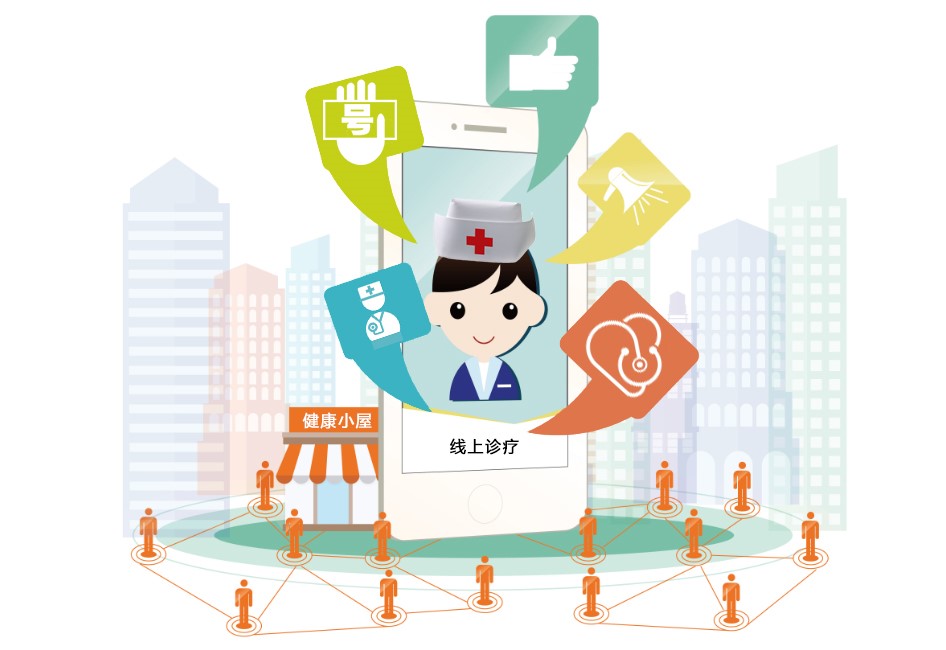
Another emerging force, represented by the “Guangdong Cloud Hospital,” operates differently from traditional offline clinics. After downloading the app, patients can complete the entire process—appointment registration, consultation, medication purchase, payment, and delivery—directly on their mobile devices. This care-delivery model is indeed much “lighter,” offering certain advantages in terms of operations and capital investment. According to an executive at Yuntai Network, the technology provider for Guangdong Cloud Hospital: “Since the launch of Guangdong Cloud Hospital, we have received numerous applications from hospitals seeking to join the platform; many tertiary Grade A hospitals and government entities in other provinces have also expressed interest in establishing their own cloud hospitals. Moreover, at a time when the mobile health industry generally lacks clear profitability models, this asset-light and operationally flexible approach has attracted significant interest from investors, with multiple investment firms extending olive branches.”
Of course, it is overly one-sided to judge the “winners and losers among online hospitals” solely based on their patient consultation models, as both models face insurmountable barriers—namely, policy. In fact, national policies are the true behind-the-scenes drivers of this “great battle.” Even setting aside the absolute guiding force of policy, there is another “battle within the battle”—the scramble for hospital and physician resources.
Online Hospitals Turn Bloodthirsty in the Fierce Scramble for Hospital and Physician Resources
Indeed, patients flock to Grade A tertiary hospitals for medical care, making these institutions the core battleground for “internet hospitals.” Fundamentally, however, patients seek treatment at Grade A tertiary hospitals not only for their advanced in-house medical equipment but also for their abundant pool of high-quality physicians. This phenomenon is evident from the severe shortage of appointment slots for specialist and renowned expert clinics. In light of this, would an internet hospital platform with access to the largest number of hospitals and the richest physician resources across China really struggle to attract patients? Thus, it goes without saying that various internet hospital platforms are highly covetous of premium hospital and physician resources.
Currently, there are three primary models for resource integration in online hospitals. Taking the Guangdong Provincial Online Hospital as an example, its services are mainly provided by the Second People's Hospital of Guangdong Province and other hospitals and physicians within its medical consortium. In contrast, the renowned Wuzhen Internet Hospital has benefited from the promotion of the "multi-site practice" policy, which allows any physician holding a valid practicing certificate to engage in multi-site practice via the internet hospital platform. Meanwhile, the "Guangdong Cloud Hospital" places greater emphasis on the integration of hospital resources; since its launch in March, dozens of partner hospitals, including the nationally acclaimed Nanfang Hospital, have applied to join the platform.

Here, we will focus on the two models of Wuzhen Internet Hospital and Guangdong Cloud Hospital: the former “sets its sights on” doctors, while the latter “encounters” hospitals. Which pair will ultimately “tie the knot”?
The Wuzhen Internet Hospital model offers significant advantages in the flexibility of patient consultations. Physicians practicing at multiple sites can fully utilize their fragmented time to provide care, allowing patients to seek medical attention at their convenience while increasing physicians’ income. This is undoubtedly a win-win model. Although this approach benefits from national policies supporting multi-site practice, hospitals are not necessarily fond of such “dual-commitment” staffing arrangements. Consequently, most physicians have adopted a wait-and-see stance, with the vast majority of high-quality medical resources still firmly controlled by hospitals. Given the already heavy workloads physicians face within hospitals, the path to a successful partnership between these two parties is far from easy. Nevertheless, considering the evolution of national policies, transformations in hospital operational models, and shifting market demands, the increasingly “open” trend in the healthcare industry will create new opportunities for this collaboration.
Undoubtedly, the current awkward predicament of multi-site practice has not gone unnoticed by “Guangdong Cloud Hospital,” which has adopted an assertive approach in its partnerships. By collaborating with hospitals, it enables physicians to conduct consultations within hospital premises during working hours. This model mitigates medical risks while driving patient traffic to hospitals and increasing their revenue. Furthermore, hospital administrations retain full control over physicians’ online consultation schedules, allowing for optimized allocation of medical staff time and maximization of physician value. Such a “two-birds-with-one-stone” strategy is likely why Guangdong Cloud Hospital has found ready alignment with hospitals. However, this model does fall short in terms of flexibility regarding consultation hours and departmental configurations.
Internet Hospitals Are an Inevitable Trend: Have “Unicorns” Already Emerged?
The above analysis of the “triplets” of online hospitals remains rather superficial; there is much more to be explored in terms of interoperability of medical information, models for resource integration, and forms of ecosystem building. In any case, facing an vast blue-ocean market, it is a consensus among industry insiders that “online hospitals have become an irresistible trend.” The author can even assert with confidence that 2016 will undoubtedly become the “Year One” of the explosive growth of online hospitals.
However, online hospitals remain in the experimental stage. The three major players in this field—the long-established Guangdong Provincial Online Hospital, the renowned Wuzhen Internet Hospital, and the emerging Guangdong Cloud Hospital—cannot yet be considered “unicorns” in the online hospital sector. Business model transformation and strategic restructuring remain the norm for online hospitals, and new entrants will continue to emerge. It is therefore premature to determine the market leaders at this juncture.