

HPE China Advances Healthcare Big Data in Guiyang with Integrated Population Health Cloud Platform
Hewlett Packard Enterprise (HPE), which spun off from HP Inc. last November, is a Fortune 500 company with annual revenue reaching $53 billion and a leading provider of enterprise-grade technologies.
In July 2014, the Guiyang Municipal People’s Government signed a Memorandum of Strategic Cooperation with HPE China, agreeing to collaborate in the big data industry. The cooperation encompasses areas such as the Agricultural Cloud, service outsourcing centers, and healthcare big data. At this year’s Guiyang Big Data Expo, HPE made a high-profile appearance as an exhibitor. To gain insights into HPE’s latest research achievements in the healthcare sector, VCBeat conducted an on-site interview with Dr. Tao Ying, HPE’s Enterprise Services Healthcare Industry Expert.
According to Tao Ying, HPE’s big data applications in Guiyang are divided into three segments: medical assistance, government support, and public benefit, corresponding to three distinct audiences—physicians, the government, and the general public. He revealed that HPE obtained big data, including information from healthcare systems and population information systems, through collaborations with medical and governmental agencies such as the Guiyang Health and Family Planning Commission and the Human Resources and Social Security Bureau. This dataset covers 11 large hospitals and over a thousand clinics, encompassing big data information on patients’ household composition, income levels, and other relevant factors.
According to VCBeat, the big data platform currently serves a population of 4.7 million in Guiyang, covering more than 1,000 public medical institutions, and is expected to generate nearly 10 petabytes (PB) of healthcare big data in the future.
In terms of medical assistance: Based on the Vertica big data analytics system, the HPE Medical Big Data Analytics Platform comprises six major functions, including a clinical case search engine, random analysis of medical big data, prediction of hospitalization risk for chronic diseases, early warning of adverse medical events, search-based real-time clinical decision support, and analysis of poverty caused by illness. This section primarily introduces the first five functions.
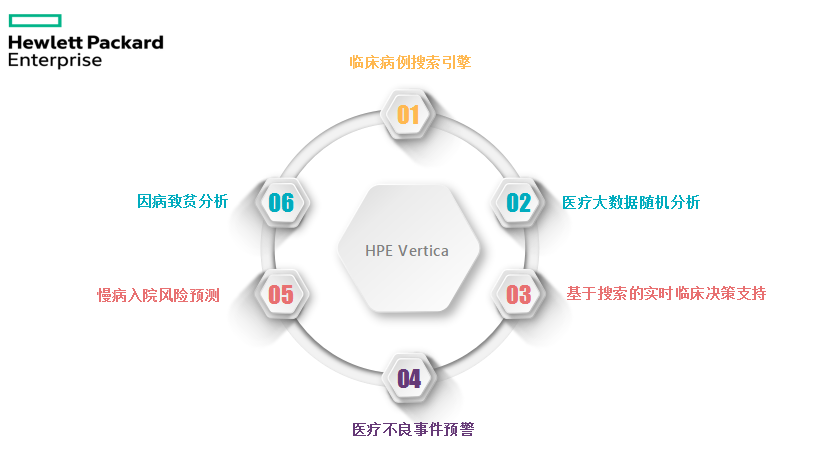
Through this feature, physicians can search patient data from electronic medical records across major hospitals, thereby obtaining treatment plans and outcomes for previously similar cases.
Due to the extreme complexity of big medical data and the vast number of fields involved, traditional data search methods are highly inefficient. Taking the front page of medical records as an example, retrieving results from mere dozens of characters can be very slow, typically requiring several minutes or even hours to return feedback.
To enhance the efficiency of medical big data, HPE has developed a proprietary medical big data analytics tool based on HPE Vertica, currently the world’s fastest structured data analytics platform. Leveraging parallel processing technology, this tool accelerates medical big data search speeds by 100-fold. It enables instantaneous queries and real-time analytics for block data encompassing both simple and complex combinations of patient attributes sought by physicians.
To address the high risk of misdiagnosis associated with uncommon and rare diseases, physicians can query a clinical decision support system using patients’ electronic health records. Leveraging backend big data analytics, the system automatically matches potential disease categories and provides similarity-based recommendations, thereby assisting clinicians in evaluating patients’ conditions.
Due to negligence in hospital hygiene and disinfection practices, patients may acquire conditions not present prior to admission, such as infections and venous thromboembolism. This issue is also a significant contributor to strained doctor-patient relationships. To address this, medical adverse event early warning systems can be employed to perform real-time aggregation and analysis of nursing records, thereby alerting physicians to promptly identify and manage relevant situations and prevent medical accidents.
Currently, the focus is primarily on two conditions: diabetes and hypertension. Taking diabetes as an example, since it cannot be cured at present, long-term medication is required for disease management, such as insulin and hypoglycemic agents. Non-adherence to medication regimens can lead to disease progression.
In response to this situation, chronic disease hospitalization risk prediction is employed to monitor patients’ recent medical records and medication adherence. Upon detecting any abnormalities in the patient’s condition or medication schedule, the system proactively alerts and warns physicians. Armed with this information, physicians can then contact the patient via telephone or other means to facilitate timely medical consultation.
For physicians, the key data obtained through this system can play a crucial role in treatment planning, clinical research, and other areas.
Administrative Support: This module also comprises six major functions, including big data analysis of poverty caused by illness, blood usage and inventory early warning, big data analysis of emergency care, monitoring of special healthcare-seeking behaviors, predictive early warning for infectious diseases, and analysis of patient flow for medical treatments outside the county. The following section focuses on the first five functions.
Targeted poverty alleviation is a key initiative vigorously promoted by the government, as exorbitant medical expenses impose a heavy financial burden on patients’ families, thereby driving them into poverty.
HPE Big Data Analytics System for Poverty Caused by Illness integrates medical expenses, household composition, household registration information, subsistence allowance data, and hospital diagnosis and treatment records. By aggregating these datasets into block data for analysis, the system generates scoring results that enable administrators to clearly identify the causes and severity levels of poverty among patients.
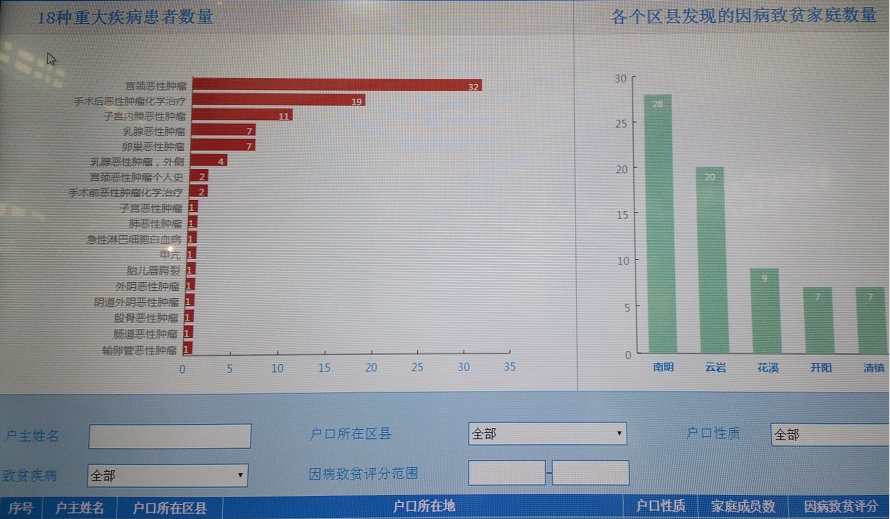
This system enables administrators to conveniently monitor blood bank inventory levels, types, and usage trends at each hospital in the Guiyang region. Once a shortage is detected at any hospital, blood allocation or donation drives can be promptly arranged.
This system enables real-time location monitoring of all ambulances and hospitals within Guiyang. In the event of a major traffic accident, administrators can rapidly dispatch the nearest ambulance to provide immediate on-site assistance and transport patients to the closest hospital equipped with emergency resuscitation capabilities.
By analyzing patient visits for knife wounds, gunshot wounds, and other injuries that may involve criminal activity, law enforcement agencies can promptly track the movements of suspects.
Leveraging big medical data to visualize the status of infectious diseases in the region through heat maps. This facilitates timely identification of high-risk infectious diseases by the government, enabling immediate determination of affected areas and outbreak dynamics, thereby allowing for prompt implementation of isolation measures.
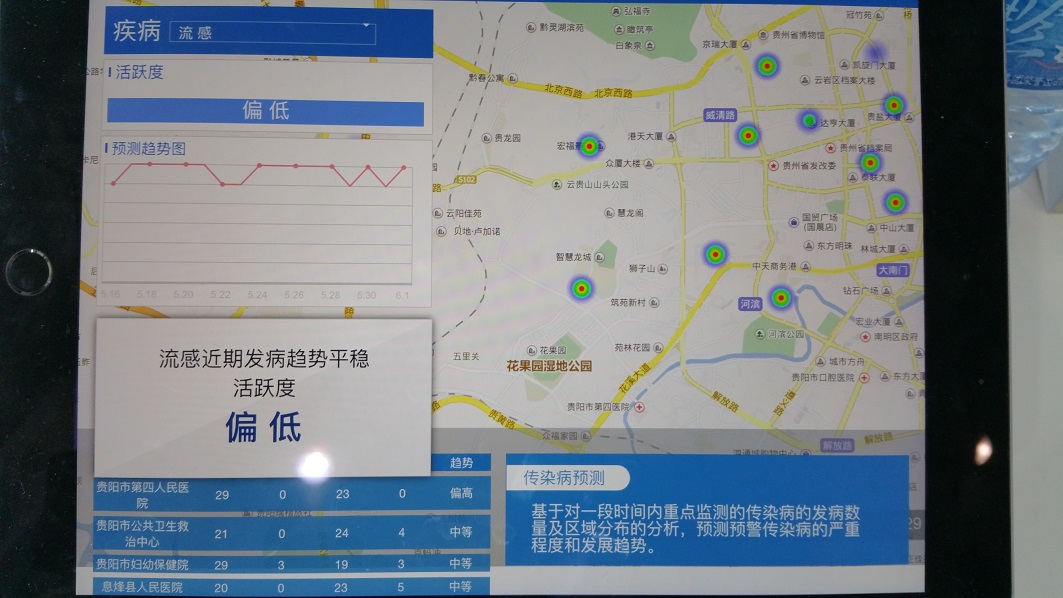
Public Benefit: The Guiyang Population Health Information Cloud Platform primarily comprises four major functions: distribution of areas with recent high-incidence diseases, analysis of hospital visit popularity, comparison of treatment costs for common diseases, and precision chronic disease management. This section focuses on the recent high-incidence diseases and their regional distribution.
**Recent High-Incidence Diseases and Regional Distribution:** Previously, users could only learn about recent epidemic trends in a specific area through news reports or word of mouth. Now, by accessing the Guiyang Population Health Information Cloud Platform via its website or mobile app, users can view the latest data on high-incidence diseases across various regions. The results are displayed in real-time as a heat map, alerting citizens to avoid areas with a high risk of disease transmission.
In addition to these four major functions, the Guiyang Population Health Information Cloud Platform also enables online medical services and health management: users can perform tasks such as online appointment scheduling, remote consultations, medication inquiries, and establishing personal health records through the information cloud platform.
At the Big Data Industry Summit of this year’s China International Big Data Industry Expo, Mao Yunan, Chairman of HP China, stated, “Within two years, HPE has built the Guiyang Population Health Information Cloud Platform—the only cloud platform in China that integrates health records and electronic medical records across an entire city. Capable of supporting thousands of applications, it has helped Guiyang become a pioneer in the development of China’s big data industry.”