PCSK9 Inhibitors: The Rising Star of the Lipid-Lowering Market
PCSK9 Inhibitors: The Rising Star of the Lipid-Lowering Market
Clinical trials have demonstrated that PCSK9 inhibitors possess potent lipid-lowering effects, reducing cholesterol levels by more than 50% beyond those achieved with statin therapy. PCSK9 inhibitors accelerate the clearance of cholesterol from the body by reducing the degradation of low-density lipoprotein receptors (LDL-R) on the surface of hepatocytes.
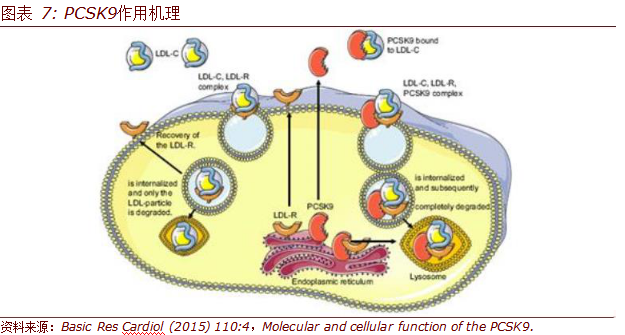
Unlike statins, which inhibit cholesterol synthesis by reducing its “source,” PCSK9 inhibitors enhance its “clearance” by decreasing the degradation of LDL receptors (LDL-R), thereby stabilizing LDL-R levels and accelerating the removal of already synthesized cholesterol from the body.
Major international pharmaceutical giants are targeting PCSK9, leading to intense market competition. Current inhibitors targeting PCSK9 include monoclonal antibodies, Adnectins, siRNAs, small molecules, and peptide mimetics, with monoclonal antibody products being the most mature.
In July 2015, Sanofi and its partner, the U.S.-based pharmaceutical company Regeneron, acquired a Priority Review Voucher for $67.5 million, enabling their fully human monoclonal antibody product, Praluent (alirocumab), to surpass Amgen’s Repatha (evolocumab) and become the first PCSK9 inhibitor approved by the FDA.
Pfizer’s bococizumab is expected to be the third approved drug. Eli Lilly, Bristol-Myers Squibb, Merck, Novartis, and other companies have PCSK9-targeting therapies in clinical trials.
The approved indications for PCSK9 inhibitors are gradually expanding, revealing significant market potential. Praluent and Repatha are currently FDA-approved as adjunctive therapies to further reduce low-density lipoprotein cholesterol (LDL-C) in patients with heterozygous familial hypercholesterolemia (HeFH) or atherosclerotic cardiovascular disease (ASCVD) who require additional LDL-C lowering despite dietary modifications and maximally tolerated statin therapy. (Repatha has additionally gained approval for homozygous familial hypercholesterolemia [HoFH].)
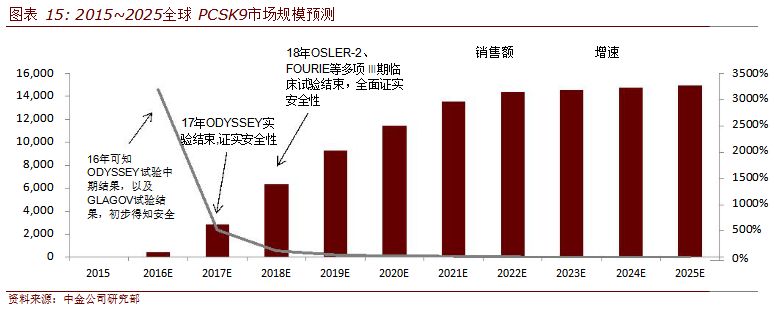
As more clinical trials are completed and their results disclosed, the penetration rate of PCSK9 inhibitors will gradually increase. The market size for PCSK9 inhibitors is projected to reach $14.9 billion by 2025.
Statins Patents Expiring, Billions-Size Lipid-Lowering Market to Be Re-Explored
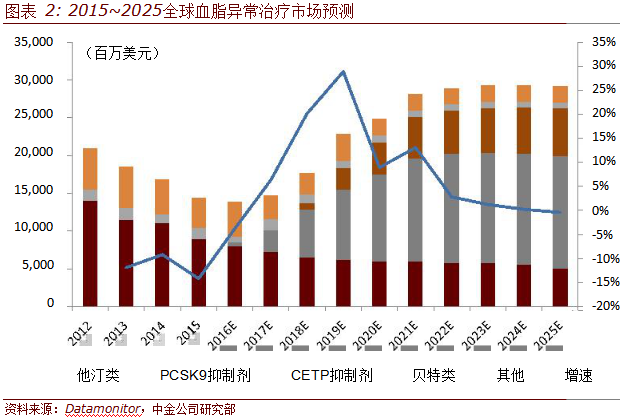
In 2014, the global market size for lipid-lowering drugs was approximately $14 billion, less than half of its peak level. In recent years, although the global lipid-lowering drug market has gradually contracted due to the expiration of statin patents, the essential demand for medication continues to grow. With the introduction of innovative drugs offering superior lipid-lowering efficacy, the market size is expected to rebound strongly, reaching an estimated $30 billion globally by 2025.
Patents for Statin Blockbusters Expire, Price Cuts Lead to Rapid Shrinkage of the Lipid-Lowering Market SizeIn recent years, patents for blockbuster statin drugs have expired one after another.
Statins are hydroxymethylglutaryl coenzyme A (HMG-CoA) reductase inhibitors that inhibit the synthesis of endogenous cholesterol in the liver during the early stages of cholesterol biosynthesis. Statins are currently the most effective lipid-lowering agents and are the first-line choice for clinical lipid-lowering therapy.
Commonly used statins in clinical practice include lovastatin, simvastatin, pravastatin, atorvastatin, and rosuvastatin.
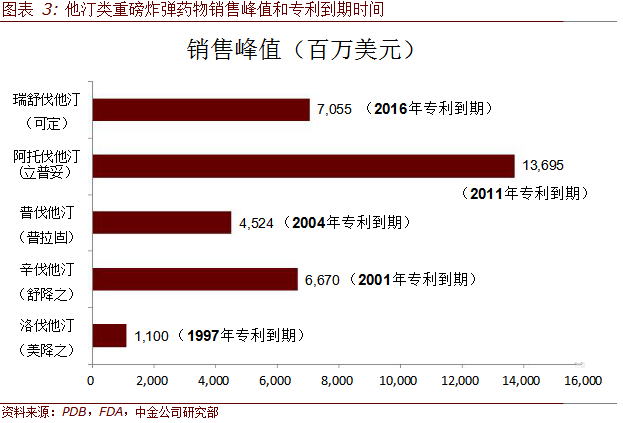
The expiration of Lipitor’s patent led to a significant contraction in the global market size for lipid-lowering drugs. Sales of statins, which peaked at over $20 billion in 2006, gradually declined, with global sales falling below $10 billion by 2014.
The primary reasons were the expiration of Pfizer’s Lipitor (atorvastatin) patent in 2011 and the impact of generic competition, which led to a rapid decline in Lipitor’s market share. By 2014, its sales had dropped to $2.5 billion, merely one-fifth of its peak sales in 2006.
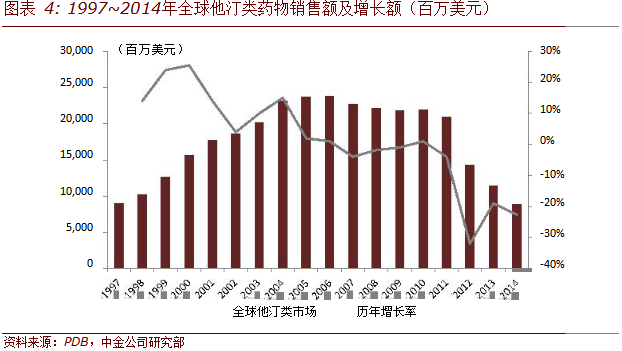
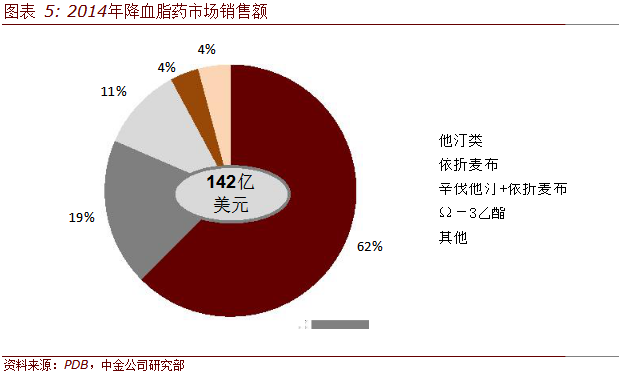
Statins remain the mainstream medication. With the patent expiration of Crestor in 2016, the statin market size is expected to shrink further. In 2014, the global blood lipid-lowering drug market reached $14.2 billion, with statins accounting for 62%.
Ezetimibe ranked second in sales, while the combination of simvastatin and ezetimibe ranked third. Statins, either as monotherapy or in combination with ezetimibe, accounted for over 90% of total sales in the lipid-lowering market, with statins remaining the mainstream treatment.
PCSK9 Inhibitors Are the Most Potent New Lipid-Lowering Agents Since Statins
PCSK9 (Proprotein Convertase Subtilisin/Kexin Type 9) is the third gene associated with cholesterol metabolism, discovered in 2003, and plays a critical regulatory role in maintaining cholesterol homeostasis in the body. Low-density lipoprotein cholesterol (LDL), commonly known as "bad cholesterol," is cleared from the bloodstream through specific binding to its receptor (LDL-R) in the liver.
PCSK9 binds to low-density lipoprotein receptors (LDL-R), leading to their accelerated degradation and consequently causing a significant increase in low-density lipoprotein cholesterol (LDL-C) levels. PCSK9 inhibitors block the interaction between PCSK9 and LDL-R, thereby increasing the number of LDL-Rs available on the hepatic surface to clear LDL, ultimately achieving a reduction in systemic cholesterol levels.
All currently published clinical trial data demonstrate that PCSK9 inhibitors have potent LDL-C lowering efficacy. Their novel lipid-lowering mechanism addresses the substantial market need for patients with statin intolerance, positioning them as a potential new “blockbuster” in the lipid-lowering market following statins.
Currently, major international pharmaceutical companies have all joined the race to develop drugs targeting PCSK9.
Excellent LDL-C lowering efficacy. When added to baseline statin therapy, it reduced LDL-C by more than 50% on average compared with placebo, and by 30%–40% on average compared with ezetimibe;
Preliminary safety and tolerability were favorable. Existing data indicate an overall favorable safety profile, with a trend toward reducing the incidence of cardiovascular events;
Addressing unmet clinical needs. It demonstrates significant efficacy in patients with familial hypercholesterolemia (FH) whose condition is not adequately controlled by statin therapy;
Safety is expected to be fully confirmed in 2018. Currently, there is a lack of definitive clinical trial data demonstrating a reduction in cardiovascular risk. Amgen, Sanofi, and Pfizer are all conducting large-scale safety clinical trials involving more than 10,000 participants, which are expected to conclude in 2018 and comprehensively confirm the safety profile of PCSK9 inhibitors.
Disclosure of Safety Trial Results in 2017–2018 to Significantly Boost PCSK9 Inhibitor Penetration
Due to the lack of trial data on the incidence and mortality of cardiovascular disease, the current penetration rate of PCSK9 inhibitors is low. In the clinical treatment of patients with hyperlipidemia, in addition to considering the LDL-C lowering effect, it is also necessary to comprehensively evaluate the impact of lipid-lowering drugs on the incidence and mortality of cardiovascular disease.
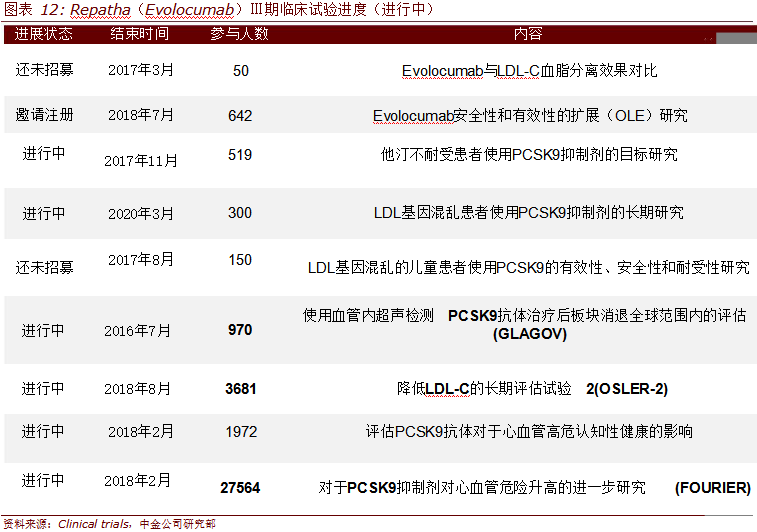
Multiple long-term safety studies are scheduled to conclude in 2017–2018, and the penetration rate of PCSK9 inhibitors is poised for significant growth over the next three years. Currently, Sanofi, Amgen, and Pfizer have all launched multiple Phase III clinical trials focusing on the safety of PCSK9 inhibitors in the treatment of cardiovascular diseases, with these trials set to conclude sequentially between 2016 and 2018.
Repatha currently has nine Phase III clinical trials underway or in preparation. Of particular note are two studies: the FOURIER trial (“Further Cardiovascular Outcomes Research with PCSK9 Inhibition in Subjects with Elevated Risk”), which enrolled more than 27,000 participants and concluded in early 2018, and the OSLER-2 trial, involving over 3,000 participants and completed in August 2018. These trials were expected to confirm the safety profile of Repatha in 2018.
PCSK9 Inhibitors: Promising Future Market Prospects
The global PCSK9 market is projected to reach $14.9 billion. With a novel cholesterol-lowering mechanism and robust clinical efficacy in lipid reduction, PCSK9 inhibitors hold significant market potential among patients with hyperlipidemia that cannot be controlled by statins.
With the disclosure of results from long-term safety assessment trials of PCSK9 inhibitors in patients with cardiovascular and cerebrovascular diseases between 2016 and 2018, PCSK9 inhibitors are expected to capture approximately 9% of the target market at their peak.
Based on the market launch dates and clinical trial completion timelines of various PCSK9 inhibitors, the global PCSK9 market size is projected to exceed $14.9 billion in 2025. The global sales of both Praluent and Repatha are expected to surpass $5 billion each in 2025.
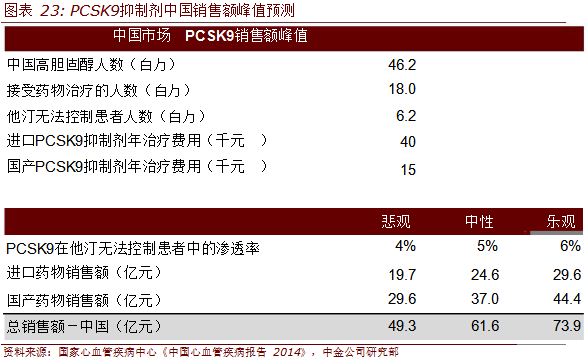
Market Size of PCSK9 Inhibitors in China: The market size of PCSK9 inhibitors in China is projected to peak at RMB 6.2 billion, with domestically produced PCSK9 inhibitors accounting for RMB 3.7 billion. In February 2015, Amgen’s Repatha began Phase III clinical trials in China.
Domestic R&D of PCSK9 inhibitors is also actively underway. Junshi Biosciences’ monoclonal antibody PCSK9 inhibitor is expected to file for clinical trials in the second quarter of 2016, positioning it at the forefront of domestically developed PCSK9 inhibitors. Innovent Biologics ranks second, with clinical trial filing anticipated by the end of 2016.
Key Assumptions for Projecting the Peak Sales and Market Size of PCSK9 Inhibitors in China:
► The ratio of patients choosing domestically produced PCSK9 inhibitors to those choosing imported drugs is 8:2;
► The prevalence of hypercholesterolemia in the Chinese population is approximately 3.3% (data sourced from the Report on Cardiovascular Diseases in China 2014);
► Approximately 39% of patients with high cholesterol receive pharmacological treatment (data sourced from the Report on Cardiovascular Diseases in China 2014);
► The proportion of Chinese cholesterol patients whose condition cannot be controlled by statins is 34.2%, higher than the 30% in the United States (data sourced from the "Report on Cardiovascular Diseases in China 2014");
► The penetration rate of PCSK9 inhibitors among patients whose conditions are not controlled by statins is 4–6%;
► The annual treatment cost of imported PCSK9 inhibitors in China is RMB 40,000 per year (similar to the European sales price of USD 7,000 per year, and half that of the United States), while the price of domestically produced PCSK9 inhibitors is 3/8 that of imported drugs, at RMB 15,000 per year.