Market Report on HER2-Targeted Monoclonal Antibodies for Breast Cancer: Strong Growth Driven by Trastuzumab and Emerging Biosimilars
Recently, CICC published a series of research reports on the field of biological innovation. VCBeat has selected four of these reports and compiled their key highlights for excerpting. As the fourth installment in this series, this report provides a detailed analysis of the market size and current R&D status of HER2-targeted therapies.
HER2 Originator Drug Herceptin Exceeds $6 Billion in Sales, Indicating Vast Market Potential
As a blockbuster drug from Roche for many years, Herceptin (trastuzumab) has been confirmed by years of clinical experience since its launch in 1998 to significantly reduce the risk of recurrence and death in patients with HER2-positive (overexpressed or amplified) breast cancer.
In 2012, Herceptin was approved by the CFDA for use in patients with HER2-positive metastatic gastric cancer. Since 2012, Herceptin’s annual sales have exceeded $6 billion. In 2015, Herceptin’s patent expired in the United States, and its sales began to decline.
Currently, numerous trastuzumab biosimilars are under development. Given the anticipated influx of low-cost biosimilars and the inclusion of more provinces and municipalities in the national reimbursement drug list, the penetration rate of trastuzumab in China—particularly for breast cancer—is expected to rise rapidly.
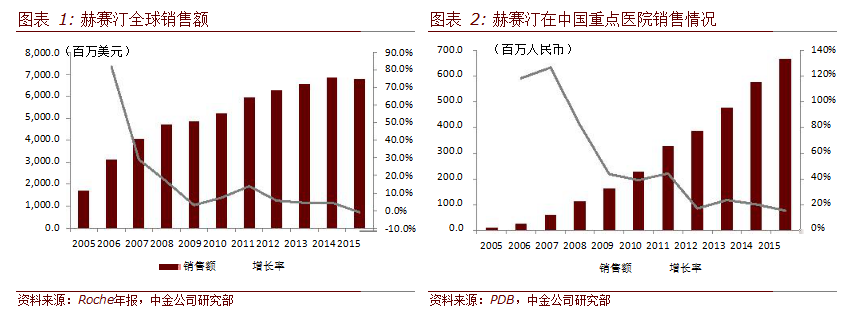
Herceptin’s global annual sales exceed $6 billion, making it Roche’s third best-selling drug. Approved by the FDA in 1998, Herceptin surpassed $6 billion in annual sales in 2012 and has since maintained stable performance. However, with patent expirations in Europe and Japan in 2014 and in the United States in 2015, sales began to decline in 2015.
Numerous biosimilars of Herceptin are currently under development, and global sales of Herceptin are expected to decline significantly in the coming years.
Herceptin’s sales in China have grown steadily, reaching approximately RMB 2 billion in 2015. Since the Chinese CFDA approved Herceptin for market launch in 2002, the product has maintained consistent growth in China. In 2015, sales at key domestic hospitals amounted to RMB 660 million, with a compound annual growth rate (CAGR) of 49% from 2005 to 2015.
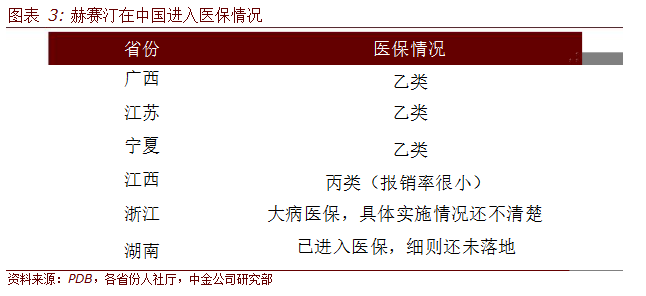
Currently, Herceptin has been included in the medical insurance coverage of Guangxi, Jiangsu, Ningxia, Hunan, and Zhejiang. Due to high treatment costs, Herceptin’s market penetration rate in China remains low. However, given the substantial rigid demand in the domestic market, the penetration rate of trastuzumab is expected to rise rapidly as a large volume of low-cost generic drugs enters the market and more provinces and municipalities include it in their medical insurance formularies.
As multi-provincial medical insurance negotiations and implementation progress, the growth rate of the Chinese market is expected to further accelerate. Herceptin has currently been included in the Category B medical insurance lists in Guangxi, Jiangsu, and Ningxia, while it is classified under Category C medical insurance in Jiangxi.
In terms of the scale of medical insurance coverage, Jiangsu Province is currently the only major province with extensive coverage. Zhejiang Province began including critical illness insurance in its medical insurance scheme in 2015, although the specific implementation details remain unclear. Hunan Province has also incorporated it into its medical insurance system, but detailed regulations have yet to be fully implemented. If the medical insurance penetration rate increases in these two provinces, the growth rate of Herceptin is expected to rise further.
The breast cancer market will remain the primary growth driver in the future. Compared with chemotherapy alone, trastuzumab-based combination therapy significantly extended median overall survival (OS) by 23.6% in breast cancer patients (25.1 vs. 20.3 months), demonstrating favorable clinical efficacy. Amid future price reductions, market penetration for breast cancer treatments is expected to increase substantially; we project penetration rates of approximately 60% and 80% under neutral and optimistic scenarios, respectively.
The gastric cancer market is unlikely to reach the scale of the breast cancer market. Currently, the penetration rate of Herceptin among target gastric cancer patients in China is significantly lower than that in breast cancer. Due to the relatively low incidence of gastric cancer in Europe and the United States, Roche has not been proactive in promoting or researching the gastric cancer indication for Herceptin, resulting in a lack of evidence-based medical data. Clinicians perceive its cost-effectiveness as suboptimal and are therefore less inclined to prescribe it actively.
Given the emergence of novel therapeutic modalities such as tumor immunotherapy, clinical investment in HER2 itself may be relatively limited. We anticipate that patient penetration will struggle to reach the scale observed in breast cancer, with estimated neutral and optimistic penetration rates of 20% and 30%, respectively.
Trastuzumab is a first-line treatment for patients with HER2-positive breast cancer and gastric cancer.
Breast cancer is the most commonly diagnosed cancer among women in China and ranks as the sixth leading cause of cancer-related mortality. In China, the age-standardized incidence rate (ASR) of breast cancer is 41.64 per 100,000 women, with the ASR in urban areas being twice that in rural areas.
According to data released by the China Anti-Cancer Association, the incidence of breast cancer in China has been increasing year by year in recent years, with nearly 200,000 women diagnosed with breast cancer annually. Based on molecular subtyping, breast cancer is primarily classified into four major categories: Luminal A, Luminal B, ERBB2-positive (HER2-positive), and Basal-like. HER2-positive patients are mainly distributed among the Luminal B and ERBB2-positive subtypes.
Trastuzumab in Combination with Chemotherapy Becomes the First-Line Treatment for Patients with HER2-Positive Breast Cancer. HER2-positive disease is more aggressive, accounting for approximately 15–30% of breast cancer cases. Disease-free survival (DFS) and overall survival (OS) in these patients are significantly shorter compared to other subtypes. For patients with HER2-positive breast cancer, trastuzumab combined with chemotherapy has become the gold standard of treatment.
Compared with chemotherapy alone, breast cancer patients receiving trastuzumab-based combination therapy demonstrated a statistically significant 23.6% prolongation in median overall survival (OS) (25.1 vs. 20.3 months), along with significantly prolonged median time to disease progression, improved overall response rate (ORR), and extended median duration of response, indicating favorable clinical efficacy.
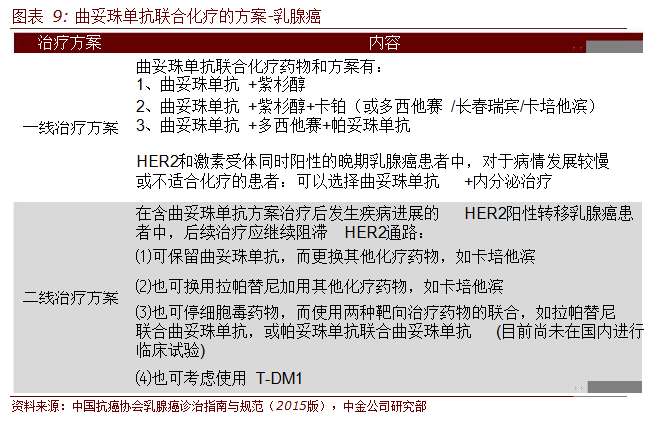
Trastuzumab can be combined with a variety of chemotherapy drugs and regimens. According to the "Guidelines and Standards for Diagnosis and Treatment of Breast Cancer by the China Anti-Cancer Association (2015 Edition)," trastuzumab combination chemotherapy regimens include paclitaxel with or without carboplatin, docetaxel, vinorelbine, and capecitabine, as well as in combination with docetaxel plus pertuzumab. For patients who have failed taxane-based therapy, treatment with trastuzumab combined with vinorelbine or capecitabine should be considered.
Gastric cancer is the second most common malignancy in China, with an incidence rate far higher than that in other regions of the world. The incidence of gastric cancer in China reaches 37.1 per 100,000 among men and 17.4 per 100,000 among women, resulting in 400,000 new cases and 300,000 deaths annually.
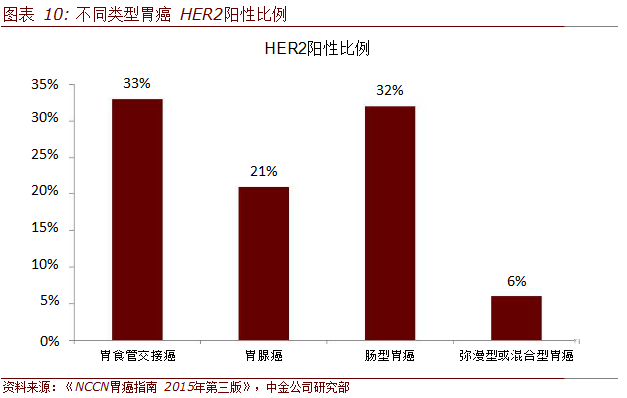
According to the NCCN Clinical Practice Guidelines in Oncology: Gastric Cancer, Version 3.2015, the HER2 positivity rate varies by histological type (intestinal type > diffuse type) and tumor differentiation (moderately differentiated > poorly differentiated).
In the ToGA clinical trial evaluating the role of trastuzumab combined with chemotherapy in HER2-positive gastric cancer, the HER2 positivity rates were 33% in gastroesophageal junction cancer, 21% in gastric adenocarcinoma, 32% in intestinal-type gastric cancer, and 6% in diffuse or mixed-type gastric cancer.
Herceptin has an extremely low penetration rate among gastric cancer patients, and it is unlikely that the Chinese gastric cancer market will reach the scale of the breast cancer market in the future. Currently, the penetration rate of Herceptin among gastric cancer patients in China is far lower than that among breast cancer patients. There are three main possible reasons:
Limited Reimbursement Support. Herceptin is currently included in the national medical insurance primarily for breast cancer, with very limited coverage for gastric cancer.
Clinicians remain hesitant in their prescribing practices. Although clinical trials have demonstrated that trastuzumab (Herceptin) combined with chemotherapy improves median overall survival (OS) by 12%, the actual extension in survival time is modest (less than 2 months: 13.1 vs. 11.7 months; whereas in breast cancer, the benefit approaches 5 months: 25.1 vs. 20.3 months). Meanwhile, the average cost of trastuzumab for gastric cancer treatment is approximately RMB 147,000. Consequently, clinicians perceive its cost-effectiveness as suboptimal, leading to less aggressive prescribing.
Outside of China, Japan, and South Korea, gastric cancer is a malignancy with relatively low incidence, and its market share is not substantial; consequently, Roche has not been actively engaged in evidence-based medicine research for this indication. The correlation between HER2 expression status and prognosis in gastric cancer patients remains to be further elucidated.
It will be difficult for the market penetration rate of gastric cancer treatment in China to reach the scale seen in breast cancer. Due to the aforementioned reasons, the current penetration rate of Herceptin in China is extremely low. Given the emergence of new therapeutic approaches such as tumor immunotherapy, clinical investment dedicated specifically to HER2 may be relatively limited. We anticipate that patient penetration rates will struggle to match those observed in breast cancer, with estimated neutral and optimistic penetration rates at 20% and 30%, respectively.
A New Generation of HER2-Targeted Drugs Emerges
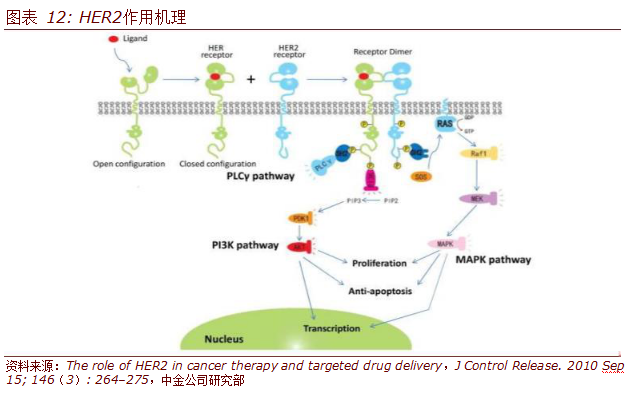
HER2 belongs to the proto-oncogene family and plays a crucial role in tumorigenesis and tumor progression. Human Epidermal Growth Factor Receptor 2 (HER2) is a transmembrane glycoprotein with receptor tyrosine kinase activity, belonging to the epidermal growth factor receptor family. Receptor dimerization leads to phosphorylation of tyrosine residues on the receptor, initiating multiple signaling pathways that result in cell proliferation and tumorigenesis.
As prognostic and predictive biomarkers, HER2 gene amplification or overexpression occurs in approximately 15–30% of breast cancers and 10–30% of gastric/esophageal cancers. HER2 overexpression is also observed in other tumors, such as those of the ovary, endometrium, bladder, lung, colon, and head and neck.
A diverse array of new drugs targeting HER2 has emerged in recent years, including monoclonal antibodies, antibody-drug conjugates (ADCs), and small-molecule inhibitors. Representative agents include the monoclonal antibody Perjeta (pertuzumab), the ADC Kadcyla (T-DM1), and small-molecule drugs such as lapatinib and afatinib.
Perjeta (pertuzumab) is a novel monoclonal antibody targeting HER2, developed by Roche and approved by the FDA for market launch in 2012. Pertuzumab inhibits HER2 activation by blocking receptor dimerization, and its binding site differs from that of trastuzumab. Pertuzumab is approved for use in combination with trastuzumab and docetaxel in patients with HER2-positive metastatic breast cancer who have not received prior hormonal therapy or chemotherapy.
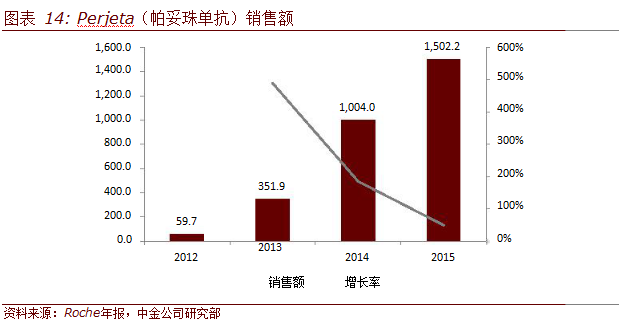
Perjeta’s 2015 sales exceeded $1.5 billion. Perjeta has become a second-line treatment for breast cancer and is the first neoadjuvant therapy for breast cancer approved by the FDA. According to the third edition of the 2015 NCCN Clinical Practice Guidelines in Oncology for Gastric Cancer, it can be used in combination with trastuzumab in patients with HER2-positive metastatic breast cancer who experience disease progression after treatment with a trastuzumab-containing regimen.
Kadsyla (Ado-Trastuzumab Emtansine, abbreviated as T-DM1) is an antibody-drug conjugate (ADC) developed by Roche and approved by the FDA in 2013. Most patients with HER2-positive metastatic breast cancer eventually develop resistance. T-DM1 enables trastuzumab and the cytotoxic agent to target HER2-overexpressing cells, thereby overcoming resistance mechanisms.
Kadcyla achieved sales of nearly $800 million in 2015. T-DM1 was approved as a monotherapy for patients with HER2-positive metastatic breast cancer who had previously received trastuzumab and a taxane, either separately or in combination. T-DM1 is now established as a second-line treatment for breast cancer. According to the NCCN Clinical Practice Guidelines in Oncology for Gastric Cancer (Version 3.2015), T-DM1 may be considered for patients with HER2-positive metastatic breast cancer who have experienced disease progression following trastuzumab-based therapy.
China’s HER2-Targeted Drug Market Size to Reach RMB 5.2 Billion
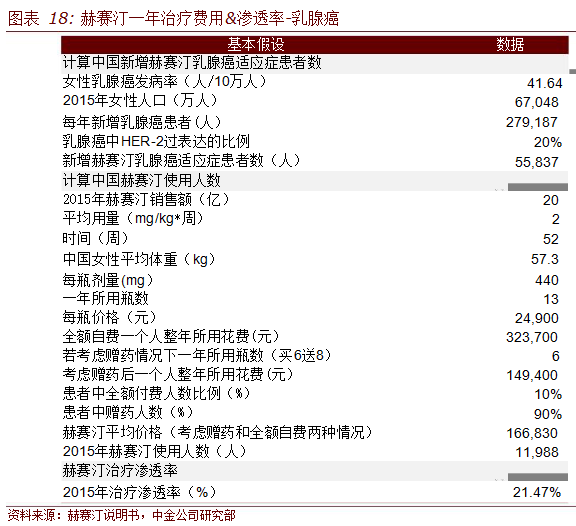
Herceptin, the originator drug, has achieved a 21.47% penetration rate among the target breast cancer patient population in China. As the only monoclonal antibody targeting HER-2 overexpression available in the Chinese market, Herceptin serves a substantial patient base. Furthermore, its patient assistance program (buy 6, get 8 free) helps reduce treatment costs for patients.
In 2015, Herceptin’s sales for breast cancer treatment in China amounted to approximately RMB 2 billion. Based on an average treatment duration of 52 weeks, around 12,000 breast cancer patients received Herceptin in 2015, accounting for 21.47% of all breast cancer patients eligible for trastuzumab therapy.
Future Market Forecast for Trastuzumab in China
At its peak, the trastuzumab market in China is projected to reach RMB 5.2 billion, with the originator drug Herceptin accounting for RMB 1.88 billion and domestically produced trastuzumab accounting for RMB 3.31 billion. The breast cancer segment is expected to reach RMB 4.42 billion, while the gastric cancer segment is projected to reach RMB 0.78 billion.
Basic Assumptions:
1. The incidence rate of breast cancer in China is 41.64 per 100,000 population;
2. HER2-positive patients account for 20%;
3. The cost per treatment cycle of the originator drug Herceptin is RMB 166,830, while the domestically produced version costs 70% of that amount, i.e., RMB 116,781;
4. The ratio of domestically produced trastuzumab to imported Herceptin for treatment is 7:3.
5. The incidence rate of gastric cancer in China is 23.1 per 100,000 population;
6. HER2-positive patients accounted for 11%;
7. The cost per treatment cycle of the originator drug Herceptin is RMB 146,910, while the domestically produced version costs 70% of that amount, at RMB 102,837;
8. The ratio of selecting domestically produced versus imported trastuzumab for treatment is 8:2.
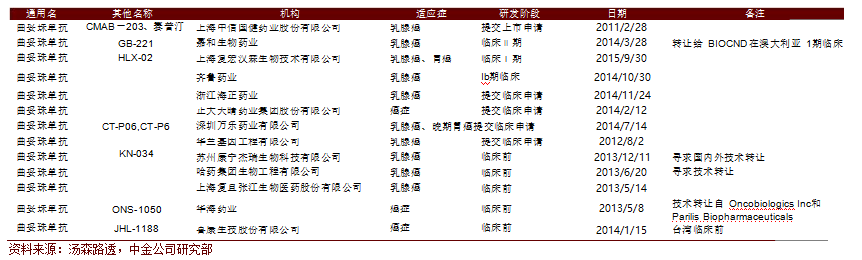
Multiple domestic pharmaceutical companies are developing HER2-targeted drugs. Currently, more than 10 companies in China are engaged in the development of trastuzumab. Among them, CSPC Guojian Pharmaceutical has made the most rapid progress and has already submitted a marketing application.
Next is Genor Biopharma, which has currently entered Phase II clinical trials. Genor Biopharma has reached a collaboration agreement with South Korea’s BIOCND, granting the latter development rights for trastuzumab GB221 in regions excluding Greater China, the United States, Japan, and Europe.
Qilu Pharmaceutical and Henlius have both entered Phase I clinical trials. Multiple pharmaceutical companies, including Hisun Pharmaceutical and Chia Tai Tianqing, have submitted clinical trial applications.