

3.87 Million Dollars Invested Across 9 Distinct Digital Health Ventures, All Recently Filed IPO Prospectuses

VCBeat Investment and Financing News Report, May23From [date] to June 5, the total financing amount generated in the domestic and international digital health sector was approximately3.87hundred million U.S. dollars.
It is reported that,During this periodIn China, a notable financing event was Gancao Doctor’s completion of its first round of funding, amounting to RMB 10 million. Meanwhile, abroad, the Mayo Clinic received $142 million from the U.S. National Institutes of Health, marking a significant step in the United States’ advancement of its precision medicine initiative.
First, let’s focus on the domestic market. Gancao Yisheng has claimed the top spot as the most prominent financing and investment event of the week. The company is committed to building the first TCM physician group.
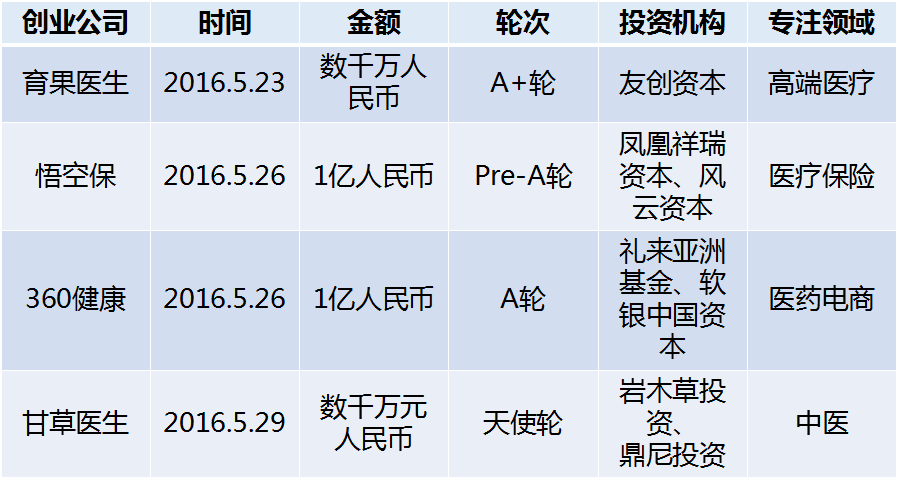
List of Domestic Investment Projects This Week
· Gancao Doctor — Committed to Building a Group of Traditional Chinese Medicine Physicians
Gancao Doctor is a mobile internet-based online Traditional Chinese Medicine (TCM) service application developed by Hangzhou Ganzhicao Technology Co., Ltd. It offers features such as cloud-based consultation rooms, cloud classrooms, and offline consultations. The platform aims to address key pain points in the TCM industry, including difficulties and high costs associated with accessing medical care, poor patient experience, inconsistent quality of herbal medicines, non-standardized decoction processes, and challenges in the inheritance of TCM knowledge.
On May 29, 2016, “Gancao Doctor” announced the completion of its first round of financing, amounting to tens of millions of RMB. This round was led by Yanmucao Investment, with Dingni Investment participating as a co-investor. Following this financing, Gancao Doctor will continue to accelerate its layout in Zhejiang Province and major central cities across China, while focusing on establishing renowned TCM physician studios in four key specialties: internal medicine, surgery, gynecology, and pediatrics, thereby creating China’s first TCM physician group.
In October 2015, Tu Youyou was awarded the Nobel Prize in Physiology or Medicine, reigniting interest in Traditional Chinese Medicine (TCM). Currently, health and wellness applications account for 75% of internet-based medical services, appointment and consultation apps make up 20%, and physician assistant applications comprise 5%. As an enterprise operating in the internet-driven TCM sector, Gancao Doctor’s strategic entry point is to help TCM practitioners establish physician groups. With specialization being key, companies that possess a unique perspective and precise positioning are more likely to succeed in the wave of “Internet Plus.”
·360 Health: In-Depth Analysis of Pain Points in the Internet Pharmaceutical Industry
360 Health is an online platform offering B2C pharmaceutical product guidance and B2B technical support.,Core Strategy: To address the two major pain points in the development of China’s pharmaceutical internet industry—technology and traffic—we have separately built a Technology Cloud Platform and a Shopping Guide Cloud Platform. To date, 360 Health has provided cloud warehouse systems and member management platform services to more than ten well-known manufacturers, including Dekai Pharmacy, Baiyang Pharmaceutical, and Tongrentang.
In addition,,360 Healthalso launched“360 Good Medicine”a pharmaceutical product guide platform, with an average daily traffic of 350,000; as of the end of March, it had partnered with nearly 150 merchants and offered a product assortment of 32,000 SKUs.On May 26, 360 Health publicly announced the completion of its RMB 100 million Series A financing round, with the full amount already secured. The investors participating in this round were Lilly Asia Ventures and SoftBank China Capital. It was revealed that the financing was closed on December 25, 2015, just four and a half months after the establishment of 360 Health. The raised funds will be primarily used to further explore the pharmaceutical e-commerce sector and to comprehensively enhance the company’s operational capabilities and user experience.
·Wukong Bao — Providing Insurance Services to the Top Ten Internet Industries
On May 26, 2016, Wukong Bao announced that it had secured RMB 100 million in Pre-A financing, led by Phoenix Xiangrui Capital and participated by Fengyun Capital, and entered into a strategic partnership with 58 Finance, a subsidiary of the 58 Group. Founded in August 2015, Wukong Bao initially received RMB 15 million in angel investment from Meihua Angel Ventures, Qingshan Capital, and Chen Hua, founder of Changba. Wukong Bao adopts a B2B2C business model, customizing insurance products for internet companies (the B-side) to serve end consumers (the C-side).It is reported that thisThis round of financing is primarily allocated to team building and deep collaboration across various vertical sectors.

Huh, Changba has also invested in Wukong Bao’s first round of financing. It seems that Wukong Bao is a comprehensive internet insurance provider with well-rounded development in morality, intelligence, physical fitness, aesthetics, and labor skills. In the medical field, Wukong Bao has already partnered withQuYun, Medlinker, Yihu Doctor...and other projects reached cooperation. Wukong Insurance has achieved comprehensive development, and Yiguo Doctor, which is also committed to the insurance sector, has identified opportunities in the high-end medical insurance market.
·Yuguo Doctor—China'sOscar Health Insurance Company
Recently, Yiguo Doctor, a high-end medical service platform, secured tens of millions of RMB in its Series A+ financing round. The round was led by Youchuang Capital, with participation from several other institutions. Qingtong Capital served as the exclusive financial advisor for Yiguo’s financing round.
Yuguo Doctor’s business model closely resembles that of Oscar, currently the most prominent online health insurer in the United States. Both share the common goal of thoroughly simplifying healthcare services and health insurance, enabling users to enjoy a seamless experience in accessing medical care and purchasing insurance.
What sets Yuguo apart is its initial focus on middle- and high-income individuals who prioritize health, value the quality and privacy of medical services, are price-insensitive, or hold premium health insurance plans, with the aim of building a nationwide platform for the optimized allocation of high-end medical resources.
Yuguo Doctor and the United StatesOscar’s business model is quite similar. Next, let us turn our attention overseas to examine which healthcare projects secured funding during the same period and what characteristics attracted investors’ interest.
Analysis of Hot Financing Projects Abroad
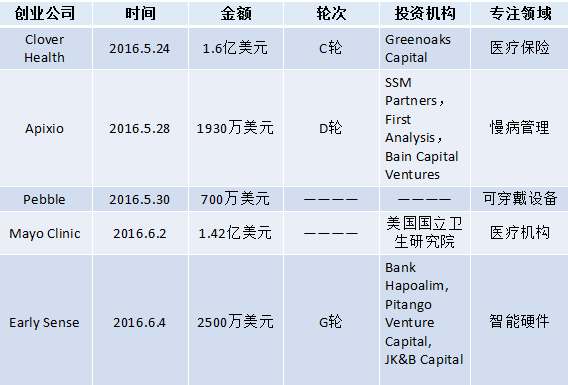
Overview of Funded Projects Abroad
·Clover Health——Medical Insurance+Big Data
Recently,OneClover Health, a health insurance company based in San Francisco, USA, secured $160 million in its latest Series C funding round. By integrating insurance with big data, Clover Health aims to identify potentially high-risk patients through database queries, reduce healthcare costs via disease prevention, and provide users with a better medical experience.
The investor in this round of financing is Greenoaks Capital,Sequoia Capital, Social Capital and Wildcat Ventures, AME Cloud Ventures, Casdin Capital, Nexus Ventures, Refactor Capital, and Spark Capital. To date, Clover Health has raised a total of approximately $285 million.
Clover Health, backed by Sequoia Capital, integrates health insurance with big data. By leveraging database searches to identify individuals at risk of developing diseases, it enables early intervention and prevention, thereby transforming the traditionally passive insurance claims process into a proactive one. While big data is currently a hot topic in the healthcare sector, with Clover Health combining it with insurance, the following project utilizes big data for chronic disease management in patients.
·Apixio——This platformProcess Data Using Cognitive Analysis
Apixio, a rising star in the medical big data sector, has raised $19.3 million in its latest Series D funding round. Apixio aims to provide healthcare institutions with a big data analytics platform to enable physicians to deliver more precise diagnoses and treatments. The round was led by SSM Partners, with participation from First Analysis and Bain Capital Ventures. To date, Apixio has raised a total of $41.88 million.
Apixio's Big Data PlatformAll data processing was conducted using cognitive analysis methods.,Cognitive analytics represents a new stage in the evolution of data analysis.Integrating New Technologies with the Healthcare Sector,Apixio unlocks the value of vast amounts of underutilized medical data, helping patients receive personalized treatment plans. Currently, many companies are capturing market share through technological advantages, and wearable devices are also a product of continuous technological advancement.
·Pebble – A company specializing in smartwatches
Pebble is a smartwatch manufacturing company and one of the pioneers in driving the commercialization of the modern smartwatch market. The company recently launched Pebble Core, a new product designed specifically for runners. Although Pebble is known for its smartwatches, the Pebble Core is a clip-on device that attaches to clothing. Compact in size, it is comparable to a pin or a keychain. It runs on Android 5.0 and features a comprehensive suite of built-in sensors, including Bluetooth, Wi-Fi, 3G connectivity, GPS, and a heart rate monitor. Additionally, it includes 4GB of storage space for saving offline music downloaded from Spotify.
Pebble Core can work in tandem with Pebble wristband watches to share data. Currently, the product’s crowdfunding price is $69, and within one day of its launch, the fundraising amount reached $7 million.
Indeed, Pebble raised $7 million in crowdfunding within a single day! This substantial funding amount indicates a growing number of running enthusiasts and an increasing emphasis on personal health. As a company specializing in smartwatches, Pebble has a deeper understanding of user pain points and designed its product in a clip-on style that can be attached to clothing, thereby meeting the needs of many running enthusiasts.

Pebble Inc. accurately identified users’ pain points and improved its design. This demonstrates the critical role that “precision” plays in the development of various endeavors. The following investment and financing case focuses on a precision medicine project.
· Mayo Clinic, ranked as the best hospital in the United States, will establish a biobank with funding from the National Institutes of Health
Recently, the U.S. National Institutes of Health (NIH) hasMayo ClinicA $142 million investment was made to advance the implementation of the Obama administration’s Precision Medicine Initiative. It is reported that,Mayo ClinicThe world’s largest biobank will be established within the next five years. The funds will be used to collect and store samples of known biological species and to build a biological sample repository.
Biobanks are crucial to advancing the U.S. Precision Medicine Initiative and serve as its cornerstone.Mayo Clinic states,Biobanks are crucial to advancing the U.S. Precision Medicine Initiative and serve as its cornerstone.
Mayo Clinic, founded in 1864, is a world-renownedA non-profit private medical institution founded by the Mayo doctors in Rochester, Minnesota, USA.Since the early 20th century, Mayo Clinic has gradually established a new model of medical management, medical philosophy, and treatment methods, becoming a multi-specialty collaborative care hospital and pioneering the residency training system. Currently, Mayo Clinic has built a comprehensive healthcare system that includes outpatient services, hospitals, medical research, and medical education institutions.
The United States Will Establish a Biobank. What? A Biobank?! It sounds quite sophisticated. In simple terms, it involves collecting and storing diverse biological information in a repository, where trained professionals analyze the collected samples to understand individual variations. Once these individual differences are thoroughly understood by the medical community, physicians can better prevent and treat patients’ diseases, thereby achieving precision medicine. The funding for this initiative is provided by the National Institutes of Health (NIH), demonstrating the Obama administration’s substantial support for the project.

Precision medicine enables personalized treatment, and all medical interventions rely on various medical devices. Currently, the rapid iteration of medical devices is enhancing patients’ hospital experience. Recently, an Israeli company specializing in digital health products has integrated sensor technology with hospital beds, providing significant convenience for physicians and caregivers.
·EarlySense—The product has received funding from Samsung, and its smart hospital bed enables physicians to monitor patients’ conditions in real time.
EarlySenseFounded in 2004Israel, is an R&DDigital HealthProduct's publicSi. EarlySense'sMain Productsfor<span st