

Brookdale Senior Living Inc. Prospectus: America's Largest Senior Housing Operator Unveils Comprehensive Service Portfolio and Growth Strategy
Brookdale Senior Living is the largest senior living services company in the United States. Founded in 1978 and headquartered in Brentwood, Tennessee, it primarily operates senior housing communities tailored to high- and upper-middle-income consumers, providing them with an active retirement lifestyle and high-quality personalized services.
Brookdale was listed on the NASDAQ in the United States on May 2, 1997, under the stock ticker BKD. Currently, Brookdale operates more than 1,100 senior living communities across 47 states, covering 80% of the U.S. population. It employs nearly 80,000 staff members and serves over 100,000 residents.
Brookdale’s mission is to provide users with a high-quality life in their later years. Brookdale not only strives to be the largest senior living company but also aims to be the best, which is its core business philosophy.
Brookdale initially focused on developing large, upscale urban retirement communities in major cities such as Chicago, New York, and Miami. The model for these early senior living communities drew inspiration from five-star hotels like Hyatt, Marriott, and the more recent Hilton. From the 1990s to the early 2000s, Fortress Investment Group, a well-known hedge fund management firm, became Brookdale’s largest shareholder with a 51% stake.
From the late 1990s to the early 2000s, with the rapid development of the elderly care industry, marked by the emergence of assisted living communities, Brookdale expanded its portfolio beyond previous models. New community types began to appear, including independent living communities, assisted living communities, and specialized memory care (Alzheimer’s) communities, gradually forming four major business segments.
1、Independent Living Community: Independent living communities primarily target seniors aged 70 to 80 who are capable of self-care.
2、Assisted Living Community: Assisted living communities primarily serve individuals aged 80 and above who, while free of major diseases, require assistance with daily living. These communities provide basic services including dining, recreational activities, housekeeping, maintenance, emergency response, short-distance transportation, and regular health check-ups. Additionally, residents can access other personal care services, medication management, and specialized care for Alzheimer’s disease (also known as senile dementia or geriatric dementia) through paid options.
3、Specialized Care (Dementia Care) Community: Primarily targeting elderly individuals with chronic diseases, those in postoperative recovery, and those with memory impairments. Professional nurses are stationed within the community to provide a range of nursing and medical services.
4、Continuing Care Retirement Community:Targeted at seniors who have recently retired and are currently self-sufficient, but wish to avoid the frequent relocation often necessitated by a future decline in their ability to perform activities of daily living. Among its offerings, the lifetime care business provides the “Peace of Mind” program, which ensures that users will receive care for the remainder of their lives, with guarantees even in the event of personal bankruptcy.
In addition, Brookdale also owns a wholly-owned subsidiary, Innovative Senior Care (ISC), which is engaged in rehabilitation, fitness, educational planning, and home health services.
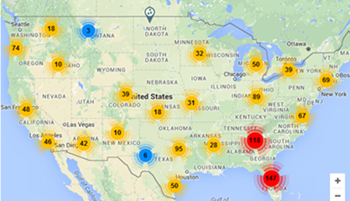
Distribution of Brookdale Senior Living Communities
In June 2005, Brookdale merged with Alterra Healthcare Corporation, which was then a leading company in the senior living industry, and went public with an initial public offering in November. In July 2006, Brookdale announced the acquisition of American Retirement Corporation (ARC), based in Nashville, Tennessee. At the time, ARC operated nearly 130 communities across the United States. Having been in operation since the 1970s, ARC’s portfolio spanned from Continuing Care Retirement Communities (CCRCs) to assisted living and independent living communities.and.
Fortress believes that the merger with ARC presents a strategic opportunity for Brookdale to propel itself to the forefront of the industry, not merely by expanding its scale, but by uniting two of the longest-operating and most successful senior living companies in the sector. Following the acquisition of ARC, Brookdale operates nearly 550 communities across 36 states.
In October 2009, Brookdale and Sunrise Senior Living reached an agreement under which Brookdale acquired 21 senior living communities from Sunrise. In October 2011, Brookdale completed its acquisition of Horizon Bay Retirement Living, gaining nearly 90 senior living communities across the United States. At the end of July 2014, Brookdale finalized its acquisition of Emeritus Senior Living, which was then the second-largest senior living operator in the United States.
As a result, Brookdale has become the only nationwide provider of comprehensive senior living solutions in the United States, operating more than 1,100 senior living communities across 46 states and reaching 80% of the U.S. population. The acquisition of Emeritus was highly significant for Brookdale: it not only propelled the company to become the largest senior living operator in the country, increasing its community count by 493 and rapidly expanding its footprint to 47 states, but also carried substantial importance for its brand promotion and development.
As of the end of 2015, Brookdale operated 959 self-owned and leased senior living communities with a total of 81,067 units; it also provided management and operational services for 164 communities comprising 27,353 units. By community type, Brookdale managed 130 retirement center communities (24,486 units), 915 assisted living communities (62,567 units), and 78 Continuing Care Retirement Communities (CCRCs) (21,367 units). Most of Brookdale’s communities are located on campus-style grounds or in areas with well-developed supporting facilities. As of the end of 2015, the company’s revenue composition was as follows: 38.8% from resident occupancy and management fees at self-owned communities, 48.7% from leased communities, 11.1% from Brookdale’s ancillary services, and 1.4% from management service fees provided to third-party companies.
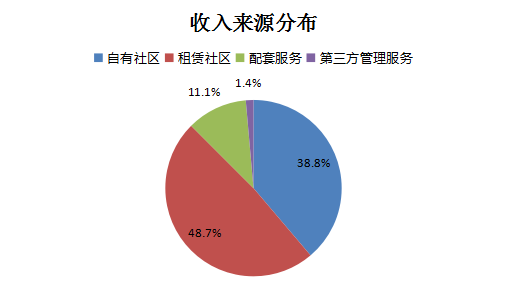
Regarding the company’s operating revenue and profits, as shown in the chart (data source: MarketWatch), based on Brookdale Senior Living’s 2015 annual financial statements released on February 16, 2016.
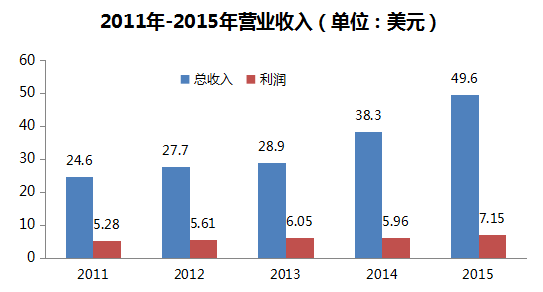
The chart clearly illustrates Brookdale’s operational performance in recent years. From 2011 to 2014, although revenue continued to rise, profit margins grew slowly, even experiencing negative growth from 2013 to 2014. Following the acquisition of Emeritus, the second-largest senior care company in the United States, in 2014, its financial performance saw a rapid short-term improvement. Despite having become the largest senior care provider in the U.S., its profitability still has room for improvement based on historical data.
In terms of fundraising, Brookdale completed two public offerings: its initial public offering on May 2, 1997, raised $51.7 million; and its second public offering on November 22, 2005, raised $211 million.
Currently, Brookdale’s communities consist of retirement center communities, assisted living communities, leased Continuing Care Retirement Communities (CCRCs), and private-pay CCRCs. Meanwhile, Brookdale also manages certain third-party or joint venture communities, holding equity interests in accordance with contractual agreements. Furthermore, Brookdale offers ancillary services, including outpatient therapy, home health care, personalized living assistance, and hospice care.
Retirement Center Community
This type of community is specifically designed to provide high-quality elderly care services for seniors aged 75 and older with middle-to-high incomes. A typical retirement center community includes both independent living and assisted living units, allowing it to offer tailored independent or assisted care services based on the specific characteristics of each unit and the needs of its residents. As of the end of 2015, 78.9% of units in retirement communities were independent living units, with the remainder being assisted living units. Retirement center communities are generally large, multi-story residential buildings featuring comfortable and well-equipped common areas and facilities, with an average of 188 units per community. Residents can choose between one-bedroom or two-bedroom apartments according to their needs.
Each retirement community provides residents with basic services, such as dining services, 24-hour emergency response, housekeeping, concierge services, transportation, and recreational activities. Most of these communities also offer additional services for an extra fee, which may include medication reminders, personalized medical care, check-in assistance, escort and companionship services. Long-term residents can freely choose the services they need within the scope of available offerings, except for specialized care. Residents who are physically or cognitively “frail” are typically placed in specific units or communities where they are assigned dedicated staff to assist with their daily living needs.
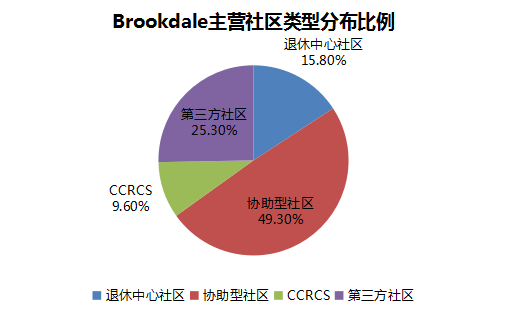
Retirement communities include those owned and leased by Brookdale, as well as retirement communities where Brookdale provides services to third parties or joint ventures. As of the end of 2015, Brookdale’s senior living center business segment comprised 95 continuing care retirement communities with 17,140 units, accounting for 15.8% of Brookdale’s total community capacity; it also provided management services to 35 communities with 7,346 units, representing 6.8% of the company’s total community capacity. Together, these retirement communities accounted for 22.6% of Brookdale’s total community capacity.
Target Audience: The primary target audience for retirement communities consists of middle- to high-income individuals aged 75 and older who desire or require a better living environment. The average length of stay for residents in retirement communities is 33 months. Many individuals relocate to retirement communities in other major cities to be closer to their children.
Assisted Living Community
Brookdale’s assisted living communities provide housing for residents, offering 24-hour assistance with activities of daily living for those in need, as well as services for older and frailer individuals. These communities offer customers both single-story detached homes and multi-story housing units, with most facilities having more than 50 beds.
Depending on the specific location, housing options may include: private studios, one-bedroom and two-bedroom luxury apartments, or units with separate rooms for one or two residents. There are even home-style accommodations that feature a living room, dining area, terrace or enclosed balcony, laundry room, personal care area, and a caregiver station.
Assisted living communities also include memory care communities. These independent assisted living communities are specifically designed for residents with Alzheimer’s disease and other forms of dementia, whose cognitive abilities are progressively declining and who require care, in order to ensure a certain quality of life. Memory care communities have 14 to 69 beds, and some are configured according to school-based standards, including an independent assisted living community.
In assisted living and memory care communities, all residents have access to essential health services, including ongoing health assessments, three daily meals plus snacks, specialized diets managed by registered dietitians, physician medical services, social and recreational activities, housekeeping, and personal laundry services. Some communities offer exercise programs specifically designed for residents with early-stage Alzheimer’s disease and other forms of dementia. Additionally, these communities provide extra premium paid services to deliver a higher level of healthcare for residents who are frail, have early-stage Alzheimer’s syndrome, or exhibit other symptoms of dementia.
Due to their declining cognitive abilities, residents in memory care communities typically require a higher level of personal care and services, resulting in higher monthly service fees. Specialized services include assistance with activities of daily living (ADLs), behavioral management, and activity programs, with the goal of providing a structured environment that helps residents maintain their functional independence for as long as possible.
As of the end of 2015, there were 820 assisted living communities with 53,504 units, accounting for 49.3% of Brookdale’s total community capacity; 95 communities participating in management services had 9,063 units, representing 8.4% of Brookdale’s total community capacity. These assisted living communities collectively accounted for 57.7% of Brookdale’s total community capacity. Among them, 571 communities, comprising 14,077 units, provided memory care services.
Target Population: The target population for assisted living communities consists of individuals aged 80 years or older who require assistance from two to three people for their daily activities. The average length of stay is approximately 20 months. Residents in assisted living communities are typically those in urgent need of care services or requiring immediate medical assistance at any time.
CCRCS (Continuing Care Retirement Communities)
Brookdale’s CCRC communities are large-scale developments that offer a variety of living arrangements and services tailored to different levels of physical condition and health. Most CCRCs include independent living, assisted living, and skilled nursing services, with some communities also providing memory care (Alzheimer’s care) services.
CCRC communities include leased CCRCs and third-party CCRC communities managed and operated by the company. As of the end of 2015, Brookdale owned 44 CCRC communities with 10,423 units, accounting for 9.6% of Brookdale’s total community capacity; 34 communities with 10,944 units were under the company’s management and operation, accounting for 10.7% of Brookdale’s total community capacity. These CCRC communities accounted for 19.7% of Brookdale’s total community capacity.。
Twenty CCRCS communities allow residents to pay a one-time “entrance fee” for independent living apartments, typically ranging from $100,000 to $400,000 or more, with partial refunds available under certain circumstances. The amount of the entrance fee is determined by factors such as housing type and unit size, the selected contract type, whether the contract includes life-care benefits (e.g., healthcare discounts), the refund amount and timing, and other variables.
These agreements are subject to various state regulations. In addition to the initial entrance fee, residents signing the contract must pay a monthly service fee to access certain facilities and services. Due to the upfront entrance fee, their monthly costs are significantly lower than those of standard rental arrangements. The refundable portion of the resident’s entrance fee is reimbursed within a specified number of months or days, typically upon termination of the contract, sale of the unit, or under other agreed-upon conditions, such as resale of the room or within 12 months after the resident vacates the unit.
As of December 31, 2015, the leased portion of CCRC communities, comprising three “entry-fee” CCRC communities with 1,172 units and 17 “entry-fee” CCRCs with 8,152 units under Brookdale’s management, accounted for 8.1% of Brookdale’s total community capacity.
Target Population: The target population for CCRC communities consists of individuals who require a variety of health services and seek a place to spend their later years in comfort. They typically begin by residing in independent living communities, and subsequently move into assisted living or skilled nursing communities as their needs change.
Brookdale Assisted Living Services (Ancillary Services)
Brookdale’s assisted living services currently provide community residents with home health care, therapy, education, and wellness programs.
These initiatives primarily focus on health and physical fitness, with the aim of helping residents maintain the highest possible level of independence. Through health fairs, workshops, and other interactive activities, these services provide numerous continuing education opportunities for residents and their families.
In terms of medical services, the company primarily provides physical therapy, occupational therapy, speech-language pathology, and home health services. Home health services are delivered as needed and include skilled nursing, physical therapy, occupational therapy, speech-language pathology, home health aide services, and social work services. In addition to providing these therapeutic and healthcare services within its own communities, the company also serves residents of other communities or those living outside senior living communities. These services may be covered by insurance or paid for out-of-pocket. Additionally, Brookdale offers hospice care in select regions. Compared with competitors, Brookdale’s ancillary services enjoy a distinct advantage due to its industry standing and extensive experience.
Management and Operational Services
Some communities managed by Brookdale are owned by third-party entities or unconsolidated joint ventures, in which Brookdale holds an ownership interest. These communities are operated under management and operating agreements, pursuant to which Brookdale charges corresponding management fees for the services provided.
As of the end of 2015, Brookdale provided management services for 164 communities comprising 27,353 housing units, accounting for 25.3% of the company’s total community capacity. Among these, 22 communities with 2,211 housing units were third-party owned, while 142 communities with 25,142 units were owned by joint ventures. These communities consisted of 35 retirement communities, 95 assisted living communities, and 34 Continuing Care Retirement Communities (CCRCs).
The senior care industry is highly competitive, with Brookdale Senior Living facing competition from numerous enterprises of varying sizes, including home health agencies, community service programs, retirement communities, and skilled nursing facilities. Furthermore, the construction of new senior housing projects has been steadily increasing in recent years. Generally, regulatory and other barriers to entry in the retirement center and assisted living segments are not significant. Consequently, the competition Brookdale may encounter could restrict its ability to attract residents or expand its business, thereby adversely affecting its revenue and profitability.
Currently, the main competitors among publicly listed companies are Five Star Quality Care and Capital Senior Living. Private competitors include Holiday Retirement, Life Care Services, Sunrise Senior Living, and a large number of non-profit entities.。
(1) A highly experienced and technically proficient management team. Brookdale’s senior management team possesses extensive experience in acquisitions, operations, and senior living asset management, including sectors such as senior housing, healthcare, and real estate.
(2) Diversified geographic scope of products and services, with high-quality, specialized communities. In particular, the acquisition of Emeritus, the second-largest senior living company in the United States, in 2014 expanded Brookdale’s senior living community capacity by two-thirds, added operations in ten new states, and significantly increased Brookdale’s scale, especially by opening up markets in the Western and Northeastern regions. As of December 31, 2015, Brookdale became the largest operator of senior living communities in the United States, with 1,123 communities across 47 states, serving nearly 108,000 residents.
(3) Diversified Product and Service Offerings: Capability to provide a wide range of health services. Currently, Brookdale boasts a diversified portfolio of senior living solutions, including retirement centers, assisted living communities, and Continuing Care Retirement Communities (CCRCs), catering to a broad spectrum of customer needs. Brookdale is one of the few companies in the senior care industry with such capabilities and the only national senior living operator at this scale. This product diversification and unparalleled coverage create additional sales opportunities, strengthening its competitive position in the senior care market.
(4) Economies of Scale: Brookdale’s substantial business scale enables it to maximize cost savings and enhance operational efficiency. As the largest provider of senior living services in the United States, its scale facilitates cost reductions through bulk procurement of goods and services, thereby lowering operating expenses. Meanwhile, Brookdale leverages the economies of scale generated by its nationwide platform and its robust professional expertise to consolidate national resources and compete effectively with local senior care companies.
(5) Extensive Industry Experience: Significant expertise in providing ancillary services. Brookdale’s ancillary services program offers a range of educational, health care, therapeutic, and home health services to residents of its retirement centers, assisted living communities, and Continuing Care Retirement Communities (CCRCs). A distinct competitive advantage is the integration of therapy clinics and home health agencies within its senior living communities, ensuring residents have direct access to necessary care. Furthermore, Brookdale is committed to expanding its ancillary services beyond its owned communities.
Brookdale has become the largest senior care company in the United States. Prior to 2014, its profit growth was sluggish, even experiencing negative growth at one point. Following the acquisition of Emeritus Corporation, its profit growth rate exceeded 10%. However, revenue growth remains the primary concern for this publicly traded company. Below are the key measures Brookdale has recently implemented to boost revenue:
While controlling operating costs, increase community occupancy rates and raise monthly service fees.
Brookdale plans to sustain its growth by continuously improving and optimizing community operations and intensifying marketing execution. To this end, Brookdale has established a multi-tiered marketing system that leverages call center resources across national, regional, and local markets to enhance efficiency and establish a rapid-response mechanism. Additionally, capitalizing on the positive momentum from its merger with Emeritus, the company is striving to improve operational efficiency and reduce operating costs.
Boosting Corporate Revenue Through Strategic Capital Allocation
Brookdale plans to allocate a portion of its capital toward value-enhancing improvements in its existing communities, such as redevelopment and renovation, as well as the replanning and repositioning of select communities. These initiatives aim to maximize the unique strengths of each community, thereby boosting their appeal and occupancy rates. Meanwhile, at appropriate times, Brookdale will selectively acquire existing operating companies, diversified investment portfolios, home healthcare agencies, and senior living communities to expand its scale. The company is also considering the acquisition of senior living communities it currently leases and manages to strengthen resource integration. Its acquisition strategy remains focused on products that provide significant complementary value to its market presence.
Enhance Brand Influence
Brookdale plans to build a highly recognizable national brand, creating market differentiation by improving community occupancy rates and growth rates, thereby enhancing its brand value. It aims to position Brookdale as a leader in the U.S. senior living industry and a provider of solutions for aging-related challenges. Brookdale seeks greater recognition of its brand among more users, partners, and talent sought by companies, fostering brand loyalty.
Innovative Product and Service Offerings, Including Brookdale’s Ancillary Services
Brookdale aims to continuously meet customer needs by offering innovative product formats and new solutions for senior living. For instance, rather than limiting these services to its owned senior living communities, Brookdale plans to extend them to individuals who prefer to age in place at home, thereby expanding its service reach beyond community settings to serve a broader population in need.