

StemCells Inc.: From $410 to $0.40 — A Biotech Pioneer’s Fall After Terminating Spinal Cord Injury Trial

StemCells
Biopharmaceutical Manufacturer
Extra! Extra! Affected by the termination of the mid-stage Pathway™ Study for spinal cord injury, the latest stock price of StemCells, Inc., a pioneer in U.S. stem cell research, has plummeted from its 2007 peak of $410 to $0.40, representing a decline of more than 1,000-fold.
Who exactly is StemCells, Inc.? What? You still don’t know! StemCells, Inc. is a leading player in the U.S. stem cell industry, holding more than 40 U.S. patents and over 170 patents worldwide. In 2007, its stock price once soared to more than $410. Therefore, the precipitous plunge in StemCells, Inc.’s share price came as a bolt from the blue—a shocking blow. Stunned? Is your curiosity piqued? No rush. What is StemCells, Inc., and how did it edge toward bankruptcy? Let me explain in detail.
StemCells: Pioneer of U.S. Stem Cell Research
The renowned StemCells, Inc., founded in 1988, was among the first companies to bring stem cell-based therapeutic products to market, primarily leveraging stem cell technology for the treatment of central nervous system (CNS) disorders.
The Company’s proprietary HuCNS-SC® (purified human neural stem cells) platform technology is currently under investigation for the treatment of chronic spinal cord injury (SCI). The Company’s experts believe that, with further research advancement, HuCNS-SC cells will ultimately be developed into commercial-scale “off-the-shelf stem cells,” labeled with patient-specific dosages, and marketed and sold as a ready-to-use, off-the-shelf pharmaceutical product.
With over two decades of pioneering research and innovation, StemCells is undoubtedly the leader in the field of human neural stem cell research and development. StemCells pioneered clinical trials of human neural stem cells in the United States and remains the only company to have established safety and preliminary efficacy data for stem cells to date. The company’s comprehensive patent portfolio includes groundbreaking technologies in cell biology and patents related to neural stem cells, covering composition of matter, manufacturing processes, and methods of use. The StemCells team comprises internationally renowned experts in stem cell biology, biotechnology, regenerative medicine, and cGMP manufacturing. Through their efforts, the company has achieved multiple breakthroughs in the field of stem cell research.
A Dramatic Plunge: Stock Price Falls from a Peak of $410 to $0.40
In 1992, the company was listed on NASDAQ, committed to value creation and sustainable business development by combining scientific rigor with clinical integrity.
In December 2008, the company, based in Palo Alto, received approval from the U.S. Food and Drug Administration (FDA) to conduct a Phase I clinical trial for Pelizaeus-Merzbacher disease, evaluating the safety of transplanting human neural stem cells as a treatment for the condition. The trial was launched in November 2009 at the University of California, San Francisco (UCSF) Benioff Children’s Hospital.
In April 2009, StemCells, Inc. acquired the UK-based company Stem Cell Science, consolidating its leading position in the field of human neural stem cell technology, expanding its proprietary cell technologies, and bringing additional experts and infrastructure to the company.
On July 18, 2014, StemCells, Inc. announced the completion of a $20 million financing round. “Based on our interim clinical data, two investors jointly provided us with $20 million in funding,” said Greg Schiffman, Chief Financial Officer of StemCells, Inc. “The proceeds from this financing will be used to cover operating expenses in 2015.”
In 2016, as the efficacy observed in the company’s mid-stage clinical trial for spinal cord injury began to decline, rendering the capital investment disproportionate to the therapeutic outcomes, StemCells announced on May 31, 2016 (local time) the termination of its mid-stage Pathway™ Study for spinal cord injury. Subsequently, the company’s stock price plummeted, currently hovering around $0.40 per share, a stark contrast to October 2007, when it exceeded $410 per share.
StemCells R&D Status
Due to their self-renewal capacity and ability to differentiate into various functional cell types, stem cells hold the potential to regenerate diverse tissues, organs, and the human body. Single-cell transplantation therapy represents a potential treatment approach that may restore damaged organs within the patient’s body.
The discovery of cells in the Middle Ages demonstrated that all living organisms are composed of cells. It was not until the late 1990s that Dr. Fred Gage, a member of the company’s Scientific Advisory Board, overturned the prevailing belief that brain neurons must last a lifetime, by showing through research that the adult brain can generate new neurons from stem cells. The identification and isolation of stem cells represent a relatively recent scientific advancement.
1. Preclinical Research
①Spinal Cord Injury (SCI)
In the United States, spinal cord injury is the second leading cause of paralysis, and there is still no effective treatment. Since 2002, numerous studies have shown that neural stem cells can be long-term transplanted at the site of spinal cord injury, where they differentiate into neurons and myelin-producing oligodendrocytes. Human neural stem cells have been demonstrated to form new myelin sheaths around damaged nerve axons and restore lost motor function.
In 2010, scientists from StemCells, Inc. and researchers at the University of California, Irvine (UCI) first demonstrated that transplantation of human neural stem cells could restore lost motor function, even when administered beyond the acute phase of trauma. When transplanted into mice with chronic spinal cord injury, controlled experiments showed that human neural stem cells had a significant and sustained capacity for recovery.
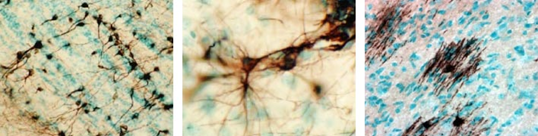
Differentiation of HuCNS-SC Cell Transplants in Mouse Brain Tissue
② Retinal Disorders
Two separate visual tests demonstrated that the transplanted cells exert robust protective effects on rod and cone photoreceptors, as well as long-term preservation of visual function. Consequently, the company is considering human neural stem cells as a therapeutic approach for retinal degenerative diseases such as retinitis pigmentosa.
③ Myelin Disorders
Studies have shown that when transplanted into animal models with defective neural myelination (shiverer mice), neural stem cells differentiate into mature oligodendrocytes and form myelin sheaths around host nerve fibers. StemCells uses the same approach to treat spinal cord injury. Preclinical studies indicate that after neural stem cells are transplanted into the injured spinal cord, they form myelin sheaths around axons in the damaged nerves, thereby restoring lost motor function.
④ Lysosomal Storage Disorders
Compared with the control group, mice transplanted with neural stem cells showed a significant reduction in cellular waste accumulation, which was statistically significant for protecting host neurons and delaying the progression of motor deficits.
⑤ Alzheimer’s Disease and Stroke
StemCells and its collaborators have demonstrated that HuCNS-SC cells can survive in the brain environment of animal models with Alzheimer’s disease, supporting the hypothesis that brain pathology—namely, the abnormal accumulation of so-called plaques and tangles—leads to functional impairment of healthy neurons. However, this study did not show that transplantation improved or restored memory in mice, and the company is seeking further funding to investigate alternative approaches.
Regarding stroke treatment, the company’s preliminary studies indicate that human neural stem cells enhanced functional recovery in mice after stroke. Compared with the control group, transplantation of these cells increased neovascularization and improved blood-brain barrier integrity.
2. Clinical Programs
Central nervous system (CNS) diseases and disorders afflict hundreds of thousands of people worldwide. The loss of CNS cells leads to neurological damage and disability, yet there are currently no effective treatments. Cell-based therapies offer a promising new approach to protecting or restoring CNS function, which could fundamentally improve prognoses for conditions involving all three components of the central nervous system—the brain, spinal cord, and eyes.
This project focuses on advancing the HuCNS-SC® (purified human neural stem cell) platform technology, leveraging it as a therapeutic approach for various central nervous system (CNS) disorders.
① HuCNS-SC® (human neural stem cells) HuCNS-SC Platform Technology
Human neural stem cells are manufactured by qualified personnel in a cleanroom production environment, in accordance with current Good Manufacturing Practices (cGMP). In 1999, scientists at StemCells achieved a medical first by isolating and expanding human neural stem cells. This groundbreaking research involved the prospective isolation of neural stem cell populations from human brain tissue using monoclonal antibodies against specific cell surface markers, followed by purification and expansion of these cells into a cryopreserved cell bank. These unmodified, high-purity cells are used for direct transplantation.
The company’s clinical approach is based on a vision to harness the therapeutic potential of neural stem cells by performing autologous transplantation of tissue-derived “adult” (non-embryonic) stem cells, which represents the most natural, promising, and feasible pathway.
Clinical Approaches (Three Types):
Homologous Cells
Application of Central Nervous System Stem Cells in the Treatment of Diseases of the Brain, Spinal Cord, and Eyes
Allogeneic Transplantation: Allogeneic Transplantation
Utilize cells from different individuals, rather than autologous or subject-derived cells from the same individual.
Scalable and Bankable “Stem Cells in a Bottle” Commercial Bottled Stem Cell Products
HuCNS-SC cells can ultimately be commercially produced and manufactured according to patient needs, becoming an off-the-shelf pharmaceutical product.
② Spinal Cord Injury: Clinical Program for Chronic Spinal Cord Injury
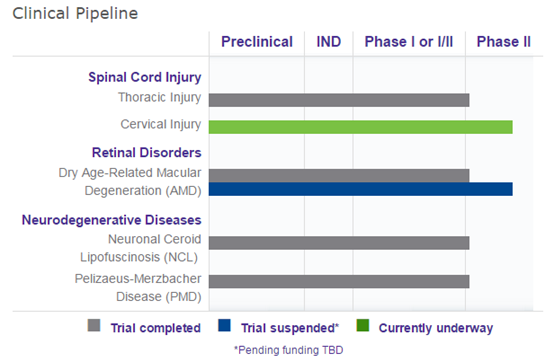
Phase I/II clinical trials for thoracic spinal cord injury have been completed. As most spinal cord injuries occur in the cervical region, leading to loss of function in both the arms and legs, a Phase II clinical trial in patients with cervical spinal cord injury, known as the Pathway Study, is currently underway. In April 2015, the company completed dosing for the first cohort of six patients in the Pathway Study. The primary objective of the first cohort was to assess the safety of cell therapy, while the second cohort is currently ongoing.
③ Age-related Macular Degeneration (AMD): Clinical Program
Phase I/II trials have been completed; the Phase II trial was suspended due to uncertain funding sources.
④ Pelizaeus-Merzbacher Disease: Clinical Program
Phase I trials have been completed, with a 12-month follow-up of patients conducted after the Phase I study. Congenital Pelizaeus-Merzbacher disease is the most severe form of the disorder, characterized by overt neurological dysfunction diagnosed shortly after birth. Post-transplantation outcomes demonstrated a favorable safety profile for the HuCNS-SC cell transplantation procedure.
⑤ Neuronal Ceroid Lipofuscinosis (NCL) Clinical Program
Phase I trials have been completed. Among the six patients followed up for 12 months postoperatively, five were enrolled in a separate four-year long-term study. This long-term study has now been concluded, with three of the five patients surviving over the four-year period.
3. Technical Advantages
① Pioneering Clinical Translation for CNS Disorders
StemCells’ central nervous system program is the most advanced neural stem cell clinical development initiative in the field. The company has clinical protocols involving the three major regions of the central nervous system—the brain, spinal cord, and eyes—that are either underway or have been completed.
② Homologous Approach Using Tissue-Derived “Adult” Stem Cells
Focus on the use of tissue-derived “adult” stem cells for homologous therapy (i.e., using central nervous system-derived neural stem cells to treat central nervous system diseases). Unlike embryonic or induced pluripotent stem (iPS) cells, tissue-derived stem cells do not require any modification prior to transplantation.
③ Strong Intellectual Property Position
The Company holds the most extensive and deepest comprehensive intellectual property portfolio in its field, comprising approximately 45 U.S. patents and 250 issued foreign patents.