

Analysys Reports Overseas Medical Tourism Enters Platform-Driven Era
According to the "2016 Special Research Report on China's Overseas Medical Tourism Market" released by Analysys, with the maturation of Chinese residents' healthcare awareness and the gradual formation of outbound travel habits, online overseas medical tourism is accelerating its development, entering a platform-based development stage, and the flow of market resources between domestic and international markets is also accelerating. Cross-border medical service providers represented by Chunyu International and Jiuyi 160 are leading the cross-border medical industry into the 4.0 era as industry practitioners and innovators.
Medical tourism essentially integrates healthcare and travel, offering consumers a new type of cross-border service product with one-stop solutions. According to research by the Stanford Research Institute in the United States, global medical tourism revenue is projected to reach 678.5 billion yuan in 2017, with China becoming a major source country for worldwide medical tourism.
China’s online medical tourism industry began in 2000, progressing from a primitive exploration phase led by a very small number of patients (2000–2010), to an initial club-style stage dominated by overseas medical institutions and catering to high-end consumers (2011–2014), and is currently entering a platform-based development stage driven by online medical tourism platforms leveraging internet technologies (2014–present).
I. The timing for the development of the online overseas medical tourism market is essentially ripe, with an increasingly diverse range of global medical products and destinations.
From a policy perspective, the government has actively provided guidance, making medical tourism a current hotspot in the development of both the healthcare and tourism industries. Regarding the healthcare environment, Chinese residents have demonstrated heightened health awareness, leading to sustained growth in healthcare expenditures. In terms of consumer habits, data from Analysys shows that in 2015, the number of outbound trips by Chinese citizens exceeded 120 million, with the online outbound tourism market accounting for 51.4% of the overall online vacation tourism market. The continuously growing outbound tourism market has cultivated a consumer base with an international outlook, proficiency in global languages, mature travel experience, and a preference for in-depth, themed travel, thereby laying a solid foundation for overseas medical tourism.
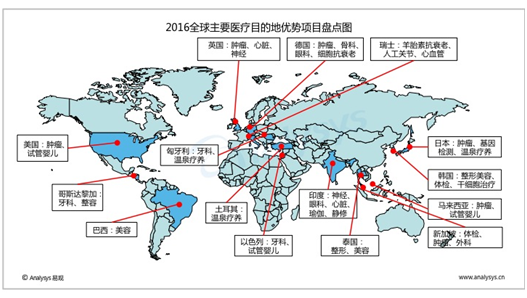
The global medical tourism industry is booming, with major destinations including the United States, Japan, South Korea, the United Kingdom, Germany, and Singapore. Key services offered include oncology treatment, in vitro fertilization (IVF), cosmetic surgery, health and wellness retreats, and spiritual healing.
The greatest advantages of overseas medical tourism destination products for the Chinese market are reflected in their leading medical technology and high cost-effectiveness. European and American countries rely on advanced medical technology, Japan and South Korea on high-quality services and cost-effective products, and South Asian countries on competitively priced offerings, making them the primary destinations for Chinese outbound medical tourism.
II. The overseas medical industry chain is becoming increasingly comprehensive, with the healthcare and tourism sectors each fulfilling their respective roles
Analysys believes that overseas medical tourism service providers, by connecting with market demand and medical tourism service suppliers at both ends of the industry chain, are gradually becoming the primary platforms for the exchange of domestic and international medical resources. Through the joint efforts of online healthcare companies, traditional overseas medical institutions, and online travel agencies, China’s overseas medical tourism industry chain is becoming increasingly refined.
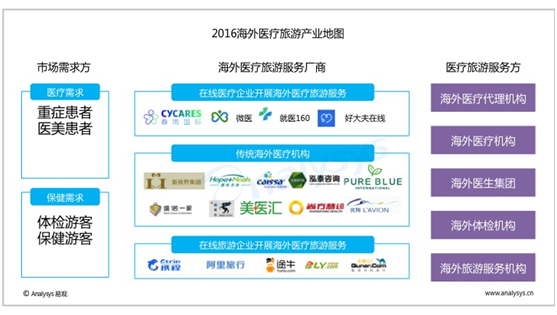
In the online medical tourism industry chain, online healthcare providers have emerged as the dominant force, driven by the professionalism of medical resources and their core appeal to consumers. Meanwhile, online travel agencies provide customized itinerary planning and cultural experience support to both online healthcare providers and consumers, with the two sectors integrating and complementing each other.
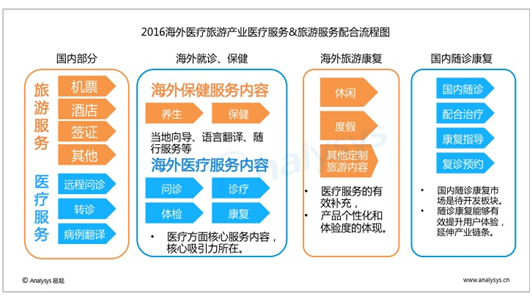
III. Iteration of High-End Healthcare: Online Medical Companies Such as Chunyu International Lead the Industry into the 4.0 Era
Analysys believes that the essence of online overseas medical tourism is an iterative manifestation of high-end healthcare. The development of high-end healthcare carriers has evolved through the 1.0 era—domestic special-needs outpatient clinics—catering to the needs of those born in the 1950s and 1960s; the 2.0 era—high-end private hospitals; the 3.0 era—overseas medical intermediary services—addressing the high-end healthcare demands of those born in the 1970s; and is now entering the 4.0 era—online cross-border healthcare—which offers high cost-performance ratio for the high-end healthcare needs of those born in the 1970s, 1980s, and 1990s.
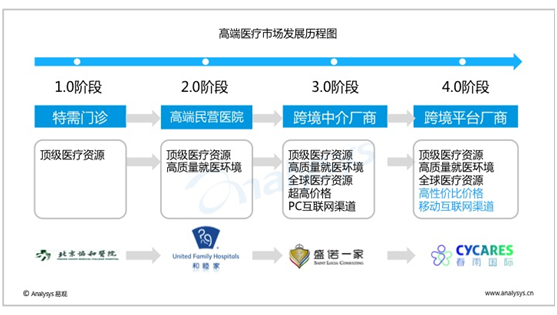
The latest generation of products, represented by online healthcare providers such as Chunyu International and Jiuyi 160, not only continues the tradition of previous three generations in offering consumers access to top-tier medical resources, high-quality care environments, and global medical resources, but also provides cost-effective solutions for a broader consumer base. Leveraging internet platforms, particularly mobile internet, these companies have established a highly transparent cross-border service system for consumers.
IV. Leverage online overseas medical platforms to build a comprehensive product portfolio and accelerate effective communication between domestic and international resources
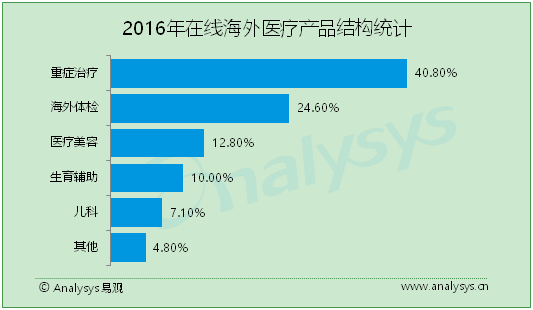
Based on consumer demand (i.e., from healthy individuals and those with severe conditions), the current overseas medical tourism product portfolio primarily consists of services such as treatment for severe diseases, overseas health check-ups, medical aesthetics, assisted reproduction, and pediatric care. Among these, treatments for severe conditions (e.g., cancer and tumors) account for the largest share at 40.8%, followed by health check-up products; together, they constitute more than half of the total market.
V. Online Travel Becomes an Important Component of Online Overseas Medical Tourism
As consumption among Chinese residents continues to upgrade, the search for high-quality healthcare resources has become a growing demand of the domestic middle class. Overseas destinations that combine premium medical resources with abundant tourism offerings have become key targets for expansion in both the healthcare and tourism industries. In response to these demands, domestic online travel agencies (OTAs) have launched medical-themed tour products, continuously designing and introducing overseas medical tourism packages that emphasize both standardization and uniqueness. The product portfolios of these OTAs primarily cater to non-critical patients, offering integrated medical tourism solutions that combine health wellness with leisure vacations. Major players in the online overseas medical tourism market include Ctrip, Tongcheng, Honghu Vacation, and U-Share International. Taking U-Share International, founded in 2006, as an example, its operational strategy focuses on meeting the personalized needs of high-end domestic clients by providing bespoke, butler-style services designed by senior travel experts. Currently, U-Share International’s products are mainly distributed across global destinations renowned for both tourism and medical resources, such as Switzerland, Singapore, Japan, South Korea, Spain, and New Zealand. Its offerings primarily cover two segments: overseas medical treatment and overseas health check-ups. High spending and high entry barriers characterize its most immediate consumer experience.
VI. The Future Is Here: Dual Upgrades in Consumer Demographics and Product Structure Become the Main Direction for the Development of Overseas Medical Services
(1) Shift in Consumer Base: Overseas Medical Tourism Products Offer Better Value for Money
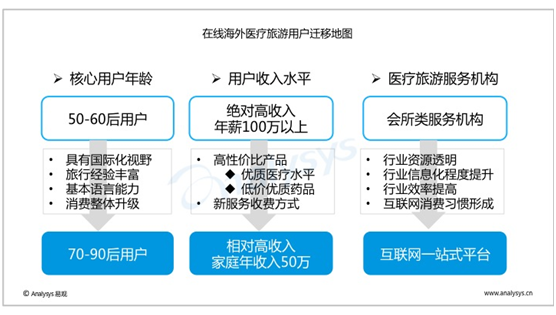
As consumers develop a more global perspective, accumulate richer travel experiences, and improve their basic language proficiency, the market structure is undergoing a subtle shift. The core consumer base is shifting toward relatively high-income individuals (with annual household incomes exceeding RMB 500,000) from the generations born in the 1970s, 1980s, and 1990s.
(II) Product Structure Upgrading, Internet Platforms Accelerating the Exchange of Domestic and International Resources
The overseas medical tourism industry is upgrading from a limited number of discrete, club-style offerings to systematic products guided by online healthcare providers. Represented by Chunyu International, mobile health companies are accelerating the exchange and communication between domestic and international resources by building internet platforms and establishing comprehensive product systems to increase the flow frequency of overseas medical resources within China.
(3) Capital Market Recognition: The Overseas Medical Tourism Niche Is Poised for Growth
In recent years, market demand for overseas medical tourism has become increasingly evident, and major industry players have gained growing recognition from investors. According to publicly available financing data compiled by Analysys, several comprehensive mobile health companies offering overseas medical services have secured funding smoothly and advanced beyond Series C rounds, with WeDoctor and JiuYi160 as representative examples. Vertical online providers specializing in overseas healthcare have also attracted significant attention from the capital market, leading to continuously rising valuations. Cross-border healthcare firms, exemplified by Chunyu International, are experiencing rapid growth and are currently seeking Series B financing.