

Huashukang: Leveraging Big Data for Intelligent Medical Insurance Cost Control
Excessive and irrational expenditures on medical services and pharmaceuticals constitute the primary challenge in controlling healthcare costs within China’s medical insurance system. Since the launch of the new healthcare reform in 2009, the government has implemented pilot programs across China, yielding successful models such as the Sanming Model and the Zhanjiang Model.
Currently, most healthcare reforms have focused on measures such as capping drug prices and regulating payment processes. However, in the face of information silos within hospitals, it is difficult to truly address the core contradictions without sufficient support from big data. The rise of medical big data technology has made intelligent health insurance cost-control audits possible, thereby spawning a market worth hundreds of billions.
Due to limitations in technical and maintenance capabilities, government agencies lack the capacity to build and maintain big data intelligent audit systems. Therefore, adopting the Public-Private Partnership (PPP) model to introduce professional companies with medical information backgrounds and jointly establish third-party service platforms for intelligent monitoring has gradually become the industry mainstream.
Facing a burgeoning market, Huashukang leveraged its technological advantages in big data to establish cooperative partnerships with multiple provinces and municipalities across China—including Xinjiang, Inner Mongolia, Shaanxi, Sichuan, Fujian, and Guangdong—within just two years, rapidly emerging as a market pioneer in the field of intelligent cost containment for medical insurance.
How Does Huashukang Leverage Big Data Technology to Assist the Ministry of Human Resources and Social Security and Insurance Companies in Cost Containment? With These Questions in Mind, VCBeat Conducted an Exclusive Interview with Dr. Wei Chen, Chief Information Officer (CIO) of Huashukang.

The healthcare insurance system exerts absolute control over funds. Leveraging this, it can be used to drive reforms in medical services and pharmaceuticals, thereby achieving the goal of coordinated reform across the three key sectors: healthcare, medical insurance, and pharmaceuticals (the “Three-Medical Linkage”). Wei Chen argues, “As the only quantifiable component among the ‘Three Medicals,’ healthcare insurance serves as the critical entry point for healthcare reform. Patients find it difficult to assess the quality of services provided by medical institutions, and apart from price controls, the government lacks more effective measures to regulate drug supply. Healthcare insurance, however, is different. As a quantifiable fund, any worsening deficit will quickly trigger a sense of crisis within the government. Using this as impetus to propel healthcare reform is therefore highly appropriate.”
“We found that because the level of pooling for medical insurance is too low, with many areas only pooling at the prefecture-level city or even county level, this has led to significant management and control issues in medical insurance, placing enormous pressure on the Human Resources and Social Security Bureau regarding medical insurance expenditures. It has become common for medical insurance funds to be stretched thin,” Wei Chen told VCBeat.
After identifying this issue, Dr. Wei Chen, who has a background in data technology, became determined to leverage big data to help the government change the status quo. Founded in 2014, Beijing Huashukang Data Technology Co., Ltd. is a technology-driven company focused on the broader health industry. It serves as an integrated big-data solutions provider, combining medical insurance, commercial insurance, healthcare services, and pharmaceuticals.
After thoroughly understanding and comparing the products of multiple competitors in the industry, Dr. Wei Chen and his R&D team developed a comprehensive Real-World Evidence (RWE) + Big Data solution. This integrated solution encompasses software, hardware, and big data applications, featuring two subsystem platforms: HCS and PROBIT. It is designed to resolve conflicts between medical insurance departments and hospitals during cost-control processes and address the drawbacks of excessively low-level pooling in medical insurance through enhanced data interaction.
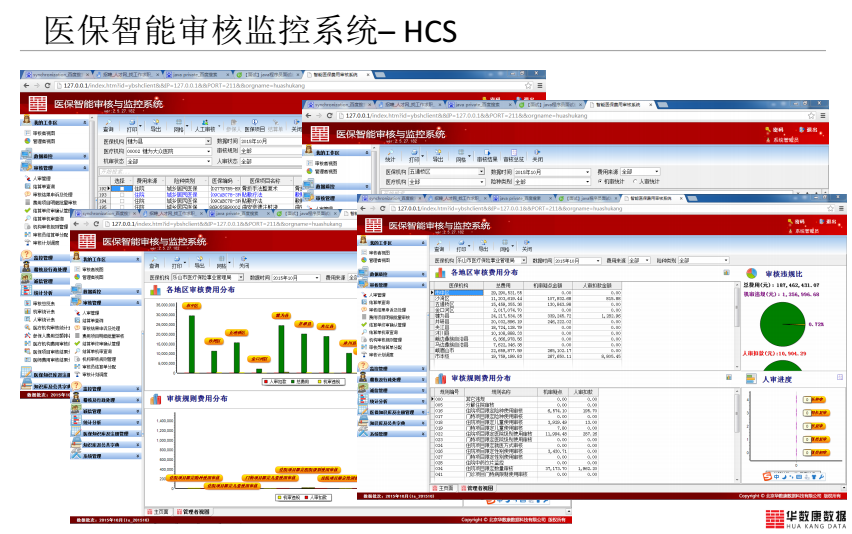
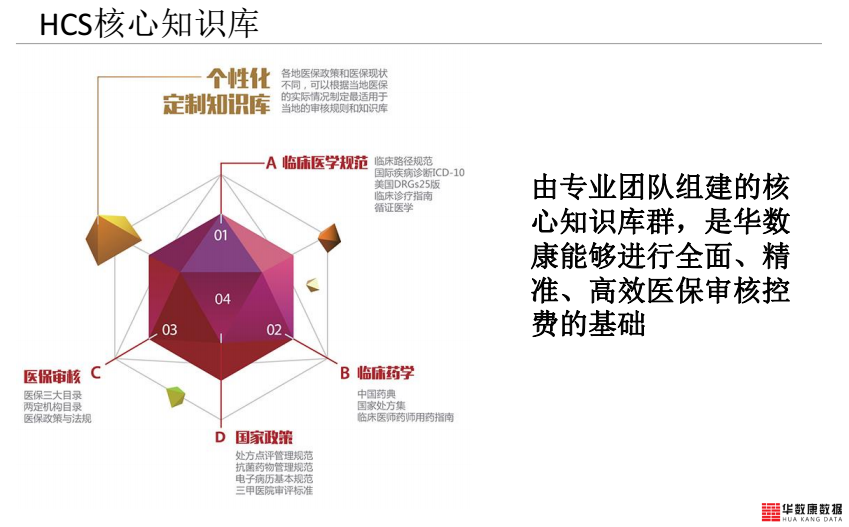
HCS System Platform: An intelligent medical insurance audit and monitoring system designed by Huashukang, integrating a clinical knowledge base, a medical insurance knowledge base, and an automated analysis algorithm engine. It serves as an expert-level information system to assist medical insurance agencies in conducting intelligent audits and monitoring of medical insurance expenses, and to support healthcare institutions in cost control and performance management.
The system enables end-to-end medical insurance audit management and intelligent monitoring, featuring pre-event prompts, in-process alerts, and post-event reviews. The knowledge base is the core of the HCS system, integrating clinical medicine, national policies, and the three medical insurance catalogs. This foundation allows Huashukang to conduct comprehensive, precise, and efficient medical insurance audits and cost control.
HCS applies relevant medical insurance claim review rules to conduct comprehensive automated scanning and auditing of settlement documents across the pre-, intra-, and post-payment stages. It identifies and flags non-compliant claims for prioritized manual review, performs statistical analysis on audit outcomes, and supports the improvement of the credit system by establishing comprehensive databases, including physician and insured member integrity repositories.
PROBIT is a precision cost-control management and analysis platform for medical insurance, independently developed and launched by Huashukang. Driven by underlying big data, it provides comprehensive solutions for top-level government design. Building upon the operational foundation of the HCS system, PROBIT enhances the coordinated management level of medical insurance funds along the vertical axis. Leveraging authentic databases, it conducts multi-variable, multi-dimensional, multi-perspective, and multi-layered comprehensive analyses of the utilization efficiency of both medical insurance funds and commercial insurance. This enables decision-makers to make objective and accurate judgments based on real-world conditions.
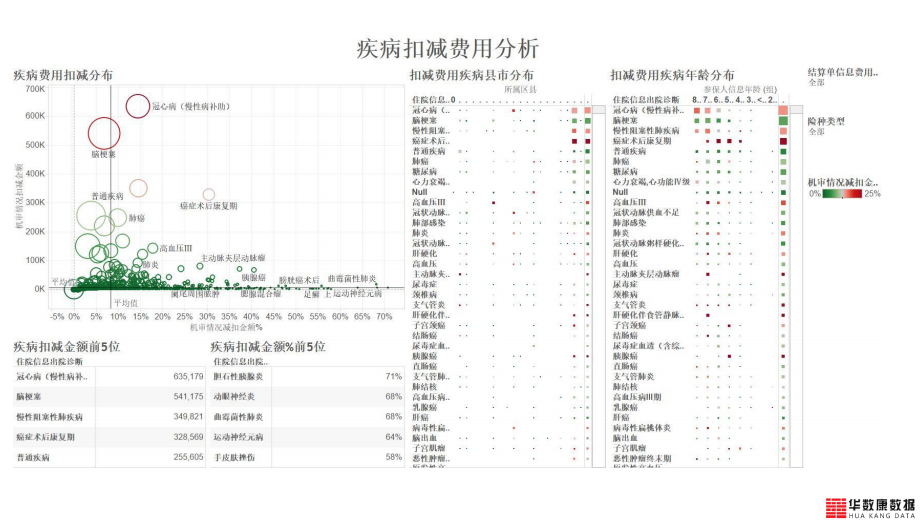
Taking the PROBIT system’s credit assessment of medical institutions—analysis of deducted fees—as an example, data analysis of health insurance fee deductions across all medical institutions in a given city or region enables real-time updates to the list of top-ranked institutions. This approach not only identifies which region has the highest total deduction amount but also determines which type of medical institution incurs the highest deductions.
The medical credit system established based on these data will assess the creditworthiness of each medical institution and annually replace those with excessively low credit ratings. This creates a competitive mechanism among medical institutions. Once this competitive mechanism is in place, it will prompt medical institutions to spontaneously reduce unreasonable medical claims payouts, thereby continuously improving the quality of care and ultimately leading to a reduction in health insurance expenditures for both the region and the individual medical institutions.
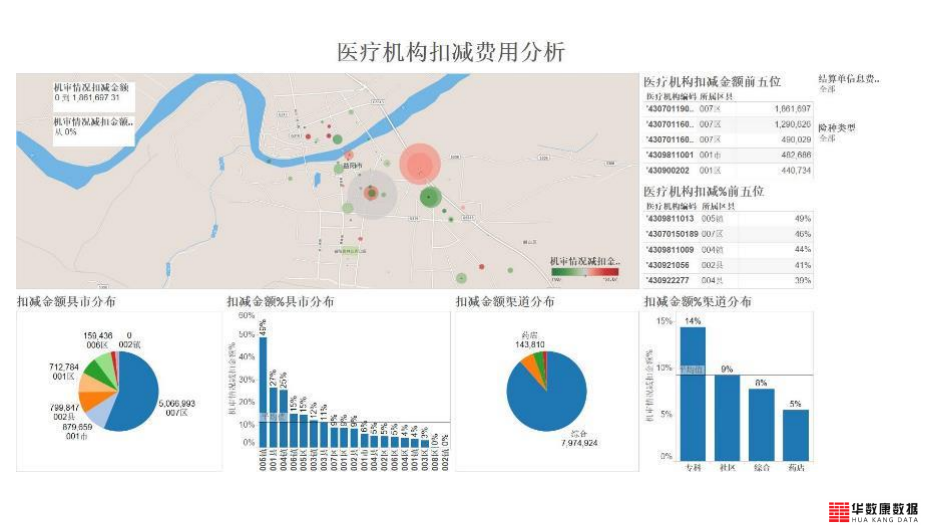
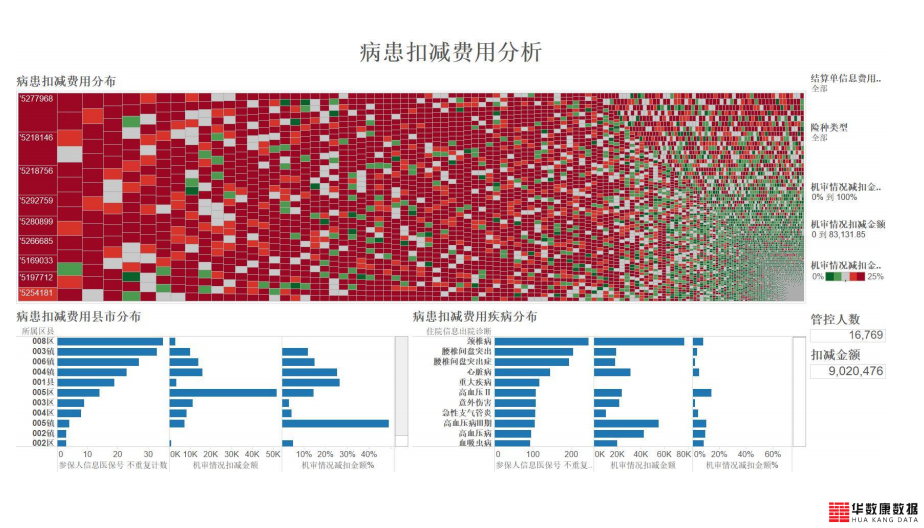
While the deduction of medical institution costs is merely one KPI setting within the PROBIT system, it also incorporates multiple key indicators related to patient creditworthiness, disease cost drivers, disease incidence rates, and the distribution of medical resources. These can be customized according to user needs, presenting precise big data analytics results in a modular and visualized manner to support top-level design.
Three Major Modules of the PROBIT Medical Insurance Precision Cost Control Decision Management System:
Credit Information for Healthcare Institutions - Analysis of Deducted Fees
Patient Credit Analysis
Disease Cost Driver Analysis
In 2012, the Chinese government launched the Critical Illness Insurance program. Following its introduction, the program rapidly expanded to cover major provinces and municipalities across the country. However, due to the unsustainable high operational costs, the Ministry of Human Resources and Social Security outsourced the administration of critical illness insurance to commercial insurers. Companies such as PICC (People’s Insurance Company of China) and China Life have since taken on the operation of more than 70% of the nation’s critical illness insurance programs.
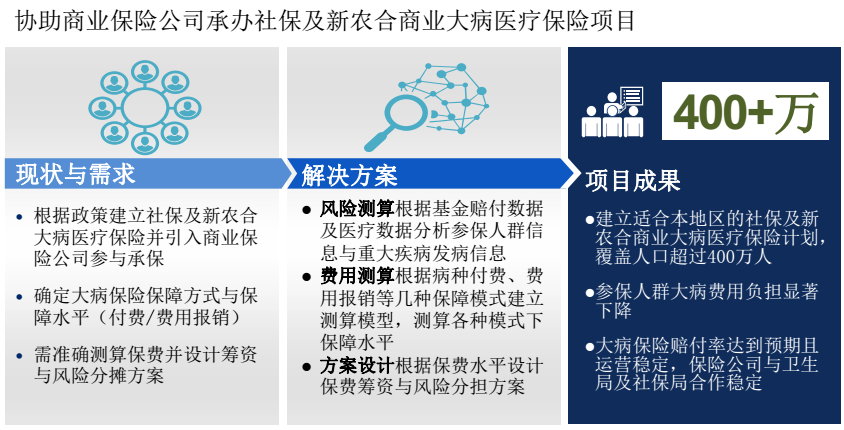
Wei Chen told VCBeat, “Social security authorities outsource critical illness insurance to commercial insurers. To lower or rationalize insurance premiums, commercial insurers need to take two actions: first, implement Huashukang’s cost-control system; second, focus on health management, which will be a key priority for Huashukang in the future.”
In addition, Huashukang’s commercial management services include the design of fund pooling schemes and welfare benefit plans. Regarding the currently popular Pharmacy Benefit Management (PBM) business, Wei Chen stated that Huashukang focuses on specialization and excellence rather than diversification. In fact, medical insurance cost containment is inherently part of PBM operations. There is no need to hype concepts by drawing on U.S. experience; as healthcare reform deepens and drug pricing mechanisms become more refined, PBM will naturally emerge as a mature solution.