

Yinjiang Technology's Journey and Innovations in Smart Healthcare
In the field of healthcare informatization, or more popularly under the concept of smart healthcare, if ranked by market appetite, Yinjiang Co., Ltd. would certainly have a place.
Yinjiang Shares, one of the first batch of companies listed on the ChiNext board in 2009, has seen its total revenue grow from RMB 500 million at the time of listing to RMB 2 billion. Its medical informatics business, one of its three core segments, has a long history; as early as 2005, Yinjiang Shares launched China’s first mobile ward-round system at Zhejiang Sir Run Run Shaw Hospital. Among the uses of funds raised through its IPO was a RMB 40 million project for the development and industrialization of key digital healthcare technologies.
The healthcare segment's revenue also maintained rapid growth,2008year550610,000 yuan,2014Age has exceeded3100 million yuan, however in2015There was a year-on-year decline of approximately 30%. During the same period, hospital clients for Yinjiang Smart Healthcare’s related solutions and products decreased from70Developed to1000Multiple.
Amid the surge in healthcare informatization driven by national policies such as tiered diagnosis and treatment, as well as the practical needs of hospitals, Cheng Ren, Chairman of Yinjiang Smart Healthcare Group—a subsidiary of Yinjiang Shares—recently gave an exclusive interview to VCBeat, outlining the company’s strategic logic in the smart healthcare sector.
Internet Hospitals, District Health Commissions, and the Internet of Things: A Three-Pronged Convergence
Amidst a pile of company profiles and product brochures, Cheng Ren stated that Yinjiang Smart Healthcare is primarily divided into three sectors: Internet Hospital, Regional Health Information System, and IoT-based Healthcare.

Cheng Ren
Regional health informatization primarily connects hospitals, community health service institutions, disease control centers, blood stations, and other entities to establish a regional health data center, facilitating health administrative departments and local governments in achieving regulatory and service objectives. The Medical Internet of Things (MIoT) mainly integrates various information sensing devices with the internet to enable intelligent resource allocation, such as systems for infant anti-theft, outpatient infusion, and sterile supply department management.
Compared to these two sectors, the Internet Hospital occupies a more central position within Yinjiang Smart Healthcare.
Yinjiang Internet Hospital Architecture
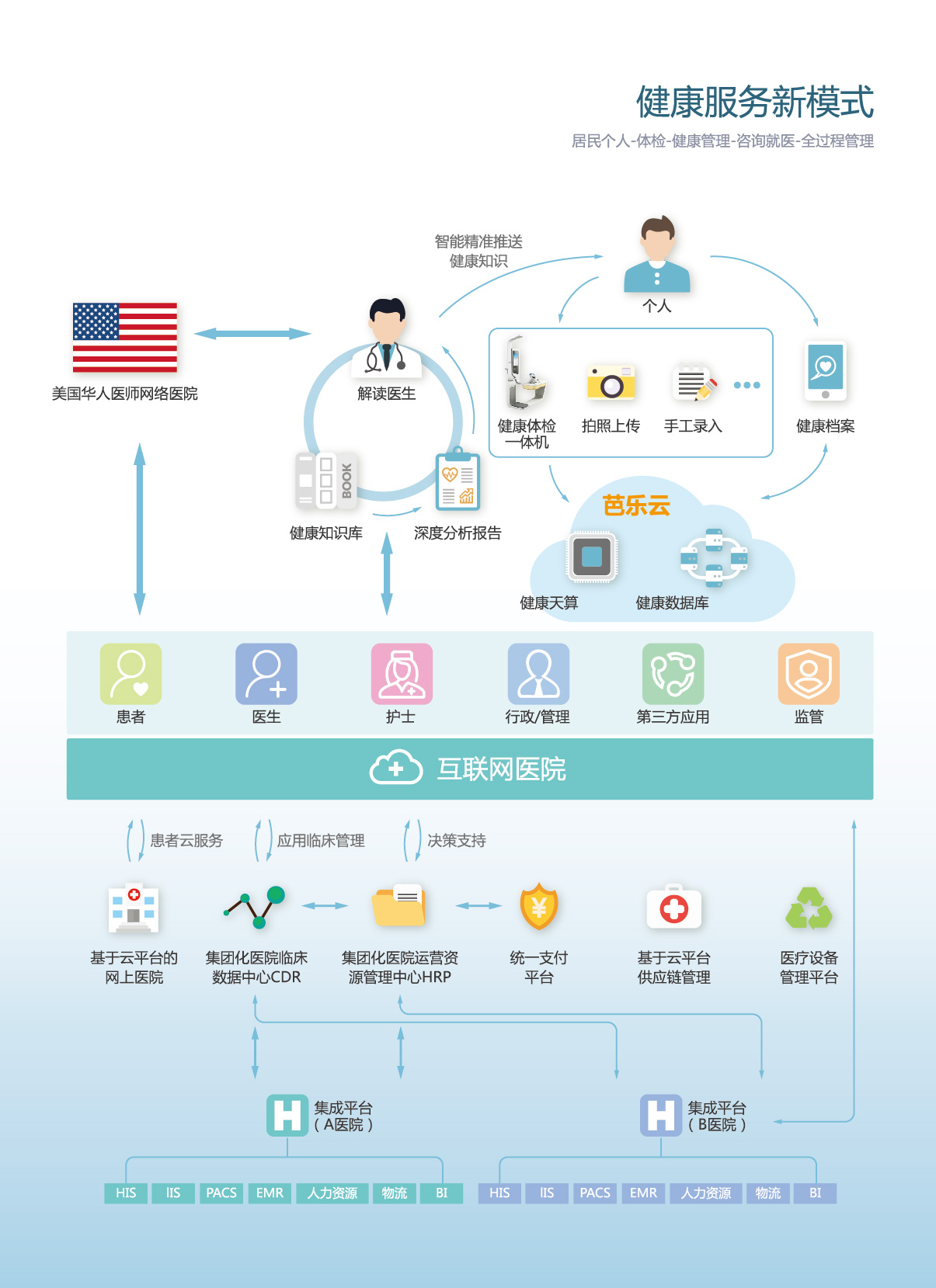
In fact, until four or five years ago, Yinjiang was still mainly engaged in hospital-related business.HIS、LIS、PACSsolutions for various modules. For a long time, data across these disparate systems has remained completely siloed and isolated.
For instance, height and weight data reside in one module, imaging data in another, and laboratory test results in yet others. When comprehensive patient data are required or for scientific research projects, data must be extracted separately from various modules (often from different vendors), which is highly inconvenient.
Whether driven by the needs of hospital administrators or by clinical and research requirements, once initial informatization has been achieved across various modules, the integration of data from all modules to support interoperability becomes a natural progression. Thus, from2014From the year before last to last year, Yinjiang Medical vigorously developed its integration platform over these three to four years.
In addition to internal hospital needs, data access demands from external sources are growing rapidly. These include not only the needs of hospital presidents and department heads during business trips, but also the requirements for interfacing patient medical records, laboratory test results, and imaging data in the context of tiered diagnosis and treatment, telemedicine, and two-way referrals.
“The myriad factors driving ever-growing demand from outside hospitals are propelling the industry forward, and at this juncture, the optimal solution is internet-based healthcare. This is somewhat akin to urban road traffic: internet-based healthcare serves as a bridge. While the surface appears to be conventional asphalt roads, the underlying structure and methodology are fundamentally different. As more bridges are built, seamless connectivity between the two banks of the river is achieved,” said Cheng Ren.
Thus, the cloud computing platform based on in-hospital information integration has assumed the role of the core hub for internet hospitals. Leveraging the data cloud platform operated by Yilianwang, a subsidiary of Yinjiang, effective interactions can be facilitated among hospitals, healthcare professionals, and between doctors and patients.
Moreover, the data cloud platform offers unlimited scalability, a major trend that encompasses two directions:One is2B, Engaging in business between hospitals; one is2C, such as providing follow-up services, and even enabling third-party applications to leverage this for insurance and regulatory purposes, thereby helping hospitals build aApp Storeof imagination.
Personal Health Cloud Integrated with Hospitals
Yinjiang Medical has also launched a personal health services cloud platform—Bale Health, which is operated and promoted by its subsidiary, Jiankangbao Internet Company.
Compared to pure internet healthcare companies, traditionalHITA clear advantage of the out-of-hospital medical service platforms launched by vendors is that, leveraging their existing business foundation, they can more easily integrate with in-hospital information systems and medical services, which is crucial for establishing a closed loop of patient care.
Currently, the services provided by Health Bao Company cover a wide range of areas, including health monitoring, chronic disease rehabilitation, and health education.The entry point is to use a device that measures20All-in-one health kiosks (Health Huts) that measure multiple health indicators are deployed in residential communities, community hospitals, and other locations. Through these devices, users can promptly upload their health data to a cloud platform to establish personal health records, with real-time feedback delivered directly to their mobile phones.APPand WeChat Official Account.
If any abnormalities are detected, the system will automatically push the data to the Bale Health database and generate a comprehensive health report, complete with physician interpretation. If clinically indicated, it will recommend referral to relevant specialists, allowing users to directly schedule appointments with these doctors on the Cloud Health Platform, thereby delivering a one-stop service.
For certain special cases, the physicians interpreting health reports on the platform may also refer patients to the Chinese American Physicians Network Hospital, which is2015In 2015, Yin Jiang participated in the investment and establishment of a high-end medical resource service project, which includes hundreds of top-tier hospitals in China and physicians from the American Chinese Medical Association, comprising over a thousand members.
A Talent War Brewing? Then Set Up More Companies
Currently, the Yinjiang Internet Healthcare segment comprises more than nine subsidiaries, including MedLinkNet for the cloud computing platform and Health Bao for personal health services.U.S. ChinaHumanDoctor Network Hospital, remote hospitals also have subsidiaries. In addition,As a founding shareholder, Yinjiang alsoParticipated in the establishment of Daren Life Insurance.
In addition to establishing separate subsidiaries by specialty to enhance management efficiency and achieve rapid strategic positioning in key areas, another critical factor is the consideration of team stability, particularly that of the core team.
As various forms of capital flock to healthcare hotspots, particularly companies employing internet-style tactics that aggressively poach talent by offering doubled or even multiplied salaries, the industry has widely heard whispers of a talent bubble fueled by this capital frenzy.
Cheng Renyi also stated that changes in the external competitive landscape have necessitated a shift in management approaches. In contrast to the company’s large-team, high-investment operational model in the transportation sector, the healthcare field is trending toward specialization and refinement. Small teams better align with market competition demands; therefore, the group has established a series of subsidiaries for these small teams to fully mobilize team enthusiasm and accountability.