

New Eyes Becomes Sole 'Triple-A Student' Among 120 Healthcare Firms Entering NEEQ Innovation Layer, Files Prospectus
The long-awaited tiered system for the New Third Board has finally been implemented. According to the regulations, tiered management of listed companies will be formally implemented starting June 27, 2016. The plan includes three parallel tiering criteria, and listed companies can enter the Innovation Layer by meeting any one of them.
Data from Choice shows that among the 7,394 companies listed on the New Third Board, a total of 957 have been admitted to the Innovation Tier. Of these, 120 are in the healthcare sector, with Xin Yanguang becoming the only company in the healthcare industry to simultaneously meet all three criteria for the Innovation Tier.
Essence:“Classified services and tiered supervision” represent the future policy direction of the National Equities Exchange and Quotations (NEEQ) Company. “Tiering” is essentially “classification,” which involves categorizing enterprises according to specific criteria and grouping those meeting the same criteria into a single category.
Significance:
1. The National Equities Exchange and Quotations (NEEQ) system boasts broad coverage, encompassing mature enterprises with strong profitability, micro-profit companies in their growth phase, and loss-making startups in their early stages. Tiered management better facilitates diversified financing options for listed companies; in the future, when introducing a series of new financing instruments such as corporate bonds, convertible bonds, and preferred shares, these can be considered separately within the internal markets of different tiers.
2. The rapid expansion of the NEEQ (National Equities Exchange and Quotations) has resulted in listed companies characterized by small scale, high technology, early-stage development, and niche market focus, which collectively heighten investment complexity. Tiered classification helps mitigate information asymmetry, enabling diverse investors to identify suitable investment targets, enhance market liquidity, and manage investment risks.
3. In addition to providing better differentiated services to companies in the Innovation Tier, regulatory and entry thresholds will be strictly enforced in accordance with established standards. High standards, akin to high barriers to entry, have a positive impact on corporate valuation, market potential, and market position;
4. For the entire NEEQ market, internal tiering serves as a further refinement of the multi-tiered capital market system, and the interconnectivity and flow among its various tiers provide valuable exploration for the future implementation of board transfers.
Completed equity financing through stock issuance (including simultaneous stock issuance upon application for listing) in the past 12 months, with an amount of no less than RMB 10 million; or the proportion of actual trading days in the last 60 transferable days is no less than 50%.
The prerequisite for companies listed on the National Equities Exchange and Quotations (NEEQ) to enter the Innovation Tier is that they must meet at least one of Criteria 1, 2, or 3, while simultaneously complying with common standards, corporate governance, and other regulatory requirements.
According to data from Choice, a total of 957 companies met the criteria for inclusion in the Innovation Tier, accounting for 12.94% of all companies listed on the New Third Board. These Innovation Tier companies contributed 32.45% of the New Third Board’s total operating revenue, 42.09% of its net profit, and 45% of its market capitalization, while representing 46.10% of financing activities since 2015, fully demonstrating the high-quality characteristics of the Innovation Tier.
Among them, 463 companies met Criterion I, 535 companies met Criterion II, and 160 companies met Criterion III. Multiple companies simultaneously met two criteria, and 21 companies met all three criteria.
Additionally, as of June 12, according to the latest data from Choice, there were a total of 483 listed companies in the healthcare sector on the National Equities Exchange and Quotations (NEEQ). Among those with publicly available data, 47 companies met Standard 1, 38 companies met Standard 2, and 35 companies met Criterion 3.
Among them, New Vision became the only company in the healthcare industry to simultaneously meet all three criteria for the Innovation Tier.
According to VCBeat, Shanghai New Eye Medical Device Co., Ltd. is a comprehensive enterprise integrating medical investment, management, and the development and production of new digital hospital equipment. Established in 2005, the company is a high-tech enterprise specializing in the research and development, manufacturing, sales, and services of products related to medical digitalization, medical informatization, and intelligent healthcare.
The company’s core business encompasses integrated medical digital products, including: Digital Imaging Communication in Medicine (DICOM) storage and transmission systems; comprehensive digital hospital solutions; 3D surgical microscope recording systems; surgical microscope recording systems; wireless PACS transmission management for ophthalmology; digital retrofitting systems for fundus cameras; slit lamp image processing systems; 3D medical imaging diagnosis and teaching systems; and remote consultation and teaching systems.
and provide healthcare IT solutions, information system integration solutions, digital operating room solutions, emergency clinical information systems, intensive care unit (ICU) information systems, perioperative anesthesia information systems, and integrated operating room solutions to support the construction and development of hospital informatization. VCBeat will continue to monitor this company and publish a special feature on it in subsequent reports.
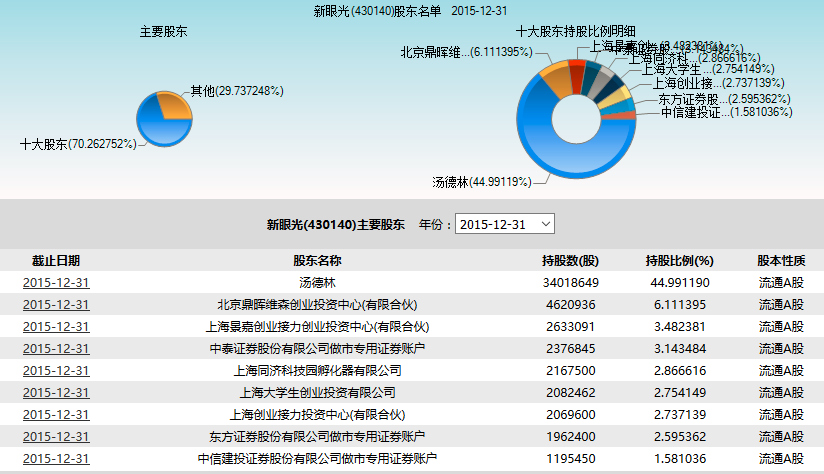
Shareholding Structure of New Vision (Data Source: China Finance Network)
Analysts believe that following the tiered restructuring, companies in the Innovation Tier will inevitably attract ample market attention, while trading in the Base Tier will become further frozen. Under these circumstances, the Innovation Tier, being closely watched by the market, will naturally present trading opportunities, whereas the Base Tier, largely overlooked by most investors, still harbors substantial investment opportunities. This scenario is particularly advantageous for investment teams with private equity (PE) backgrounds.
On the other hand, as the Innovation Tier imposes stringent information disclosure requirements, corporate costs have increased under the spotlight of this tier. Companies are not only required to disclose preliminary earnings reports and all external investments, asset purchases or sales, and external guarantees in their announcements. Meanwhile, the China Securities Regulatory Commission (CSRC) will enforce stricter oversight on stock trading by directors, supervisors, and senior executives, alongside mechanisms such as a violation point system and public disclosure regimes, all of which constitute additional burdens.