

DoctorHui Files IPO Prospectus: Dubbed the 'YY + Zhihu of Medical Community'
When mentioning “Doctor Hui,” many may find it unfamiliar, but within the medical industry, most professionals are well-acquainted with “Medical V Live.” Medical V Live is a new type of physician community that leverages popular features such as real-time bullet comments and focuses primarily on mobile live streaming. Compared with traditional PC-based physician community platforms, Medical V Live addresses the new needs of physicians in the mobile internet era. “To validate our business model and gain first-mover advantage, we initially chose to develop based on WeChat,” said Wang Jue, CEO of Medical V Live. “Doctor Hui is the standalone app we launched after validating the model and rapidly accumulating users. On June 21, the Medical V Live app ‘Doctor Hui’ officially entered public beta testing.”
The Medical V Live Streaming (Yishenghui) team was established in September 2015, and the “Medical V Live Streaming” platform officially launched in late November of the same year via WeChat and PC channels. After more than six months of operation, Medical V Live Streaming evolved from a vertical physician community into a comprehensive one, maintaining a frequency of four medical-themed live broadcasts per day. Since its launch, the platform has attracted nearly 200,000 registered physicians. Currently, each live session averages over 1,500 participating physicians, with daily active users exceeding 10,000 and cumulative video-on-demand views surpassing one million. Starting in June, Medical V Live Streaming significantly expanded its medical live-streaming content and diversified its broadcast formats, coinciding with the launch of its dedicated app, “Yishenghui.”
In the Mobile Internet Era, Physician Community Products Emerge in Full Force
In the view of Wang Jue, CEO of Yixue V Live (Doctor Hui), the rapid rise in popularity of physician communities is primarily driven by the introduction of two policies: “multi-site practice” and “tiered diagnosis and treatment.” “The multi-site practice policy has granted physicians greater professional freedom, with many recognizing the value this autonomy brings. Meanwhile, tiered diagnosis and treatment requires establishing a hierarchical structure comprising both specialist and general practitioners, necessitating increased division of labor and collaboration among physicians in the future,” said Wang Jue. As a result, a platform facilitating communication and interaction among physicians has become essential.
In fact, physician communities in the mobile internet era began to emerge in 2014. Early community-based products in the industry include China’s Yilian and Qingying Medicine, as well as international platforms such as Doximity and Figure 1. Wang Jue told VCBeat, “Physicians have diverse needs in the mobile era. Currently, the features and services offered by each community platform vary; in other words, each existing product addresses only a subset of these needs. Our mobile live-streaming service caters to another segment. This is an era characterized by the rise of many competitors.”

Currently, domestic physician community products in China are facing three major issues:
First, the content generation mechanism within physician communities presents a significant challenge; the current user-generated content (UGC) model is ill-suited to China’s national context. Wang Jue stated, “The model of leveraging physicians’ fragmented time for content creation is not viable in China, as domestic physicians face extremely tight schedules and have little personal time available for such interactions. Consequently, they lack both the motivation and the institutional mechanisms to generate content.”
Secondly, facilitating interaction between senior and junior physicians within medical communities presents a significant challenge, as the medical profession is characterized by a rigid hierarchy that makes cross-level communication difficult. According to Wang Jue, physician social interactions can be categorized into three types: interactions among senior physicians, interactions between senior and junior physicians, and interactions among junior physicians. “Interactions among senior physicians lack internet-specific attributes; they primarily rely on offline networks and do not require online platforms. While there is some demand for anonymous socializing, such as venting frustrations, among junior physicians, the conversion value of such interactions is extremely low. Therefore, the core need in physician communication lies in exchanges between senior and junior physicians. However, given the clearly defined hierarchical structure of the medical community, cross-level interaction remains a major hurdle.”
Furthermore, onboarding senior physicians with limited internet usage habits into physician communities poses a significant challenge.
From the perspective of addressing the aforementioned challenges, mobile live streaming serves as a more effective entry point. First, mobile live streaming overcomes the lack of habit among senior physicians for fragmented online communication. “Many senior physicians are not accustomed to fragmented interactions, but they do have a habit of delivering lectures. The format of mobile live streaming essentially moves the classroom online, which aligns well with their practices.” Second, mobile live streaming establishes a virtual teacher-student relationship, facilitating interaction between senior physicians and junior doctors.
Clear business model: Building the YY + Zhihu of the medical community
Currently, Medical V Live (Yishenghui) primarily conducts live broadcasts via OBS on a permanently free basis. Within less than six months, it rapidly established its own live streaming studios in seven cities, including Beijing, Shanghai, Guangzhou, Nanjing, Xi’an, Chongqing, and Hangzhou, inviting experts to host live sessions. Each day, physicians need only use the Yishenghui app to engage in real-time interactions with leading specialists. After the live broadcasts, they can continue with fragmented text-and-image exchanges and submit targeted questions to the experts. “We position ourselves as the YY.com plus Zhihu of the medical community,” Wang Jue told VCBeat.
Regarding the business model, Wang Jue stated that monetization would primarily target pharmaceutical companies in the early stages. “We essentially migrate pharmaceutical companies’ offline conferences online, which not only reduces costs but also enables more precise targeting of physician audiences.”
About the Team
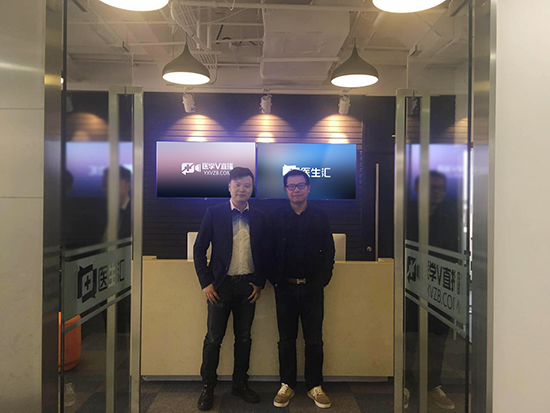
Pictured are Wang Jue (left) and Wang Siyang (right)
Both founding partners of Medical V Live (Yishenghui) graduated from Boston University. They are close friends and both possess extensive backgrounds in the pharmaceutical industry. Founder Wang Siyang hails from a private conglomerate in Zhejiang Province; his family holds controlling stakes in two of China’s top 100 listed pharmaceutical companies: Kunming Pharmaceutical Group (600422) and Jianmin Pharmaceutical Group (600976). Driven by an entrepreneurial dream, Wang was unwilling to simply take over the family business passively and sought to prove himself through startup ventures. In September 2015, he joined forces with his partner Wang Jue to establish Medical V Live. Coincidentally, Co-founder and CEO Wang Jue also comes from a family with deep roots in the pharmaceutical sector. The two founders share unique insights into China’s pharmaceutical and healthcare market. Within less than six months, the company rapidly completed its angel and Pre-A funding rounds, raising tens of millions of RMB in total.