

How Capital-Favored TCM Clinics Are Embracing the Internet: Business Models, Digital Integration, and Recent IPO Filings
The prices of healthcare service assets experienced a significant surge in late 2015, with frequent supportive policy guidelines and public endorsements by the Premier widely regarded by investors as key driving forces. Among various healthcare service targets, traditional Chinese medicine (TCM) clinics have become one of the most closely watched subsectors.
In December 2015, China’s first law on traditional Chinese medicine (TCM), the Draft TCM Law, officially entered the legislative process. On February 14 of the following year, Premier Li Keqiang placed special emphasis on deploying the industrial upgrading of TCM at the State Council’s executive meeting. On February 26, the State Council formally issued the Outline of the Strategic Plan for the Development of Traditional Chinese Medicine (2016–2030), marking the first national-level development plan for TCM.
In fact, several large-scale chain TCM clinics have already undergone a round of capital acquisition. For instance, Zheng An and Heshuntang both successfully secured tens of millions in financing, while Gushengtang was rumored to have obtained $100 million in Series B funding from foreign investors. Additionally, Nanjing Junhe just announced in mid-June that it had secured 50 million yuan in Series B financing. Furthermore, multiple “TCM + Internet” companies, including Jin Huatuo, have also obtained financing.
However, while the traditional Chinese medicine (TCM) sector is experiencing significant popularity, it also faces operational challenges. According to industry insiders, 60% of TCM clinics are unable to generate profits, with insufficient patient foot traffic being a widespread issue among clinic operators.
On June 18, the “First Traditional Chinese Medicine (TCM) Clinic Development Forum,” initiated by TCM clinics including Shenzhen Heshuntang, Nanjing Junhetang, Shanghai Taikuntang, and Yunnan Sheng’ai TCM Clinic, and hosted by Heshuntang and Jin Huatuo, was held in Shenzhen. How do operators of these mainstream TCM clinics perceive the obstacles to development, and what models and experiences did they share?
Heshun Tang Launches Traditional Chinese Medicine Insurance First
Although the overall operational performance of the traditional Chinese medicine (TCM) clinic industry remains less than ideal, a number of enterprises have begun to emerge with seemingly validated business models, even though the initial development and subsequent replication and expansion of these models required considerable time.
Wang Liyuan, Director of Hangzhou Fang Huichuntang, stated that when the first clinic opened 15 years ago, daily revenue was less than RMB 5,000, and the 2,000-square-meter facility saw very few visitors. Fifteen years later, annual outpatient visits have reached 1 million. However, while the first clinic opened in 2001, the second did not open until 2009!
Shenzhen Heshuntang has been in operation for over a decade. According to Song Gang, its founder and chairman, the company was established in March 2005 with a focus on premium traditional Chinese medicine (TCM) decoction pieces and TCM diagnostic and therapeutic services. Adopting a business model centered on “premium herbs, renowned physicians, distinguished clinics, and reputable manufacturing,” it has opened nearly 82 chain TCM clinics across the Pearl River Delta region, including Shenzhen, Guangzhou, Dongguan, Foshan, Huizhou, Zhongshan, and Hong Kong. Additionally, it operates 32 premium TCM pharmacies within institutions such as Shenzhen Traditional Chinese Medicine Hospital, Dongguan Traditional Chinese Medicine Hospital, and Sun Yat-sen University Cancer Center, achieving an annual outpatient volume of 800,000 visits.
He Shun Tang also announced its plan to expand the number of its mainland China stores to 100–150 within two years. Its “central pharmacy + metro-line clinics + app-based appointment” model in Hong Kong has gradually matured, entering a phase of rapid expansion; the number of its TCM clinics in Hong Kong will increase from 11 to 30 by the end of this year. On the morning of the 18th, He Shun Tang officially opened a TCM diagnosis and treatment center in Bao’an Qianhai, covering an area of 1,600 square meters.
Heshuntang is one of the few TCM clinics in the industry that owns its own factory for processing Chinese herbal medicine slices. Song Gang initially distributed TCM herbal slices from Japan’s Tsumura & Co., and later established his own production base for Chinese medicinal materials to create premium proprietary herbal slices, with a production capacity of over 700 varieties.
More significantly for the industry, Heshuntang has taken a substantive step forward in integrating Traditional Chinese Medicine (TCM) with insurance.
Heshuntang’s collaboration with China Life Insurance began as early as 2012, and this June, the jointly developed “Heshun Pediatric TCM Product” was finally launched—marking the official breakthrough in the integration of traditional Chinese medicine and insurance!
This product is available for online purchase on the China Life Health Platform. For children under 18 years of age, a premium of RMB 400 provides one year of coverage including up to RMB 20,000 in hospitalization medical expense reimbursement, up to RMB 100,000 in accidental disability compensation, and three complimentary consultations at Heshuntang Traditional Chinese Medicine Clinic (with each consultation fee capped at RMB 100). Additionally, the China Life service team is planned to be stationed at Heshun stores.
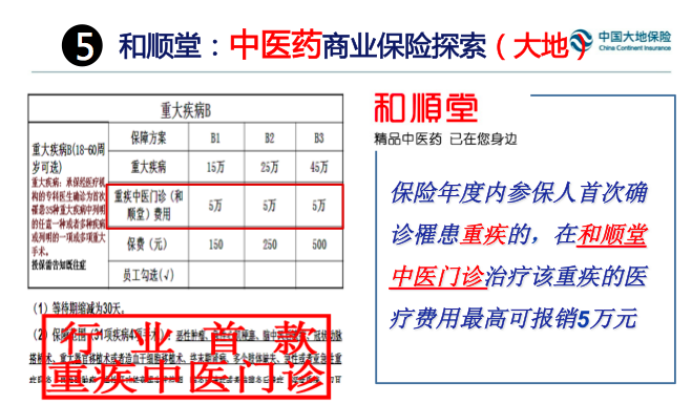
Furthermore, Heshuntang and China Continent Insurance jointly launched the first traditional Chinese medicine critical illness insurance product.
Taikuntang: A Specialized Therapeutic Model for Diseases with Advantages in Traditional Chinese Medicine
Compared with many TCM clinics of "grassroots" origin, Taikuntang appears much more upscale and prestigious.
Wu Dasheng, Chairman of Taikuntang, humbly stated, “Taikuntang was the first to transform a traditional Chinese medicine (TCM) clinic into a TCM hospital (Shanghai Taikuntang TCM Hospital), but this was only because others were unwilling to do so, as it is not profitable.” To some extent, however, being backed by Shanghai Green Valley Group has given Taikuntang the financial strength to undertake such long-term investments.
Based in Shanghai, Tai Kun Tang has independently established seven traditional Chinese medicine (TCM) hospitals and clinics in Shanghai, Jiangsu, Zhejiang, Sichuan, and other regions, five of which have been designated as medical insurance-covered providers. Its distinctive advantage lies in its positioning as the TCM clinical platform for Luye Group. By applying selection criteria that prioritize areas where TCM demonstrates expertise, conventional Western medicine faces limitations, therapeutic efficacy is superior, and market potential is viable, Tai Kun Tang has developed specialized diagnostic and treatment approaches as well as proprietary protocols across multiple medical disciplines.
Taking the “Yu’s Syndrome Differentiation Diagnosis and Treatment Protocol” for Polycystic Ovary Syndrome (PCOS), developed and implemented by Tai Kun Tang, as an example—PCOS being one of the most significant causes of female infertility—this therapeutic approach has pioneered a unique and comprehensive system encompassing theoretical framework, treatment principles, prescriptions, and herbal formulations both domestically and internationally. It has established its own dedicated clinical team, and its efficacy has gained recognition within the medical community both in China and abroad. For instance, Professor Nan Ser, Chair of the International Society of Hyperandrogenism and PCOS, stated, “I must acknowledge that your treatment outcomes are possibly the best in the world.”
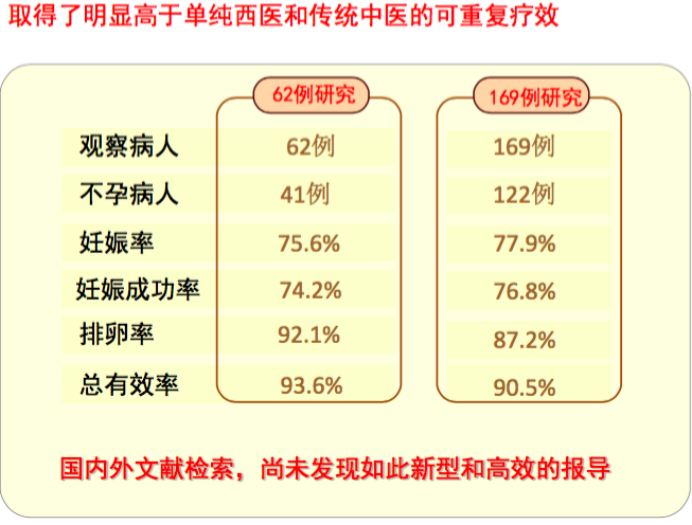
Source: Speech materials by Wu Dasheng, Chairman of Taikuntang
Jin Huatuo: Entering TCM Clinics with SaaS Software
While offline services at traditional Chinese medicine (TCM) clinics form the cornerstone of industry development, integrating with the internet is the key issue to achieving more rapid growth across the entire sector.
When the O2O concept was at its peak, traditional Chinese medicine (TCM) also became a focal area for entrepreneurial ventures. VCBeat once compiled statistics on 18 "TCM + Internet" projects that received investment in 2014 and 2015, with total financing exceeding RMB 300 million. Among these, 10 projects belonged to the tuina massage sector, while 8 fell under the category of conventional TCM practices. In terms of business models, 10 projects adopted the O2O model.
Dai Yunfeng, founder and CEO of Jin Huatuo, revealed to VCBeat that evidence has shown the door-to-door O2O model in the field of traditional Chinese medicine (TCM) is unviable, at least in the short term. Not only has it failed to improve efficiency, but it has even proven counterproductive. He argues that the Online-and-Offline (OAO) model centered on in-person visits is not merely about driving online traffic to offline services, as seen in typical O2O models. Instead, it facilitates bidirectional flow between online platforms and offline TCM clinics, thereby building a TCM service platform better aligned with the mainstream internet-savvy population. This approach represents a more suitable “TCM + Internet” model for the current landscape.
Dai Yunfeng hopes that in the future, seeking medical care will be as simple as air travel: hospitals and clinics will serve merely as venues, akin to airports; physicians and nurses will function like pilots and flight attendants; physician groups will operate like airlines; and companies such as Jin Huatuo will act as service-linking platforms based on unified standards.
Of course, this is merely a long-term vision. Dai Yunfeng believes that there are still three major challenges facing Jin Huatuo, or indeed the entire TCM clinic industry.
First, there is a shortage of TCM practitioners, with only over 330,000 licensed TCM physicians nationwide. Jin Huatuo’s strategic focus is to leverage TCM SaaS software as an entry point, providing information systems for TCM clinics, recruiting as many TCM physicians as possible, and offering them patient management tools and prescription dispensing services, thereby allowing physicians to concentrate solely on clinical care.
However, while the existing pool of physicians is undoubtedly important, the primary source of growth will stem from the national goals for cultivating traditional Chinese medicine (TCM) talent. These goals aim to “basically establish a TCM workforce by 2030, comprising 100 National Medical Masters, 10,000 renowned TCM practitioners, 1 million licensed TCM physicians, and 10 million skilled vocational personnel.” This incremental addition of more than 600,000 TCM physicians will be the decisive factor determining the success or failure of various platforms.
The second major challenge lies in the significant difficulties associated with database construction and analysis during the informatization of Traditional Chinese Medicine (TCM). This requires three key elements: large data volume, continuous longitudinal data, and an evaluation system grounded in TCM logic and semantics. For instance, although the Guangdong Provincial Hospital of Chinese Medicine possesses 20 million patient records, the data lacks continuity, exhibiting a disconnect between in-hospital and out-of-hospital information. Furthermore, Western medicine evaluation frameworks cannot be directly applied to its analysis.
Data is not divided between Traditional Chinese Medicine (TCM) and Western medicine, but the underlying logic is. For the same symptom of headache, Western medicine may attribute it to vasoconstriction, while TCM may diagnose it as Shaoyang headache, Shaoyin headache, or Qi-stagnation headache. These theoretical systems must be constructed independently; otherwise, TCM risks becoming merely substitutable by Western medicine.
The third issue is the level of trust between patients and physicians. The efficacy of Traditional Chinese Medicine (TCM) often remains unclear and difficult to articulate, which has significantly contributed to a growing lack of trust in TCM among younger populations. To rebuild or strengthen this trust, reliance on data-driven evidence of therapeutic efficacy is essential, going beyond mere patient gestures of appreciation such as presenting silk banners to physicians.
Therefore, at the current stage, platforms combining Traditional Chinese Medicine (TCM) with the Internet primarily serve the existing client base of offline clinics and physicians. Achieving genuine online-to-offline patient referral will require a considerable period of incubation.
Dai Yunfeng also disagrees with Chunyu Doctor’s initial volume-driven strategy in expanding its network of affiliated clinics, as the model for effectively integrating online and offline services to generate greater value has not yet been successfully established. Currently, the Jin Huatuo platform has 1,600 traditional Chinese medicine (TCM) practitioners, and 80 TCM clinics are using its SaaS system. Among these, the company operates one self-owned TCM clinic and manages three others under entrusted operation, in order to refine its OAO (Online-and-Offline) model.
On "Internet + Traditional Chinese Medicine"
What You Want to Know,Everything is available here.
Event Registration Link:http://h5.welian.com/event/i/MTMyNTY=
Scan or long-press the QR code to register now
Event Inquiry: Mr. Li 023-67685030
I. Cloud TCM: Embracing the Boom in TCM Clinics with SaaS
II. Investment Opportunities in “Traditional Chinese Medicine + Internet” from a Policy Perspective
IV. Dajia TCM: Leveraging Big Data to Build an Essential Tool for TCM Practitioners
V. Liudu TCM: Building Brands for Doctors and Physician Groups via the Internet