

Gem Files IPO Prospectus Following $12M Funding to Advance Blockchain Solutions for Healthcare
For many within the medical community, the term “blockchain” remains relatively unfamiliar. However, research into blockchain technology has already sparked a wave of enthusiasm in the financial sector. Blockchain offers exceptionally high data security, which is particularly critical in the era of big data. Capital and entrepreneurs have begun flooding into this field, and blockchain-based solutions are continuously emerging to address many long-standing issues in the healthcare industry. Seizing this opportunity, VCBeat is launching a series of articles on blockchain to present readers with a comprehensive overview of the blockchain business landscape.
Gem was founded on January 22, 2014. It is a blockchain company that has completed five rounds of financing from 21 investors to date, raising a total of $12 million. The most recent round was a $7.1 million Series A financing completed in January 2016, led byPelion Venture PartnersLead investor. The company is headquartered in Venice, Italy. The founder isMicah Winkelspecht,Ken Miller。
Gem Health: Providing Blockchain Technology Solutions for the Healthcare Industry
The healthcare industry stands to benefit significantly from the adoption of blockchain technology solutions, and Gem is precisely engaged in this endeavor. Gem Health focuses on optimizing supply chains and enhancing medical data management, committed to leveraging blockchain technology to provide the healthcare sector with efficient means to safeguard patient data and enable its real-time sharing across various departments.
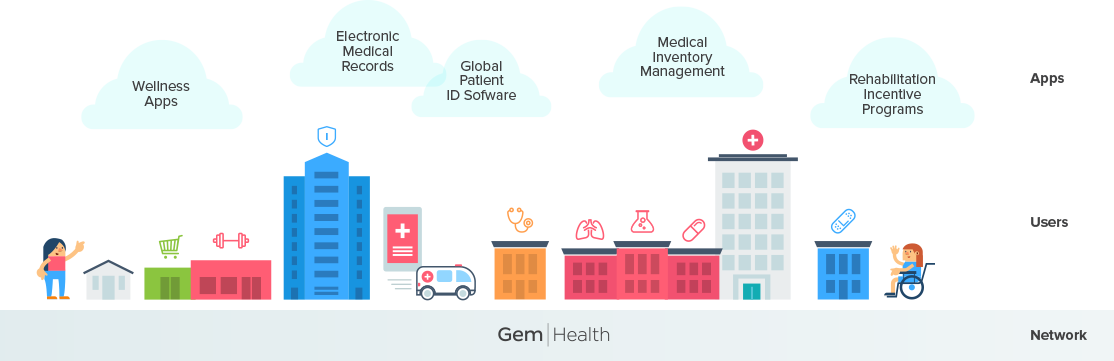
Recent anonymous malware attacks and cybersecurity threats in the healthcare industry have drawn significant attention, signaling that it is time for change. Gem Health claims its primary objective is to build a blockchain ecosystem for the global healthcare industry—a solution that precisely meets the sector’s current needs.
It is highly encouraging to see that Gem Health has far transcended the traditional boundaries of using blockchain technology merely for storing patient records and other medical data. Its efforts in patient education have garnered significant attention, and the Ethereum network is also fostering innovative healthcare applications.
Gem CEO Micah Winkelspecht stated to the media:
“Blockchain technology enables secure and efficient data exchange. For the healthcare industry, this allows hospitals, insurance companies, and laboratories to connect seamlessly in real time to share information, without concerns about data breaches or tampering. We are discussing how to integrate healthcare information transmitted across different companies and institutions into a unified system. Our comprehensive collaboration with healthcare companies is truly exciting.”
“Identity issues are critical. In blockchain, personal IDs are managed through public/private key pairs, with individuals using their private keys to generate digital signatures for authorizing and signing transactions on the network. We have engaged in discussions with numerous banks for over a year on leveraging blockchain technology to address identity challenges. Blockchain provides robust data integrity, enabling its application not only in the financial sector but also across various other commercial domains. Many systems rely on data to drive business decisions.”
“We conduct on-site education for stakeholders, helping them study application cases and build their own systems, from initial proof-of-concept to final product implementation. As I mentioned, we are seeking applications of data beyond financial transactions, as enterprises are increasingly adopting blockchain technology to safeguard data integrity.”
Gem possesses a core platform for blockchain application solutions, comprising four products: Gem Identity, Gem Logic, Gem Data, and Gem Network. Together, these four products form a complete blockchain application ecosystem. Gem is collaborating with numerous companies in the healthcare sector, with its data sharing and security platform playing a pivotal role from prototype development to market launch. Gem’s CEO has revealed a sustained special interest in the healthcare industry.
Moreover, Gem provides highly convenient tools for recording medical data on the blockchain, with GemOS serving as the foundational operating system to accomplish this task. The GemOS operating system offers the healthcare industry a streamlined approach to securely storing data and enabling real-time cross-departmental sharing.
Finally, the Gem team seeks to explore the role of blockchain in the Internet of Medical Things (IoMT). Medical devices such as wearables, pacemakers, and hearing aids generate vast amounts of critical data. How to securely collect and verify this data is an area worthy of exploration. Gem has entered into non-disclosure agreements with numerous healthcare companies, aiming to ensure the security and portability of medical health data.
Blockchain Accelerates Its Penetration into the Healthcare Sector

Blockchain technology was first applied in the financial sector, but recent interest has shifted toward non-financial domains such as healthcare, media, the Internet of Things (IoT), and IT infrastructure. In these areas, industry infrastructure requires upgrades to ensure data integrity and independence.
Many recent financial reports have accelerated the hype around blockchain technology, yet they also claim that progress in the healthcare sector has been relatively slow. However, Winkelspecht points out that the healthcare industry was among the earliest adopters of blockchain technology.
Blockchain is highly suitable for various segments of the healthcare industry. Many critical data sets often cannot be processed quickly and cost-effectively, yet these challenges can be addressed through blockchain’s distributed ledger technology.
The healthcare industry is exploring applications for blockchain technology: establishing information networks to facilitate data exchange among providers, leveraging health data to improve population health, and implementing incentive systems within IoT devices to reward healthy behaviors, among other use cases.
Critical data, such as patient records and clinical treatment data, are essential components that ensure the daily operation of healthcare systems. Furthermore, it has historically been difficult to obtain a complete medical history for any given patient due to the fragmented nature of these records, which poses significant challenges for healthcare institutions. Blockchain technology is regarded as a solution to these issues.
When a file or its hash is recorded and stored on the blockchain, the blockchain provides security guarantees. Such data are highly resistant to tampering. The data are traceable and timestamped at every stage. This constitutes the most fundamental component of automated operational systems.
In the long run, blockchain will play a significant role in the healthcare sector. Just as the development of the internet has enabled everyone today to store their data in the cloud.