

Renrenyi: The 'Wall-Breaker' Tackling Hospital Data Silos, Secures Over 100 Clients in Six Months and Files for IPO
Among the many devoted fans of “The Three-Body Problem,” He Xianchen, founder of Renren Yi, is certainly one.

In addressing the challenges faced by healthcare institutions during the new round of health IT transformation and upgrades, Renren Yi has adopted a highly focused approach. It sells productized data interface services to vendors that provide hospital information systems, thereby accelerating their project implementation cycles from two or three months down to just a few days.
He Xianchen views the role of Renren Yiyi as a barrier-breaker to the dilemma of hospital information silos.
1Hitting a Wall and Reflecting: Securing Tens of Millions in Financing
Before becoming a barrier-breaker, Renrenyi once acted as a barrier-hitter. This experience holds certain reference and reflective significance for many companies transitioning from the internet sector to undertake medical projects.
The Renren Medical Team at2014After establishing its foundation in [year], it swiftly seized the major opportunity presented by “online hospitals” upon setting its sights on the internet healthcare sector.”, in2015In [Year], a suite of solutions related to internet hospitals, sold directly to hospitals, was launched.
Given the core team’s extensive R&D experience in financial industry middleware and their mature technological expertise, the product launch proceeded smoothly. Consequently, the company embarked on its sales and marketing campaigns with full confidence.
Renren Medical selected a provincial-level hospital as its pilot client for this new product. After nearly six months of back-and-forth communications, contract signing, and implementation, the project was finally completed. However, the protracted, project-based cycle has left the team overwhelmingly frustrated; it is clearly not in line with “internet speed” that the entire company spent half a year revolving around a single project. More frustratingly, payment collection for this project has been repeatedly delayed, and even now, more than a year later, the funds have yet to be received. He Xianchen stated, “For a small startup team like ours, if this (payment collection) situation had persisted, the company would likely have shut down long ago.”

Hitting a wall is painful, but it prompts reflection. In this process, He Xianchen’s team, which was new to the healthcare IT industry, keenly recognized the opportunities embedded in the siloed nature of hospital information systems—a niche well-suited for startup teams.
Information systems within the same hospital include HIS、LIS、PACSranging from a dozen in smaller facilities to dozens in large hospitals. In the past, the implementation of these systems focused solely on meeting the needs of individual departments or units, and they were often developed by different vendors. Consequently, data interface standards were inconsistent, making seamless integration among various information systems persistently difficult.
In the new round of healthcare informatization construction, there is a need for integration of in-hospital information systems, such as the development ofCDR(Clinical Data Center), as well as numerous life sciences companies, such as those specializing in genetic testing and sequencing, need to connect and even integrate with hospital-related databases. The lack of standardized data interfaces is one of the key obstacles, a constraint that is particularly pronounced for smaller hospitals and local healthcare IT vendors.
Thus, He Xianchen’s team prepared aBP, which secured tens of millions in angel investment from Zhonghai Investment. Given Zhonghai Investment’s strong demand for such solutions in its own medical projects and its high recognition of the service, the entire investment process was completed in just over a month.
2Indirect Strategy: Over 100 Clients Signed in Six Months
After recognizing the demand for data interface services among numerous healthcare IT vendors and life sciences companies, Renren Yi abandoned its direct-to-hospital strategy and instead designed a standardized data interface product tailored for enterprise clients, offering theseBCharges for tiered customers. Primarily calculated based on the number of interfaces,10within the interface limit510,000; for each unit exceeding this amount2000yuan. For customers, the cost of integrating with a single hospital can be reduced from hundreds of thousands of yuan to tens of thousands of yuan.
Meanwhile, Renrenyi is also seeking agents across various regions to accelerate its sales and promotion efforts. By leveraging the existing collaborative foundation between its clients and hospitals, Renrenyi avoids direct engagement with hospitals.
Renren Medical's standardized data interface product, its "ESB"Enterprise Service Bus Design: Bidding Farewell to Traditional Data Aggregation Methods," Primarily Reflected in the Improvement of Data Aggregation Efficiency.
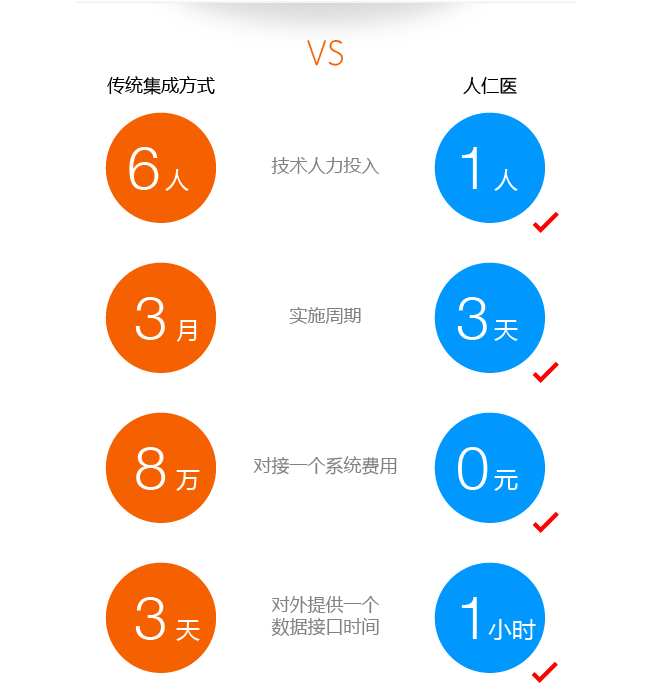
Comparison of Data Aggregation Efficiency
For such an interface technology, in some large-scaleHITManufacturers typically handle it themselves. However, for many localHITFor manufacturers, there are still certain technical challenges and barriers; while it may be feasible to do in-house, the cost-effectiveness is low, making outsourcing a more favorable option.
Zhao Liqiang, another co-founder of Renrenyi, was previously responsible for the core research and development of financial securities middleware in the Basic R&D Department of Kingdom Sci-Tech. At that time, he had already applied this technology to the healthcare sector to integrate medical data.
It is reported that in2015Following the launch of new products at the beginning of the year, customer data began to grow rapidly, and over 100 clients have been signed. However, due to ongoing delays in project advancement between clients and hospitals, only30%order.
Renren Yi already has important clients including BGI, Xi'an Yinggu, Jindou Medical, and Yunsheng Medical, which just announced its partnership, involving Yangshan County People's Hospital and its18township hospitals, Zhuhai High-Tech Zone People's Hospital, and its25community hospitals, the Lishui Regional Medical Information System in Zhejiang Province, and other hospitals or projects.
3New Hospital Data Security Product Set to Launch
According to He Xianchen, Renren Medical will7— Launch of a New Product: “Da Men Shen,” China’s First All-in-One Medical Data Security Management Appliance.
TraditionalHITManufacturers typically also deploy network firewalls for hospitals, primarily to address scenarios requiring internal information isolation and protection against external attacks. In contrast, "Da Menshen" is designed for contexts such as tiered diagnosis and treatment, where hospital information systems begin to exchange data with other hospitals or data requesters. It provides unified access management services for hospital data, monitoring aspects such as the content of data exchanges, the number and frequency of API calls, and traffic statistics. This ensures that data outflows remain compliant and do not exceed the bounds stipulated in cooperation agreements.
Regarding the company’s future vision, He Xianchen stated that the company is currently focusing on its data interface business, aiming to integrate its products into as many hospitals and life sciences companies as possible. This approach is akin to building a main highway network; once this infrastructure is established, medical data will flow across its platform, thereby creating significant potential for future business models.