

Emergence of a 'Moore's Law' in Gene Sequencing: Is Third-Generation Sequencing Set to Displace NGS?
Recently, Industrial Securities Healthcare released a report introducing the third-generation gene sequencing industry. VCBeat believes that this report helps medical professionals gain a comprehensive understanding of third-generation sequencing technology and its market prospects, and has therefore republished and curated it.
Before the investment frenzy for “next-generation sequencing” (NGS) had even peaked, “third-generation sequencing” (3GS), which has seen a string of technological breakthroughs, has once again come into investors’ spotlight. In 1986, the first commercial gene sequencer was officially launched; it took 19 years until the emergence of second-generation sequencing platforms. However, only five years passed between the debut of second-generation instruments and the birth of third-generation technologies, indicating that the iteration speed of gene sequencing equipment is continuously accelerating. This is akin to mobile phones skipping the “3G” era entirely and leaping directly from “2G” to “4G.”
The report analyzes third-generation gene testing technology from four perspectives:
Third-generation sequencing technologies, represented by Helicos Biosciences’ HeliScope single-molecule sequencer, Pacific Biosciences’ SMRT technology, and Oxford Nanopore Technologies’ nanopore single-molecule technology, have gradually matured after years of development.
Despite the current challenges of high costs, elevated error rates, and a limited selection of bioinformatics analysis software, this technology offers significant advantages in terms of read length and sequencing speed.
Third-generation sequencing instruments have achieved stability and miniaturization. In the future, as challenges related to accuracy, parallel sequencing capacity, and enzyme activity are addressed, third-generation sequencing technology will become a key technological trend, with large-scale commercialization being an inevitable direction.
Helicos Biosciences’ HeliScope single-molecule sequencer, Pacific Biosciences’ SMRT technology, and Oxford Nanopore Technologies’ nanopore single-molecule technology are considered third-generation sequencing technologies.
Compared with the first two generations of technology, their most prominent feature is single-molecule sequencing. Among these, Heliscope and SMRT technologies perform sequencing using fluorescent signals, while nanopore single-molecule sequencing technology performs sequencing using electrical signals generated by different nucleotide bases.
PacBio SMRT technology employs the sequencing-by-synthesis approach and uses SMRT cells as the sequencing substrate. Each SMRT cell contains numerous zero-mode waveguides (ZMWs), with a DNA polymerase immobilized at the bottom of each ZMW.
The fundamental principle of sequencing is as follows: DNA polymerase binds to the template, and the four nucleotide bases (i.e., dNTPs) are labeled with four distinct fluorescent dyes. During base pairing, the incorporation of different bases emits light at specific wavelengths; the type of incorporated base is determined based on the wavelength and peak intensity of the emitted fluorescence. DNA polymerase is one of the key factors enabling ultra-long read lengths. Read length is primarily dependent on the maintenance of enzyme activity, which is mainly affected by laser-induced damage.
Additionally, certain base modifications can be detected by measuring the sequencing time interval between adjacent nucleotides. Specifically, if a base is modified, its passage through the polymerase is slowed, resulting in an increased distance between adjacent peaks; this allows for the direct detection of methylation and other modifications. SMRT technology offers rapid sequencing speeds, incorporating several dNTPs per second.
However, it simultaneously exhibits a relatively high sequencing error rate of 15%, which is virtually a common limitation of current single-molecule sequencing technologies. Fortunately, these errors occur randomly and do not exhibit the systematic biases characteristic of second-generation sequencing technologies. Consequently, effective error correction can be achieved through repeated sequencing, albeit at the cost of increased expenses due to the need for redundancy.
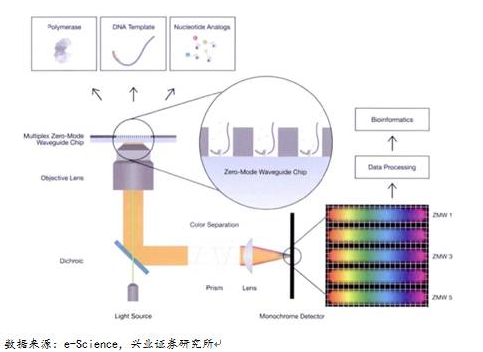
SMRT Technology Schematic Diagram
The nanopore single-molecule sequencing technology developed by Oxford Nanopore Technologies differs from all previous sequencing methods, as it is based on electrical signals rather than optical signals.
One of the key features of this technology is the design of a specialized nanopore that allows only single molecules to pass through, with molecular linkers covalently attached within the pore. As DNA bases traverse the nanopore, they induce changes in electrical charge, thereby transiently altering the ionic current flowing through the pore (with each base causing a distinct magnitude of current change). Sensitive electronic devices detect these variations to identify the passing bases.
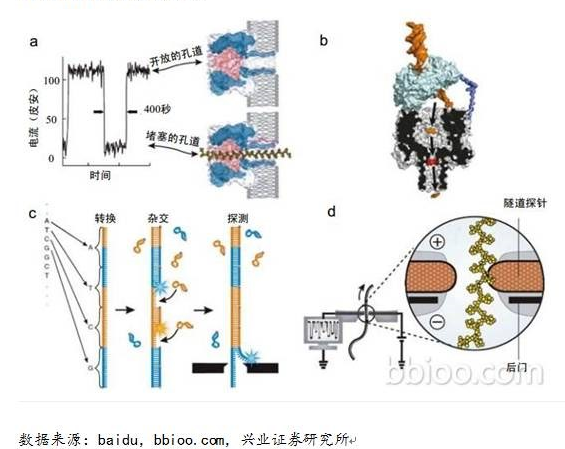
Schematic Diagram of Nanopore Technology
Compared with second-generation sequencing, third-generation sequencing has the following advantages:
Expanded the application scope of sequencing technologies. Most applications of next-generation sequencing (NGS) are DNA-based, whereas third-generation sequencing offers two capabilities not available with NGS: first, direct RNA sequencing, which significantly reduces systematic errors introduced by in vitro reverse transcription; second, direct sequencing of methylated DNA. In fact, DNA polymerase replicates the nucleotides A, T, C, and G at different rates. When using normal cytosine or methylated cytosine as a template, the dwell time of DNA polymerase differs. Based on these differences in dwell time, it is possible to determine whether the cytosine in the template is methylated.
Meanwhile, third-generation gene sequencing also has certain limitations:
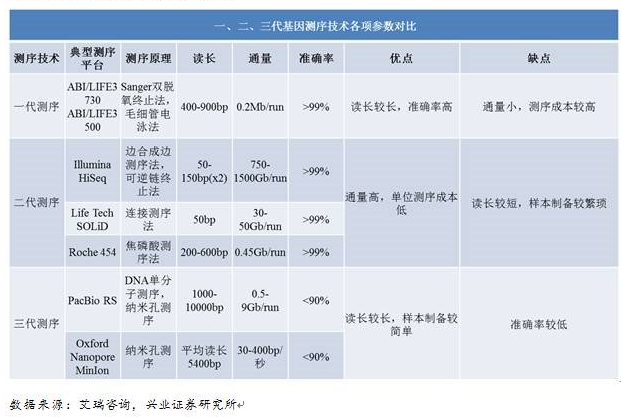
Comparison Chart of First-, Second-, and Third-Generation Gene Sequencing Technologies
Major overseas players in third-generation sequencing include Pacific Biosciences and Oxford Nanopore Technologies. On October 27, 2015, the Chinese company Direct Genomics (Hanhai Gene) unveiled a proof-of-concept prototype of GenoCare, a third-generation single-molecule sequencer developed based on Helicos technology and specifically designed for clinical applications.
The Beijing Institute of Genomics, Chinese Academy of Sciences, and Inspur Genomic Science are jointly developing domestically produced third-generation gene sequencers. Regarding instrument pricing, PacBio’s first third-generation sequencer, the PacBio RS, launched in 2011, was priced at $800,000 in the United States, while the Sequel sequencer released in 2015 saw a significant price reduction to $350,000. In terms of sequencing costs, it is projected that within the next five years, third-generation sequencing will achieve whole-genome sequencing at a cost of $100.
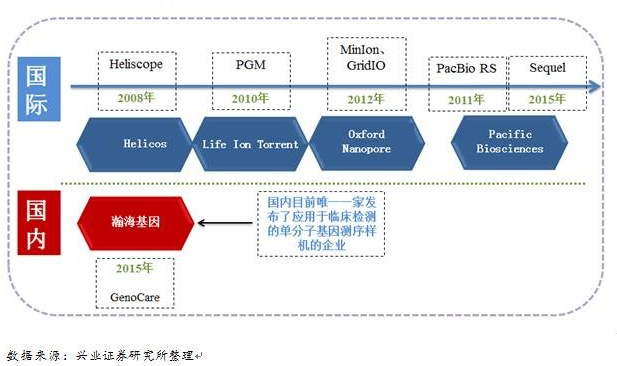
Companies Deploying Third-Generation Sequencing Technologies in China and Abroad
As indicated in the report by Xingzheng Securities Pharmaceutical Health, third-generation sequencing currently demonstrates significant technical advantages over second-generation sequencing in terms of read length and sequencing speed. However, improvements are still needed in cost and accuracy. At present, Hanhai Gene is the only company in China to have achieved clinical outcomes with third-generation sequencing, whereas commercialization of the technology has already been preliminarily realized abroad. Overall, third-generation sequencing represents a future development trend, and large-scale commercialization is inevitable.
(Note: The content of this report is compiled from the Industrial Securities Pharmaceutical and Healthcare Investment Report.)