

Snail VR: Pioneering VR Live Streaming from Gaming to Medical Applications
By 2025, the market size of VR is expected to reach $80 billion, with an optimistic projection of $182 billion. In 2016, China's live streaming market size will reach RMB 15 billion, and it is projected to grow to RMB 60 billion by 2020.

On June 8, Professor Zhang Changqing, a renowned orthopedic surgeon at Shanghai Sixth People’s Hospital, conducted a live broadcast of an orthopedic surgery using VR technology. Snail Digital’s Shanghai VR team served as the technical provider for the VR live streaming and video-on-demand services for this procedure.
Snail VR Team is a wholly-owned subsidiary of Suzhou Snail Digital Technology Co., Ltd. (hereinafter referred to as "Snail Digital"). Established in 2015, it is located in a distinctive industrial park in Shanghai, with Li Jiajun serving as the General Manager. Its parent company, Suzhou Snail Digital Technology Co., Ltd., was founded in 2000 and is one of China's earliest enterprises dedicated to the research and development of 3D virtual digital technologies. Its main business scopes include online games, virtual network operator services, mobile phone R&D and manufacturing, and application platforms.

Li Jiajun, General Manager of Woniu Cloud Computing
VR Live Streaming + Healthcare
Snail Digital boasts a robust foundation in visual and graphics processing within the gaming industry. With profound expertise in computer graphics and imaging, Snail Inc. embarked on its exploration of virtual reality (VR) at an early stage, leveraging its proprietary R&D capabilities and competitive advantages to make a strong entry into the VR live-streaming sector. Although Snail VR originated from a gaming company, its live-streaming services cover a broad spectrum. Prior to broadcasting medical surgeries, Snail VR successfully streamed numerous large-scale product launches, concerts, and conferences. Its extensive live-streaming experience, combined with advanced technical capabilities, has distinguished Snail VR from many competitors and earned the trust of Shanghai Sixth People’s Hospital. Currently, the team conducts VR live-streaming projects on a weekly basis.
In its 2016 VR report, Goldman Sachs predicted that revenue in the VR healthcare sector would reach $1.2 billion by 2020 and $5.1 billion by 2025. This indicates that “live streaming + healthcare” holds immense market potential in the future. The medical live streaming conducted by the Snail VR team has also accumulated rich experience for its future entry into the healthcare live streaming sector. For this medical surgery live stream, the Snail team employed 4K high-definition live broadcasting and 8K recorded playback. Through collaborative shooting using panoramic cameras and multi-camera setups, Snail VR successfully balanced the comprehensive overview of the surgery with detailed close-ups during the live stream. Moreover, medical live streaming presents numerous challenges, such as partial overexposure of panoramic camera footage caused by surgical shadowless lamps, and the transmission and display of multi-signal data including operating room panoramic views, endoscopic images, and instrument readings.
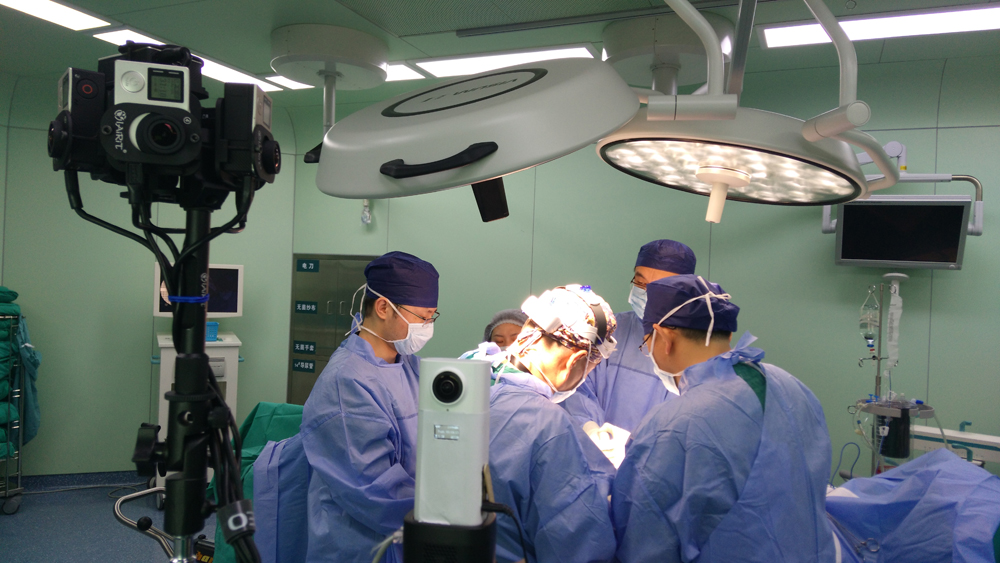
Multi-Camera Synchronized Live Streaming
During live VR broadcasts of surgical procedures, viewers can not only observe the entire surgery from the surgeon’s perspective but also freely switch viewpoints to examine every corner of the operating room. When combined with VR headsets, this immersive viewing experience makes users feel as if they are physically present in the operating theater. The 360-degree panoramic VR technology holds immense promise for clinical medical education, helping to eliminate global disparities in surgical techniques and enabling healthcare professionals worldwide to train across borders. Previously, interns and surgeons could only observe lead surgeons from a distance in the corner of the operating room; now, they can directly engage with surgical details through remote connectivity and practice. Furthermore, patients’ families can gain a clear view of the entire surgical process, while patients themselves can review the procedure, achieving real-time reconstruction of the virtual reality scene.
Core Advantages of Snail VR
The main workflow of VR live streaming includes: panoramic capture, video stitching (including synthesis and rendering), content transmission (cloud processing and distribution), and terminal output. Shanghai Snail VR is primarily responsible for developing collaborative businesses between VR and cloud computing, dedicating itself to researching the acquisition and editing of VR audio and video, VR video stitching, the transmission of high-bitrate video streams, and the display of VR videos on terminals, thereby achieving full-chain technology output. The entire process technology, from the capture end to the playback end, is independently developed by the Snail VR team.
In the early stages of image acquisition and stitching, images in the edge areas of wide-angle lenses are prone to distortion. To address this, Snail Digital’s Shanghai VR team independently developed a comprehensive video stitching algorithm that performs real-time stitching of live-streamed footage, thereby minimizing inter-image distortion to the greatest extent possible.
For long-distance video transmission, which requires a bandwidth of over 4 Mbps, the Woniu team has established its own dedicated VR transmission network to create a dynamic, zero-latency private network. By combining CDN acceleration with SDN, the system can dynamically select the lowest-latency route for each stream. It is specifically optimized for VR live streaming bitrates of 3.5 Mbps and higher, as well as VR on-demand bitrates of 10 Mbps and higher, ensuring smoother video playback.

Concert VR LiveBroadcast
VR Panorama Live Streaming Player: Compared to conventional players, VR panorama live streaming players require image stabilization features to prevent user dizziness. Currently, the mainstream approach in the VR field combines hardware and software solutions, primarily utilizing ATW (Asynchronous Timewarp) with AMOLED displays. The self-developed player by Shanghai Snail VR Team supports both planar and spherical rendering, as well as monocular and binocular rendering, with dynamic switching capabilities. It enables multi-protocol video-on-demand and live streaming across all platforms, while automatically inserting frames, stabilizing images, and reducing dizziness during playback.
VR Live Streaming Is a Red Ocean
When the domestic VR live-streaming market was not yet booming, Li Jiajun recognized its growth potential. After leaving Shanda Group and joining Snail Games, he single-handedly established the entire VR team to enter the VR live-streaming market. Over the past year, Shanghai Snail’s VR division has grown into a team of nearly 100 members. The team consists primarily of technical professionals, all hailing from major well-known internet companies, with the Shanghai team currently focused on research and development.
VR has gained tremendous popularity this year, and the rapid rise of live streaming cannot be underestimated. What kind of brilliance will the combination of VR and live streaming create? Li Jiajun stated that while the live streaming market has become a highly competitive "red ocean," few players are actually profitable. The VR live streaming market, however, is different. Currently, the market is still in its cultivation phase, and we are optimistic about its long-term development over the next 5–10 years. At present, more time and effort need to be invested in technology. We hope that Snail VR can remain focused on refining its technology, delving deeply into foundational technologies, and providing customers with a superior experience.
According to Goldman Sachs’ latest research report, the VR market size is projected to reach $80 billion by 2025, with an optimistic estimate of up to $182 billion. Survey data from Founder Securities indicates that China’s live-streaming market size reached RMB 15 billion in 2016 and is expected to grow to RMB 60 billion by 2020. The prospects for VR live streaming are highly promising; as technology matures, VR live streaming will be increasingly applied across various sectors. However, current VR live streaming still requires exploration in multiple areas to accelerate industry maturity. Moving forward, the Woniu VR team will also establish a presence across the entire VR live-streaming industry chain, including on-demand panoramic video, live panoramic video streaming, and real-time 3D audio.