

Can the Internet Hospital Model Succeed? Insights from Industry Leaders
On June 25, the “EO Healthcare+ Summit,” hosted by EO Company, was held at the Sofitel Wanda Beijing Hotel. During the event, Bai Yu, founder of Kangfu Zhijia (Rehabilitation Home); Wei Jianfeng, founder of Zhuojian Technology; Guan Tao, managing partner of Fenxiang Investment; and Dr. Martin, founder of Xingren Doctor, participated in a panel discussion titled “Evolution: The New Landscape of Internet Healthcare.”
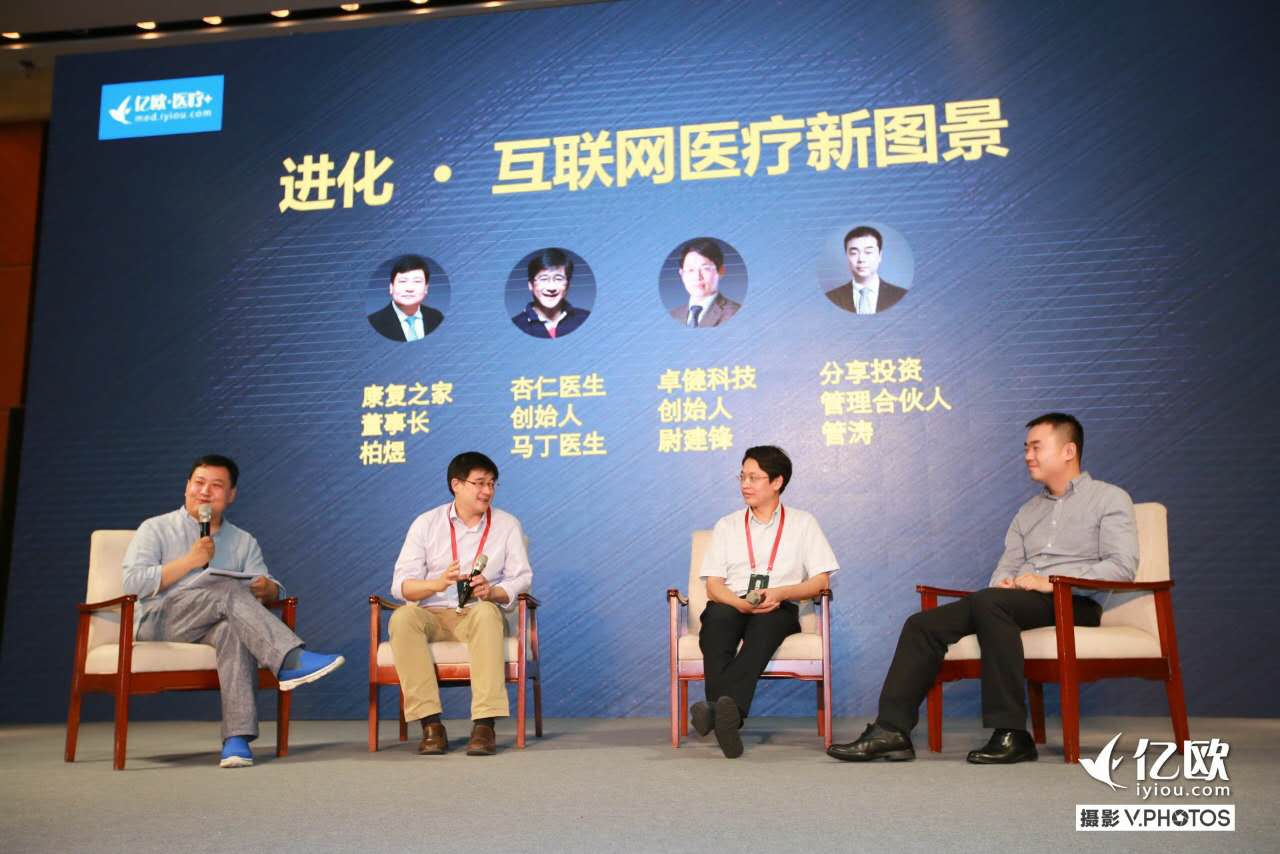
Host Bai Yu: Internet hospitals have recently gained significant traction. Let’s first invite Dr. Wei to interpret this model—what exactly is it, and can it truly succeed?
Wei Jianfeng: We are currently developing a concept similar to that of an internet hospital. This model, particularly in the United States—where I lived for over four years—was already well established; around 2010, approximately 30% of appointments at the Mayo Clinic were made online. In China, the approach has simply been to migrate existing service models onto internet platforms, without much innovation worth noting.
Building on existing foundations, we are continuously evolving our product model. Initially, we leveraged mobile apps and WeChat to facilitate services such as appointment registration and payment. Over time, we recognized the potential to support a broader range of business models, gradually integrating internal hospital operations—including staff scheduling, consultations, medication management, and follow-up care. This iterative evolution defines our approach to delivering healthcare services. This practice has long been established abroad and represents a clear industry trend. Looking ahead five to ten years, it is safe to say that all hospitals will participate in this sector; indeed, all U.S. hospitals have already adopted this model, underscoring its significant value.
Host Bai Yu: They have merely moved traditional hospitals online, without achieving genuine innovation. Wuzhen Internet Hospital has established a comprehensive system encompassing remote diagnosis and treatment, e-prescribing, and medication delivery. It already issued its first prescription last year, with Sinopharm handling the delivery. Alibaba Health is also engaged in remote prescribing, consultations, and video services. Will this become the mainstream model in the future?
Wei Jianfeng: This is merely one mode of healthcare service delivery. The backend systems can be fully integrated, covering registration, payment, pharmaceuticals, examinations, and even hospitalization and appointments. These services are delivered via the internet through voice calls, text, and images, but the core essence remains medical care itself.
As mentioned earlier regarding the first prescription, our platform currently hosts over a dozen prescriptions generated from a single hospital’s platform, with volume gradually increasing. The hospital now handles approximately 150 outpatient visits per day. By adopting this approach, prescriptions are already being issued; the innovation lies simply in applying existing internet technologies to this process.
Host Bai Yu: How does Martin view the current surge in popularity of internet hospitals?
Martin: A hospital is, in essence, a platform. Many people fail to clearly understand what a physician can actually do. To put it more directly, consider projects in pharmaceutical e-commerce: recruiting a pharmacist or a physician to help promote medications to patients by recommending specific drugs for certain conditions. While internet hospitals hold significant value, this value must be clearly defined. During my time in the Navy, there was an incident involving a nine-year-old girl with a fever. The most I could offer was to outline possibilities—one, two, three—and suggest options A, B, or C, while advising her to be taken to the nearest port facility for hospital care. The core issue explaining why patient platforms and services often fall short in user experience lies precisely here. When I am unaware of a patient’s clinical condition and cannot examine them personally, whether I can provide a diagnosis and treatment plan remains highly questionable.
Conversely, telemedicine can be highly beneficial during the follow-up phase for established patients. Many people misinterpret international experiences when translating them into Chinese. They fail to recognize that, in many countries, telemedicine is primarily conducted through consultations with physicians or case discussions with nurses, rather than through direct patient encounters. Direct patient care via telemedicine is often provided by general practitioners or family physicians. What is the difference? These are patients whom the provider has seen recently—last week or last month—and with whom they have maintained a relationship for one or several years. The physician is already familiar with the patient’s medical history, including chronic disease management. For instance, if a patient’s medication supply has run out, the physician, being aware of the clinical context, can issue an electronic prescription for the patient to pick up directly at a pharmacy. This scenario is distinct, a nuance that many people overlook.
First, the "Internet Plus" concept was directly transplanted into the healthcare industry. Consider what Didi Chuxing did: it transported passengers from point A to point B, and its operational strategies disrupted an entire industry. Meituan focused on dining, disrupting another industry through the packaged group-buying model. Returning to the healthcare sector, many projects have failed to clarify what constitutes the "A to B" value proposition yet simply injected more capital. Five to ten years later, we still have not witnessed any true disruption in our industry. We must first clearly understand what doctors are fundamentally meant to do.
Host Bai Yu: Mr. Guan, you have invested in many projects. This sector is quite hot. How do you evaluate it?
Guan Tao: The ultimate model of this concept is the same; it is undoubtedly the right direction, so there is little more to say. The final form will involve the digital transformation of traditional hospitals or the use of new technological means to improve efficiency. The level of informatization in China’s large Grade 3A hospitals is quite poor. Digitizing these major Grade 3A hospitals involves significant resistance and difficulties. Each vendor seeks integration with numerous other systems, which requires changing physicians’ habits. Conflicts and complications may arise when your solution is adopted in one segment but not in others. I have observed several players developing internet hospitals; they are building new facilities rather than retrofitting existing ones. They are exploring whether they can establish a Grade 3A hospital from scratch, designing all processes and workflows according to an idealized model from the outset. Traditional private equity funds do not invest in Grade 3A hospitals because the investment cycle and complexity are exceptionally long. Is there a new model for greenfield development? If rules and methodologies are well-established from the beginning, control can be strengthened. The key to this model lies in whether one possesses the capability and resources to execute it. Entering the Grade 3A hospital market from zero implies handling every link independently. Those who have built Grade 3A hospitals understand that every aspect is cumbersome, which constitutes a risk point. The trend and direction are sound, and the end state is identical; only the pathways and forms differ.
Host Bai Yu: Currently, there are two primary models: one involves upgrading existing platforms like the Wuzhen Internet Hospital, while the other entails large-scale tertiary hospitals, such as the Second People’s Hospital of Guangdong Province, directly launching internet-based healthcare services. In terms of growth potential, is it more efficient and effective for traditional large hospitals to achieve faster results?
Wei Jianfeng: Regarding the issue of medical data, we have attempted to promote the opening of medical data, including raising this matter at the national level. However, open medical data does not flow into large hospitals. There are two considerations for this. First, while some entities may take open data to other large hospitals, they do not bring it to county-level hospitals. Medicine is a discipline based on experience; having access to data does not automatically ensure accurate diagnoses and other aspects of care. Data sharing and openness serve only as a foundation. Ultimately, patients still prefer to seek medical care at higher-tier institutions with established reputations. This is the first issue.
The second question raised earlier concerns how these two models should evolve. I have always viewed them as mutually complementary. Why, then, does the state encourage a pure internet-based approach? From a macro perspective, the government aims to leverage capital and technological infrastructure to enhance public experience, thereby reducing complaints and healthcare expenditures. However, traditional healthcare institutions prefer to advance according to their own established practices. While competition will inevitably arise between the two sectors, they will also engage in cooperation. The ultimate goal is to improve healthcare accessibility and efficiency for the general population, facilitating more convenient communication between doctors and patients. Looking ahead, both business models will coexist; it remains difficult to predict which model will dominate the other.
Martin: I strongly agree with the data perspective. Medical practice should not rely solely on data; it is fundamentally based on interpersonal judgment. For medical students, the first step is to observe a patient without saying a word. For instance, in some general practitioner examinations abroad, candidates are prohibited from speaking during the first two minutes; they must listen to the patient and make assessments. Thus, medical consultation is essentially a process of data acquisition. Does the entire healthcare transaction depend on specific factors? I emphasize the necessity of establishing trust, as we operate as private physicians. If we clearly outline specifications and establish a robust evaluation system, transactions can occur smoothly even between strangers. However, in the education and healthcare sectors, our offerings can be considered virtual products. China is a society built on acquaintanceships. If I do not know you or trust you, will I truly pay for your service? Will a transaction take place? This is a significant challenge. As mentioned earlier regarding patients' trust in hospitals, we aim to assist the majority of doctors in China. Many hospitals are still involved, but many stakeholders have not yet clearly understood the platform's role.
Host Bai Yu: We’ve noticed that the Zhang Qiang Doctor Group has recently gained significant traction. Since you invested in them, what were your reasons for investing in the Zhang Qiang Doctor Group?
Guan Tao: In essence, when venture capital funds invest in physician groups or physician-led startups, they are not investing in the individual doctor—such as Dr. Zhang Qiang or Mr. Zhang—based on their personal traits and characteristics. Funding is not secured simply due to exceptional medical skills or high clinical proficiency. Rather, investors look for founders who, while possessing deep industry knowledge and medical expertise, still approach the venture with a business-oriented mindset. Currently, whether within physician groups or physician-led startups, founders must clearly distinguish between what constitutes a business and what represents a professional mission. Operating a private clinic may not require sophisticated management expertise and can still be a viable business; however, such entities should generally avoid taking venture capital. It is not advantageous for companies that do not seek venture funding to be aggressively pursued by VC firms. Founders who accept investment must understand that venture capitalists impose expectations on growth rates. Only those prepared to meet rigorous operational performance requirements are truly suited to embark on entrepreneurship backed by venture capital.