

Top 100 'Internet + Healthcare' Companies Secured Nearly RMB 14 Billion in H1 2016; Several Prepare for IPO
2015 was a breakout year for mobile health, with the market size approaching RMB 5 billion, the user base reaching 17.073 million, and a total of 283 financing events occurring in the internet healthcare sector. In 2016, capital market enthusiasm for the internet healthcare sector continued to rise rather than wane. As of June 28, there were 121 investment deals exceeding RMB 1 million in the first half of 2016, with the total investment amount reaching an astonishing RMB 14 billion!
VCBeat obtained the “Top 100 Most-Funded Companies in the Internet+ Healthcare Sector in H1 2016” list from the “Healthcare Exhibition” and compiled the associated data.and analysis, a total of 103 companies were shortlisted for the list. Below are the highlights:
In the TOP 100 Financing Ranking, Ping An Good Doctor unquestionably claimed the top spot with an exceptionally high financing amount of $500 million (approximately RMB 3.3 billion). As of May 19 this year (Ping An Good Doctor’s financing date), the platform had amassed over 77 million registered users, recorded a peak daily traffic of more than 250,000 visits, and contracted a team of over 1,000 full-time physicians, along with 50,000 affiliated socialized doctors. VCBeat previously published an analysis on why Ping An Good Doctor secured such substantial funding in its Series A round; interested readers are invited to click and read the article.[Exclusive] You Must Want to Know: Why Is Ping An Good Doctor Valued at $3 Billion?
Founded less than a year ago, iCarbonX, established by former BGI CEO Wang Jun, secured the second spot on the financing ranking with a RMB 1 billion raise. At iCarbonX’s founding ceremony last year, an array of high-profile representatives from Shenzhen’s business elite attended to support Wang Jun, including Tencent CEO Ma Huateng (the lead investor), former China Merchants Bank President Ma Weihua, Huawei Rotating CEO Hu Houkun, and BGI’s current CEO Yang Shuang. Such an “all-star lineup” clearly demonstrates how highly favored iCarbonX is by investors, given its integrated approach combining life big data, artificial intelligence, and the internet. Describing the company as having been “born with a silver spoon in its mouth” seems hardly an exaggeration.
Amid tightening national policies, the pharmaceutical industry’s momentum appears to be intensifying rather than waning. The fact that three pharmaceutical e-commerce companies—Jianke.com, Luyan Pharmaceutical, and Hua Medicine—have all broken into the top five is by no means coincidental. It seems that capital markets remain enthusiastic about entering the cash-burning battleground of pharmaceutical e-commerce, suggesting that the day of industry consolidation is drawing ever closer.
Codoon is the only sports and fitness social enterprise among the top five. According to official data reviewed by VCBeat, Codoon currently has over 60 million users, with tens of millions of daily exercise requests from 87 countries worldwide. In 2012, the “Codoon Sports+” app was officially launched, marking Codoon’s transition from a pure hardware provider to a “software + hardware” development model. In 2013, it released China’s first smart wearable fitness devices, the “Codoon Band S” and “Codoon Band 2.” Prior to its Series C financing round this year, Codoon had raised approximately RMB 300 million in total through its Series A and B rounds, demonstrating strong growth momentum.
In a previous exclusive interview with VCBeat, Ted, founder of Codoon, stated: “In 2013, the scale of China’s sports industry was approximately $52.6 billion, accounting for about 0.56% of its GDP; whereas in the United States, the sports industry reached $463.9 billion in 2013, representing 2.8% of its GDP. There remains a significant gap between China and the U.S. Codoon is committed to building a ‘WeChat for sports,’ fully integrating social networking into fitness.”
SoYoung, which entered the medical aesthetics industry through non-surgical cosmetic procedures, has adopted a social e-commerce model as its core development strategy. Prior to this year’s financing round, SoYoung was already processing nearly 60,000 non-surgical cosmetic procedure orders per month. Its proprietary “Cloud Clinic” model ingeniously applies sharing-economy principles by consolidating underutilized time slots and equipment from small and medium-sized clinics. Under unified management according to SoYoung’s own standards, these resources are made available to numerous public-hospital physicians on the SoYoung platform. This approach not only maximizes resource utilization but also resolves venue constraints associated with physicians’ multi-site practice privileges. SoYoung’s innovative business model has played a pivotal role in securing its place among the top five on the list.
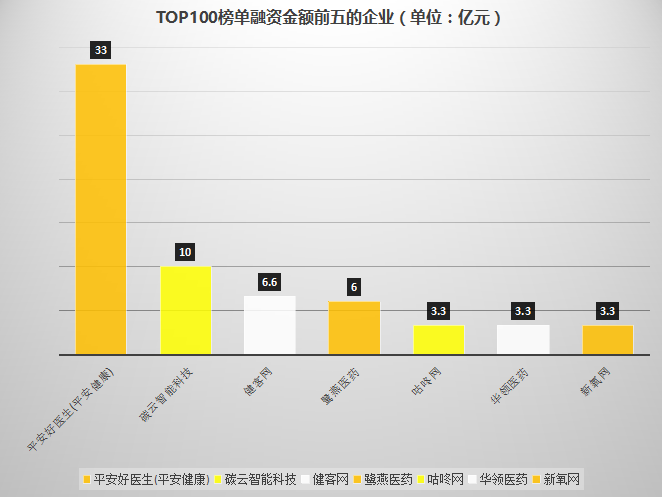
Top 7 Companies by Financing Amount
From the sector breakdown, it is evident that precision medicine, as an emerging field, has become a key focus of current capital investment, with companies engaged in genetic testing accounting for the vast majority.Data indicates that China’s genomics market has a size of nearly RMB 60 trillion. However, as a nascent niche sector, precision medicine has yet to achieve widespread adoption due to current constraints such as high costs and consumer perceptions. It remains uncertain when the industry will enter its phase of explosive growth.
In addition to the precision medicine sector, health management and pharmaceutical companies targeting the large consumer market have consistently been a key focus of investment.In terms of return on investment, companies in this sector have consistently demonstrated stability. As a specialized niche within the high-net-worth consumer market, maternal and pediatric healthcare enterprises are experiencing robust growth. Currently, the implementation of the national two-child policy is generating an annual increase of 3 million newborns. According to the latest data released by the National Bureau of Statistics, China’s infant and child population reached 227 million in 2015. This substantial demographic base and growth rate are further accelerating the rapid development of businesses focused on maternal and child health.
Notably, the current hype surrounding VR (virtual reality) has not sparked a similar investment frenzy in the healthcare industry. Due to numerous technological and application-scenario limitations, medical VR remains some distance from practical implementation, making Yiweixun the only company in this sector to secure financing this year.
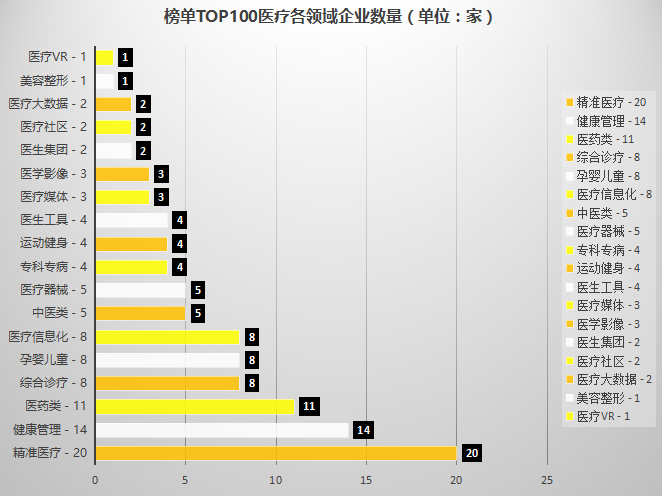
Number of Companies in Various Healthcare Sectors Among the Top 100
In terms of financing stages, the majority of the TOP 100 companies in the first half of this year secured Series A funding, with a total of 51 enterprises.Earned a BThere are very few companies that have completed subsequent financing rounds without going public (IPO), with only six in total: Codoon, Hua Medicine, So-Young, Venus Medtech, and Apricot Forest.
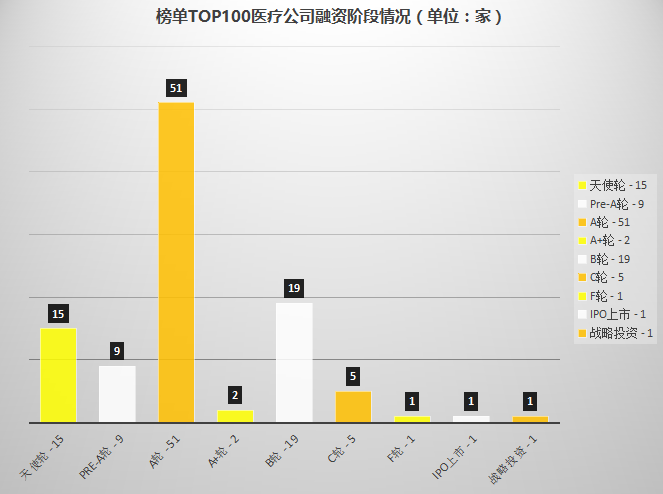
Financing Stages of the Top 100 Healthcare Companies
According to the rankings, 29 companies secured financing of over RMB 100 million, while more than 90 companies received investments exceeding RMB 10 million. Based on the categorization in the table, the vast majority of companies—accounting for 65%—raised between RMB 10 million and RMB 100 million.
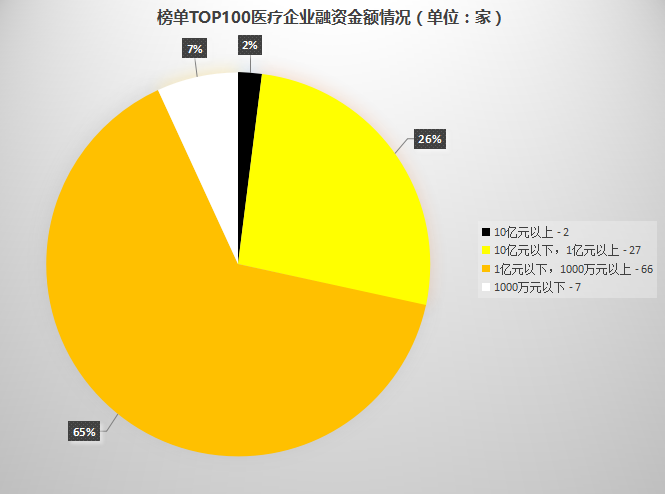
Top 100 Healthcare Companies: Financing Amounts
As described on the official website of Ping An Ventures, the firm prioritizes fast-growing small and medium-sized enterprises (SMEs) in sectors such as technology and media, internet and mobile, e-commerce, consumer goods and finance, as well as healthcare services. As a giant in the insurance industry with close ties to the healthcare sector, China Ping An Insurance’s Ping An Innovation Investment Fund—the first innovation investment fund in China’s financial industry—undoubtedly places significant emphasis on the medical innovation sector. Having narrowly secured a spot among the top 100 “Most Enthusiastic” investors, one wonders how Tencent, which has long regarded itself as the “Little King of Venture Capital,” feels about this development.
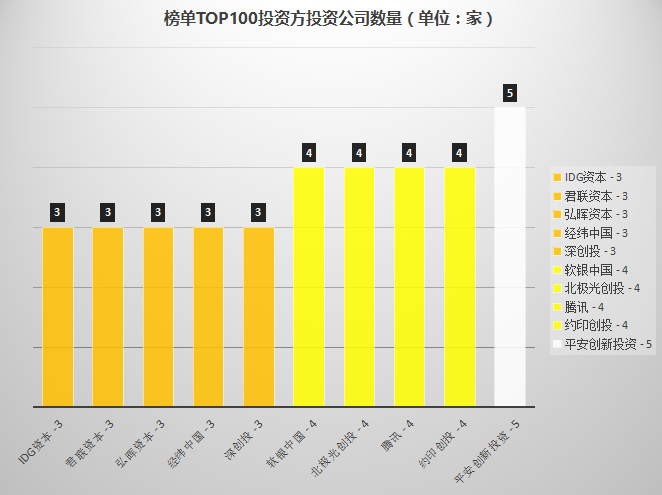
Number of Investment Firms Among the Top 100 Investors
Appendix:Top 100 Funded Companies in the Internet + Healthcare Sector in H1 2016 (Detailed List)

Source: WeChat Official Account of the Medical and Health Exhibition