

Lu Gang Advocates 'Ambush-Style' Investment Strategy as Ideal Approach for Angel Investing in Healthcare
The Legend Star WILL Conference will be held in Beijing on July 9. On this occasion, VB Group Interview has invited Mr. Lu Gang, Partner at Beijing Legend Star Venture Capital Co., Ltd., to discuss Legend Star’s investment layout in the healthcare sector and share his over ten years of investment experience.

Lu Gang
Partner, Beijing Legend Star Venture Capital Co., Ltd.
As the representative of Legend Holdings’ fund investors, he is responsible for evaluating, investing in, and managing multiple venture capital (VC) firms. With in-depth research into venture capital investment, he has directly invested on behalf of Legend Holdings in numerous companies across health services, energy conservation and environmental protection, and chip design. Since joining Legend Star in 2009, he has led the establishment of its angel investment team and has been directly responsible for investment activities in sectors such as healthcare.
Legend Stars began its angel investing activities in 2010, with its first investment being a healthcare project—Tianjin Micro-Nano Core. To date, Legend Stars has invested in thirty to forty angel-stage healthcare projects, covering areas such as novel biologics, medical devices, and mobile health.
Legend Stars began its angel investing activities in 2010. At that time, the healthcare sector did not attract significant attention, competition for investment deals was mild, and many promising projects failed to garner strong investor interest. However, this situation underwent a dramatic shift starting in 2014.
Starting in 2014, many previously overlooked projects became the target of fierce bidding wars among venture capital (VC) firms, driving valuations sharply higher. In 2014 and 2015, numerous specialized healthcare funds emerged, and mainstream large-scale VC institutions reallocated a portion of their capital from the mobile internet sector to strategically position themselves in the healthcare and wellness industry.
“I have been in this industry for fifteen years, so I can anticipate each wave of capital frenzy and the subsequent bubble bursts and winters. We also adjust our investment pace according to these market rhythms,” shared Lu Gang.“Large funds have a significant need for risk diversification by making investments and asset allocations in the healthcare sector to avoid overconcentration in the mobile internet space. The relative abundance of venture capital in the market amid this investment boom is one of the factors driving the surge in healthcare investments.”
In 2015, the bubble in the investment sector had become increasingly evident. The wave of market correction that began in the second half of 2015 hit the mobile internet industry first. In contrast, the healthcare sector experienced a relatively limited adjustment, as its downturn started later and the extent of its valuation bubble was smaller.
Lu Gang advises entrepreneurs that, from a medium- to long-term perspective, healthcare and medical services will remain a promising direction for startups. The capital winter will deflate certain bubbles and eliminate a cohort of speculative entrepreneurs. However, for startups that are purpose-driven, resilient, and value-oriented, this environment presents an excellent opportunity.
In the healthcare sector, Legend Star’s current investment portfolio is primarily focused on three major categories.namely, new biological drugs, gene technology and services, and mobile healthcare.
Biological new drugs are witnessing significant breakthroughs both internationally and in China. Judging from past accumulations and even previous bubble-like phases, these breakthroughs have reached a state akin to the “arrival of the singularity.” In the United States, numerous biotech startups with valuations in the billions of dollars have already emerged.
The recently emerged concept of precision medicine serves as an excellent illustration of the application directions and development potential for biotechnology and novel biological drugs.
Legend Stars’ investment in new drugs began with its 2011 stake in PegBio. Since then, it has invested in nearly ten new-drug companies in total. Such investments require not only courage but also a forward-looking understanding of industry development.
For angel investing, it is more of an ambush-style investment; waiting until the industry heats up to make moves would be too late.The same logic applies to entrepreneurs seeking business opportunities. When the industry is not yet overheated, have the courage to make investments; by the time the hype cycle peaks, you will be strategically positioned and naturally reap significant benefits.
Regarding gene technology, Legend Star not only focuses on equipment for genetic testing but has also invested in certain consumer and medical applications of genetic testing. For example, Legend Star invested in Burning Rock Biotech in 2014, which utilizes genetic testing technology to provide personalized medication guidance in cancer treatment. The company has experienced rapid growth over the past two years and has secured investments from Northern Light Venture Capital and Sequoia Capital.
Mobile healthcare is a key focus area for Legend Star’s attention and investment strategy. Over the past two to three years, the sector has experienced a surge in investment enthusiasm, initially driven by strong capital interest in pioneers such as Guahao.com and Chunyu Doctor. However, with the recent downturn and valuation corrections in the mobile healthcare market, questions have arisen as to whether mobile healthcare—with its still-unclear profit models—can truly transform the medical industry, or whether it represents a major bubble.
In the second half of 2015, Legend Stars and VCBeat jointly organized a training program called Xiangyihui, recruiting exclusively entrepreneurs in the mobile health sector. During this program, Lu Gang delivered a special presentation titled “On Protracted War” in Mobile Health, arguing that mobile health was not yet an industry poised for rapid explosion. He noted that certain constraining ecological factors remained powerful, and the boundary conditions necessary for an imminent breakout had not yet been met.
For example,In the actual context of China, there is a shortage of doctors, information, and mechanisms. Tertiary Grade A hospitals have become information silos, with benefit mechanisms that are highly unreasonable or even distorted, leaving doctors trapped behind walls., and so on. These factors mean that mobile health is not currently an industry poised for rapid, explosive growth. Entrepreneurs must, on the one hand, maintain confidence in its bright prospects, and on the other, possess the mindset and capability to wage a protracted campaign.
In the field of mobile health, Legend Star’s understanding has also been a gradually evolving process. At the end of last year, Legend Star renamed its investment focus from “mobile health” to “New Healthcare Services,” reflecting its differentiated perspective on the mobile health sector.
“In the field of medical services, there are numerous pain points, with certain factors mutually constraining one another. Mobile internet is hardly a panacea for resolving the current issues in healthcare reform and the myriad pain points in the medical services sector,” explained Lu Gang. “Mobile internet is merely one of many tools. The abundance of pain points signifies numerous entrepreneurial opportunities; the key lies in identifying which tools best address these challenges.“Moreover, services better encompass these aspects, so we use the term ‘new medical services’ to reshape our understanding of entrepreneurial and investment opportunities in this field.”
In the field of new medical services, Legend Star invests in both model-driven projects and technology-focused categories. Additionally, it also invests in physician communities and some medical big data projects.
Our significant and diversified investments in the healthcare sector are driven not only by the strategy of asset allocation across different industries, but also by the substantial investment opportunities we have identified. Currently, China’s healthcare industry is at a pivotal turning point, with immense growth potential ahead for both technology-driven and business model innovations.
VB: How do you view the value of healthcare professionals in the field of mobile health?
Lu Gang: There is a saying in the mobile health sector: “He who wins the doctors wins the market.” Physicians are the core asset in mobile health. Those who can secure a large number of physicians with high engagement will be closer to profitability. However, given that physicians’ time is extremely valuable, maintaining their engagement poses a significant challenge.
"In the new healthcare services landscape, nursing is actually a sector with relatively ample supply. Due to certain legacy incentive mechanisms, it has not been effectively driven forward in the past. However, Lu Gang believes that nursing represents a promising direction. 'There are many pain points and challenges, including willingness to pay and the payment process, making it a difficult sector to navigate. Nevertheless, by carefully selecting niche segments and delivering high-quality care, one can build a strong reputation.'"
VB: What are the prospects for consumer-grade genetic testing?
Lu Gang: The future envisioned by genetic testing is promising, as it enables a wide range of applications, including the identification of disease risk factors and providing a stronger foundation for personalized health management. However, we also recognize that genetic testing currently faces several challenges.
On one hand, the commercial essence of consumer-grade genetic testing is currently akin to a health screening service. It even has certain disadvantages, such as low frequency; since an individual’s genetic profile remains largely constant throughout their lifetime, a single test is generally sufficient. This is a critical consideration—and often a concern—for investors. Therefore, unless consumer-grade genetic testing companies integrate their services with effective future solutions, they will struggle to achieve sustainable growth.
Certainly, as a form of health screening, genetic testing is poised for significant growth due to the vast market population. However, from a business model perspective, it may merely represent a new application scenario enabled by emerging technologies, rather than driving a paradigm-shifting disruption. At its core, it remains fundamentally a health screening company.
VB: How is the mental health sector developing?
Lu Gang: The mental health services sector represents a substantial market. We invested in a mental health company as early as 2007, and it has since achieved solid growth.
As modern individuals face increasing stress levels and develop a better understanding of the importance and effectiveness of psychological services, I believe the field of mental health represents a promising direction for entrepreneurial ventures.
Moreover, investors are also paying attention to the growing popularity of mental health services targeting enterprise-level and consumer-end users, which is expected to offer significant growth potential in the future.
In fact, it is not only mental health services but also many other medical services that rely on the personalization of doctor-patient interactions, making standardization difficult. Consequently, their short-term expansion tends to be relatively slow. However, in the healthcare sector, this slowness is not a drawback; delivering high-quality services creates significant opportunities for subsequent robust growth. The inflection point lies ahead rather than in the early stages, as the period of rapid expansion requires a certain amount of accumulation and emerges later on.
VB: How to view investments in VR and AR projects?
Lu Gang: Legend Star has invested in several artificial intelligence projects, such as facial recognition and speech recognition, as well as other companies related to AI and big data. However, it has not made significant investments in the AR and VR sectors.
Recently, artificial intelligence has been labeled a hot topic, while AR and VR are regarded as a new category of technology poised to save the modern era. However, I am not particularly optimistic that AR and VR will soon trigger a major wave of technological revolution. Achieving a significant revolution depends on surrounding conditions, which are currently not yet in place.
In the fields of AR and VR, we closely monitor key trends in Silicon Valley to identify where technological breakthroughs and application scenarios are emerging. Legend Star’s investment strategy in healthcare can be broadly categorized into two areas: new technologies and innovative healthcare services. In this domain, we focus not only on companies that integrate technology with services but also on projects driven by innovative business models.
VB: How do you view the elderly rehabilitation market?
Lu Gang: Both models hold significant promise in the elderly rehabilitation market. The first is centralized rehabilitation hospitals or rehabilitation centers, which are trending toward chain-based operations. The other is home-based rehabilitation or home-based elderly care, which presents opportunities for platform-based solutions.
However, in the elderly rehabilitation market, the payment habits and cultural characteristics of older adults may serve as constraining factors. I believe that whoever can integrate these aspects with insurance or insurance-like products has the potential to unlock this vast market.
VB: What are the factors hindering the development of new medical services?
Lu Gang: In fact, payers are the most significant constraint on the development of new healthcare services. Despite years of healthcare reform in China, the domestic insurance sector remains underdeveloped. The primary issue lies in the overwhelming dominance of social health insurance, while commercial health insurance, intended as a supplementary provider in the market, has failed to gain substantial traction. Consequently, China’s payer system is fundamentally unsound. Both in developed and developing countries, social health insurance should serve as the basic safety net, with other needs addressed and complemented by commercial health insurance. Without the growth of commercial health insurance, payers will struggle to play an effective role.
Special Session of the Legend Stars WILL Conference
Xiangyihui 2 MED TED
Only Technology Can Create Disruption!
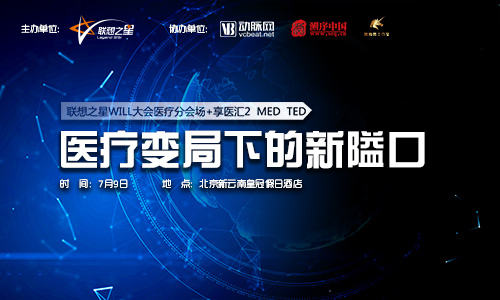
Event Registration Link:http://m.grouplus.cn/ebsufm
Scan the QR Code to Enter Future Healthcare
![[MED TED主题演讲活动]活动二维码.png](https://cdn.vcbeat.top/upload/image/c6/c3/74/56/333d4c0b44101bfae06c36e93d942890.png "1466235958996136.png")