

CFDA Halts Third-Party Online Drug Retail Pilot; Tmall and Yihaodian to Cease Medicine Sales
On August 1, 2016, Tmall Medicine will discontinue its online drug transaction services. Currently, this change only affects over-the-counter (OTC) drugs; businesses related to health supplements and medical devices remain unaffected.
Some merchants have provided screenshots as proof, with the notice stating: “In accordance with the previous requirements of the Hebei Provincial Food and Drug Administration, our company will discontinue the online drug trading function effective August 1, 2016. This notice is hereby issued.”
The suspension originated from an article reposted on the website of the China Food and Drug Administration (CFDA), titled “Pilot Program for Online Retail of Drugs via Third-Party Internet Platforms Concludes.” The article revealed that the CFDA had separately notified the food and drug administrations of Hebei Province, Shanghai Municipality, and Guangdong Province, requiring them to terminate the pilot program for online retail of drugs via third-party internet platforms.
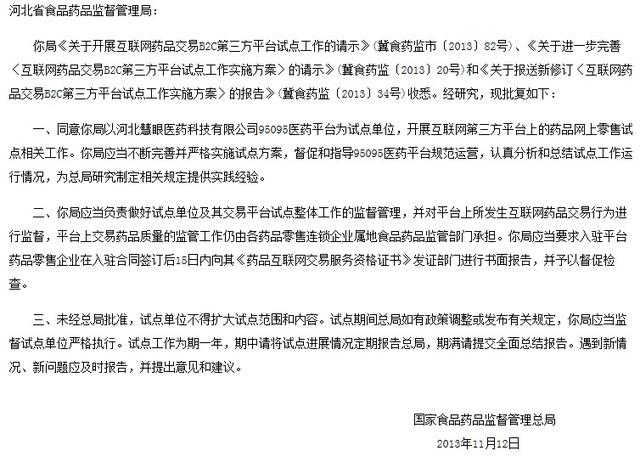
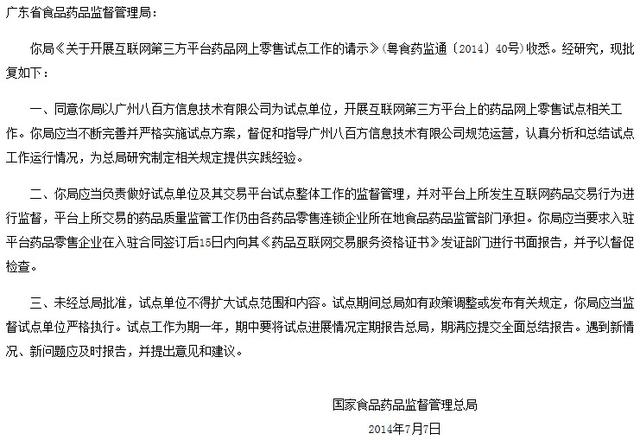
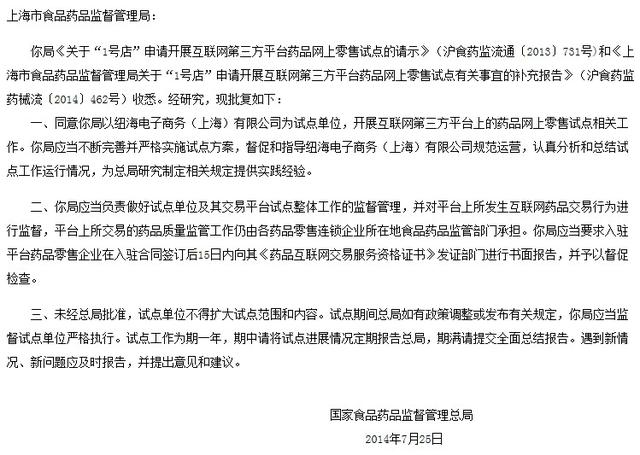
In 2013, the China Food and Drug Administration (CFDA) successively approved the food and drug regulatory authorities of the aforementioned three provinces and municipalities to conduct a one-year pilot program for online retail of pharmaceuticals via third-party internet platforms. The designated platforms were Hebei Huiyan Pharmaceutical Technology Co., Ltd.’s “95095” platform (acquired by Alibaba in 2014), Guangzhou Babai Fang Information Technology Co., Ltd.’s “Babai Fang” platform, and Newhai E-Commerce (Shanghai) Co., Ltd.’s “Yihaodian” platform.
During the pilot program, issues emerged such as unclear principal responsibilities between third-party platforms and physical pharmacies, and difficulties in effectively regulating the sale of prescription drugs and ensuring drug quality and safety. These issues were detrimental to protecting consumer interests and medication safety; therefore, it was decided to terminate the pilot program for online retail of pharmaceuticals via internet third-party platforms.
The conclusion of the pilot program for online retail of pharmaceuticals via third-party platforms shall not affect enterprises that have already obtained the "Certificate for Internet Drug Transaction Services" from continuing to conduct business-to-business and business-to-medical-institution drug transaction services in accordance with the "Interim Provisions on the Approval of Internet Drug Transaction Services" and other relevant regulations; physical pharmacies that have obtained the "Certificate for Internet Drug Transaction Services" may continue to sell drugs directly to consumers via the internet.
All pharmaceutical retail enterprises, whether conducting online or in-store transactions, must strictly adhere to the regulation that prescription drugs may only be sold upon presentation of a physician's prescription.
The debate over the suspension of online pharmaceutical sales has never ceased. As early as 2011, Tmall’s Pharmacy Pavilion was suspended from operations due to a lack of proper legal qualifications, only to resume services six months later.
On May 27, 2016, Tmall once again issued the “Notice on Emergency Control Measures for the Drug Category” to numerous merchants operating in the Tmall Health Pharmacy. The notice stated: “Effective immediately, please cease listing and selling such products, conduct self-inspections, and ensure proper handling of after-sales services and consumer rights protection.” At the time, Tmall indicated that it had received notification from the Hebei Provincial Food and Drug Administration prohibiting the listing and sale of such products as of May 27. The term “such products” referred to over-the-counter (OTC) drugs permitted for online sales, implying that Tmall Health Pharmacy would no longer be allowed to sell OTC drugs. (See details:【In-Depth】Tmall Suspends Sales of Pharmaceutical Products: The Real Reason Is...
In hindsight, the online pharmaceutical sales business was not shut down at that time; it was merely suspended for rectification. Tmall emphasized, “In response to new policy changes, we have made corresponding adjustments to our business model to better serve partner merchants and consumers in a lawful and compliant manner.” VCBeat (WeChat ID: vcbeat) also conducted in-depth interviews and analysis of the incident.
The CFDA’s comprehensive suspension was justified on the grounds that “the division of liability between third-party internet platforms and brick-and-mortar pharmacies in online retail remains unclear, posing challenges to effective oversight of prescription drug sales and drug quality and safety, which is detrimental to safeguarding consumer interests and medication safety.”
Moreover, the China Food and Drug Administration (CFDA) approved 95095 Pharmaceutical Platform (i.e., Tmall Medicine), 800 Fang, and Yihaodian as pilot programs for online retail of pharmaceuticals via third-party internet platforms on November 12, 2013, July 7, 2014, and July 25, 2014, respectively, with each pilot program lasting one year. The suspension at this time coincides with the expiration of these pilot programs.
In addition to Tmall Medicine, Yihaodian also received a notice in June this year, conveyed by the Shanghai Food and Drug Administration, requiring it to halt the pilot program for online retail of pharmaceuticals via third-party platforms. According to previous reports by Nanfang Daily, 800 Fang also confirmed at the time that it had received the notice to “cease operations.”
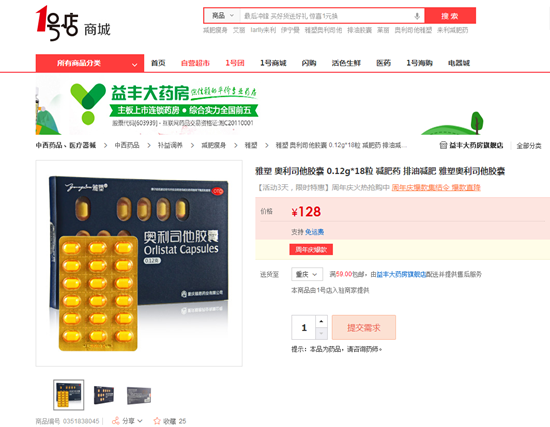
As of the date of this publication, OTC drugs on Tmall Health remain available for online purchase, while Yihaodian has shifted its OTC drug category to a “request submission and cash-on-delivery” model. Meanwhile, OTC drugs on 800 Fang require a prescription and are delivered through offline pharmacies.
It is believed that after Tmall Health completely halts sales on August 1, it will adopt a similar approach to the other two platforms. OTC drugs on Tmall Health will be used solely for display and traffic redirection; purchases will redirect users to the merchants’ own platforms, where transactions will be completed independently by the merchants.