

9 Healthcare Jobs at Risk of Being Replaced by Medical Robots: Insights from a Newly Filed Prospectus
Robots are no longer confined to science fiction; they have begun to enter the healthcare sector. If medical professionals hope to leverage robotics successfully and efficiently without having their professional value displaced, they must gain a deeper understanding of these technologies. To this end, VCBeat has compiled essential insights on medical robots that you need to know.9An exciting thing.
Do you remember in "Star WarsIII: Revenge of the Sith》,Anakin SkywalkerSeverely burned and having lost both legs? Do you also remember the surgical robot exerting its utmost efforts to save him? Although this was once a scenario confined to science fiction films, in the near future, similar robots will enter the healthcare sector to save our lives. Moreover, numerous investors have already set their sights on this emerging field with boundless potential.
Robots can support, assist, and expand services in the healthcare sector. For repetitive and monotonous tasks, robots are fully capable of performing them and may even directly replace human workers. Therefore, physicians and caregivers should develop a thorough understanding of the following aspects of robotics: their scope of capabilities, how they collaborate with humans, and the mechanisms by which they execute tasks. Gaining this knowledge in advance helps healthcare professionals prepare psychologically, as the advent of the robotics era may lead to the displacement of their routine duties, potentially leaving them feeling distressed, discouraged, and at a loss.
Hospital-acquired infection refers to infections that patients acquire during their hospital stay, also known as nosocomial infection or healthcare-associated infection. According to statistical data from the Centers for Disease Control and Prevention, in the United States, every25out of every patients1patients will acquire nosocomial infections, such asMRSA(Methicillin-resistant Staphylococcus aureus) andC.diff(Clostridium) and other bacterial infections. In9Among the infected patients, there were1patients will die.
XenexRobots can effectively improve hospital hygiene. They can perform rapid, comprehensive disinfection with no blind spots within healthcare facilities and utilize ultraviolet (UV) disinfection to eradicate lethal pathogenic microorganisms. Compared with other hospital disinfection equipment, in terms of eliminating intracellular damage and pathogenic microorganisms,XenexRobots can perform tasks more quickly and efficiently. As a result, the rate of hospital-acquired infections can be effectively reduced. According to Westchester Medical Center, in the intensive care unit,XenexRobotic Disinfection Reduces Hospital-Acquired Infection Rates70%。
“peper” height1.2Mi, a “social robot” with a human-like appearance, will be employed by two Belgian hospitals to serve as a patient guide. This is a highly intriguing concept, as in real life, patients often encounter impatient and irritable hospital guides and find themselves disoriented within hospital buildings, forced to seek assistance from nurses who appear haggard and exhausted.
PeperCapable of identifying20It can recognize various human languages and determine whether the speaker is an adult male, adult female, or child. When deployed as a patient guide in large hospitals, its powerful capabilities enable it to successfully direct visitors to the appropriate departments, alleviating concerns about getting lost within the hospital. In the future, monotonous and repetitive tasks such as patient guidance may be taken over by robots capable of smiling and greeting people like humans, while former patient guides will need to transition to more challenging and creative roles.
If you were a patient, what questions would you want to ask your doctor before undergoing surgery? Would you want to know whether the surgeon’s previous operations have been successful or whether they are currently in their optimal condition? The da Vinci Surgical System can directly alleviate these concerns by enabling visualization of the surgical procedure, offering higher precision and greater controllability in surgical maneuvers, all of which significantly contribute to surgical success.
Furthermore, the da Vinci Surgical System also features3DHigh-definition magnified vision systems and miniature curved surgical instruments offer greater dexterity than the human hand. Surgeons operate through small incisions with full, real-time control, enabling more precise procedures than ever before. As widely reported by major media outlets recently, the surgical robotics industry is on the verge of explosive growth.
Imagine this: One day, you and your father are both at home when he suddenly develops a severe headache, experiences dizziness and vertigo, and begins to speak incoherently. Under normal circumstances, you would certainly call an ambulance immediately. But what if you live in a relatively remote rural or suburban area where medical personnel cannot arrive within a short period of time?
In this case,Intouch health...and its telemedicine network can come into play. Patients in remote areas can receive high-quality emergency consultation services for conditions such as stroke, cardiovascular diseases, and burns when needed. With telemedicine services, healthcare providers in these towns and rural areas also have the opportunity to receive more specialized guidance, enabling patients to receive treatment within their own communities.
Via the telemedicine network, “telemedicine robots” have already participated in75Tens of thousands of clinical treatment cases, which would have been impossible to accomplish before due to constraints such as time and distance.
“Peper"The robot also has a robust, muscular 'older brother'—"TUGRobot. It can simultaneously transport multiple shelves, carts, or items weighing up to453kilograms of medications, laboratory samples, or other medically sensitive substances. Staff can operate directly on the touchscreen interface toTUGThe robot sends a command and requires it to complete its “mission.” After the work is completed,TUGThe robot will return to the charging dock for recharging, storing energy for its upcoming tasks.
TUGWhat Benefits Can Robots Bring to Hospitals?TUGRobots are capable of operating around the clock, helping to alleviate the burden on medical staff during night shifts. This allows them to dedicate more time and energy to interacting with and providing attentive care to patients, rather than wasting these resources on transporting hospital supplies. Furthermore, hospital staff no longer need to handle heavy loads, particularly sensitive medical materials, thereby avoiding unnecessary safety hazards.
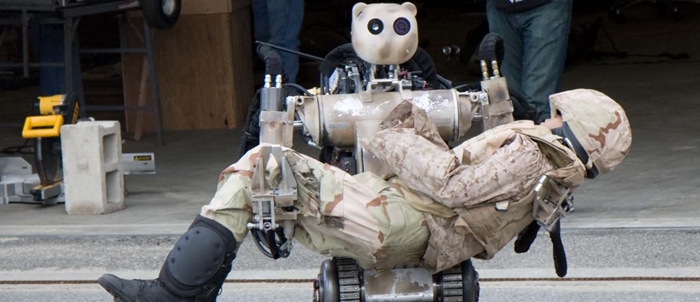
Interactive Physical Assistance Robots andTUGRobots are somewhat similar; they are suitable for home use by patients with limited mobility who require external assistance to move. The interactive physical-assistance robot, “Big Bear,” has a large stature and an adorable cartoon-bear face. These robots can lift patients from their beds and transfer them to wheelchairs, assist them in standing, and help them lie back down in bed, with all these actions repeatable according to the patient’s preference.
Interactive physical assistance robots can not only address the shortage of caregivers but also perform repetitive tasks that are physically demanding and exhausting for humans, such as helping patients get in and out of bed throughout the day.40times.
Do you still remember the last century60Do you remember the sci-fi film Fantastic Voyage from decades past? It is a science fiction movie that uses miniaturization technology to explore the interior of the human body. The film tells the story of five American doctors who are shrunk to one-millionth of their size, reaching the microscopic level, and injected into the human body to perform vascular surgery. Today, reality is gradually approaching the scenarios depicted in this movie.
Researchers at the Max Planck Institute have already achieved ultra-miniaturization (smaller than1cubic millimeters) have been tested on robots that can swim in human bodily fluids and deliver drugs in a highly targeted manner. These scallop-shaped microrobots are capable of swimming in non-Newtonian fluids, such as blood and the lymphatic system.
In developed countries, nearly all adults have undergone blood draws. However, many people experience a certain degree of fear or resistance toward this procedure. On one hand, most individuals have a fear of needles; on the other hand, nurses sometimes need to make multiple attempts to locate a vein for blood collection, andVeebotThe emergence of blood-drawing robots can shorten the duration of this unpleasant experience.
InVeebotWith the assistance of a blood-drawing robot, the entire process takes approximately one minute. Tests have shown that its accuracy in identifying venous blood vessels is as high as83%, approximately at the level of an experienced phlebotomist.
It is well known that interacting with pets and other endearing animals can help alleviate stress, divert attention from pain, and reduce feelings of loneliness among patients. Unfortunately, due to hygiene and safety concerns, many hospitals and nursing homes do not permit patients to bring animals into their facilities. Consequently, a pioneer in industrial automation in JapanAISTThe company has developed an animal-like robot that addresses this issue.
Original Source:medicalfuturist.com