

Sanjin Pian's 'Festival Marketing' Strategy: A Case Study in OTC Brand Building through Public Welfare and Multi-Channel Engagement
By | Ad Bandit
Over a three-day period, 120 urologists and department heads from public Grade II-A hospitals and above were mobilized to provide free mobile online medical consultation services to the public in need. The initiative achieved 50,000 deep engagements and effectively integrated the capabilities of offline pharmacy staff. It serves as at least one exemplary model for pharmaceutical products and enterprises in creating proprietary shopping festivals or conducting cause-related marketing campaigns.
Public Welfare "Festival Creation," Focusing on Urological Health
Amidst the dizzying array of shopping festivals created by e-commerce platforms, sales typically surge thanks to discounts and threshold-based reductions. However, this model is difficult to replicate in the pharmaceutical industry. First, regulatory policies prohibit such practices; second, from a patient psychology perspective, medication consumption is far more rational than that of apparel or fast-moving consumer goods. If you are not ill, you would not necessarily want a drug even if it were given away for free, let alone offered with a minor discount like “$10 off every $100 spent.”Likely influenced by these considerations, Sanjin Tablets’ “June 16 Urological Health Day” leverages the concept of a “shopping festival” to promote public welfare rather than commercial sales. By collaborating with health science popularization organizations, physicians, and media outlets, it conducts public education campaigns on urological diseases. In nature, this “festival” is more akin to initiatives such as “Earth Hour,” “World AIDS Day (December 1),” and “National Ear Care Day (March 3),” aiming to raise public awareness about diseases and provide correct methods for prevention and treatment. For this year’s event, Sanjin Tablets partnered with Tencent News Baike and the Chunyu Doctor app to offer the general public and patients free, real-time consultations with physicians to address urological concerns, while simultaneously disseminating educational content on urological health.
It is worth noting that the June 16 Urological Health Day “Festival” has a relatively complete framework, featuring a dedicated official website (Urology Care Network), a specific visual identity icon, and a genuine commitment to substantive initiatives. Since its official launch on June 16, 2014, Sanjin Tablets has actively conducted public science popularization activities every year.
Symptom-based positioning, deep engagement
Have you noticed the term “urinary health” in the “June 16 Urinary Health Day” campaign? This is undoubtedly a clever strategy. I have carefully examined the package insert and advertising slogans of Sanjin Tablets. Pharmaceutical products, especially traditional Chinese medicines (TCM), are often indicated for multiple conditions, which raises the issue of product positioning—a factor that determines promotional tactics. Clearly, Sanjin Tablets has adopted a broad-based approach this time. Its slogan, “For frequent urination, urgency, and dysuria, use Sanjin Brand Sanjin Tablets promptly,” aims to occupy the mental space associated with these symptoms, implying that medication (Sanjin Tablets) should be taken whenever such symptoms occur. Meanwhile, the concept of “urinary health” positions Sanjin Tablets as a solution for diseases such as urinary tract infections, acute and chronic cystitis, and chronic prostatitis. In this way, Sanjin Tablets establishes a strong association with both the symptoms of urological disorders and the disorders themselves, facilitating consumer mindshare. As more people engage in self-medication, the majority tend to choose brands that have firmly established themselves in consumers’ minds.
An analysis of Sanjin Tablets’ science popularization campaigns in recent years reveals a flexible promotional strategy that places particular emphasis on engaging with target users to capture their “mindshare.” In 2014, the brand launched accessible educational videos, comics, and interactive games. In 2015, it released China’s first White Paper on Public Urological Health, along with a companion reader and interactive games. However, due to a lack of corresponding data, further in-depth assessment is needed to fully understand the outcomes achieved.
Channel Synergy to Lock in Target Users
Based on project experience and analysis of successful cases in other industries, effective promotion should constitute a “closed-loop communication system integrating online and offline channels,” with greater efficacy achieved through closer proximity to consumers. For instance, the voluntary consultation campaign launched by Sanjin Tablets for the “June 16 Urological Health Day” integrated two key channels closest to patients—pharmacy staff and physicians—to deliver coordinated online and offline messaging.
At the physician level, a partnership with the Chunyu Yisheng (Spring Rain Doctor) app has integrated over 100 authoritative urologists. Following voluntary consultations, Sanjin Tablets further leverages the extensive data generated on the Chunyu Yisheng app’s backend, engaging authoritative experts to conduct professional analysis and interpretation of this data for secondary dissemination across relevant platforms.
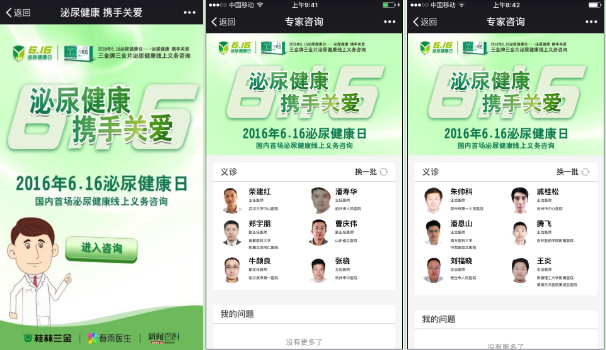
Some Urologists in Public Hospitals
Integration of the pharmacy staff channel was also prioritized. Prior to the official launch, OTC representatives across China established connections with staff at 400,000 pharmacies nationwide. A material incentive mechanism was implemented for pharmacy staff to encourage them to recommend the public to participate in free consultations. During the official campaign period, a large number of users accessed the free consultation page by scanning QR codes upon recommendation from offline pharmacy staff, constituting the second-largest source of traffic for the entire campaign.
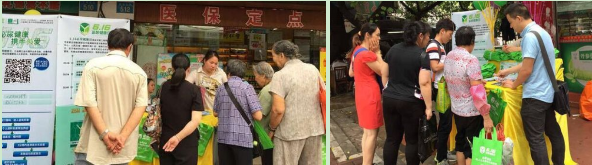
Photos of Offline Store Staff Supporting Promotional Activities
Deep collaboration with physicians serves as a strong testament to product quality, thereby enhancing trust among target users. In-store staff’s support for offline promotions ensures focused outreach to the target audience with low investment and rapid results. This approach also enables direct collection of user feedback, facilitating the evaluation of overall promotional and sales strategies, while strengthening user familiarity with and recognition of the enterprise and its products.
Beyond this, the integration of physician and pharmacy staff channels during the event served an even more critical purpose: it enabled the company to promote its offerings directly to these two consumer-proximate channels, establish a positive brand image among physicians and pharmacy staff, and further reinforce product endorsement by these two key groups of “KOLs.” This approach effectively killed two birds with one stone.