

Seizing Overseas Opportunities: Strategic Choices in Medical Investment
By Liu Yun
Recently, my neighbor “Lao Qian” immigrated to Canada. He sold an apartment in Shanghai and exchanged it for two detached villas in Canada—one larger and one smaller—spending his days watering flowers and mowing the lawn, enjoying a lifestyle that appears several times more affluent than that of his domestic peers in the same socioeconomic bracket. It is no longer surprising to Chinese people that housing abroad is cheaper than in China; however, purchasing property overseas involves many considerations. Just as economics explains that the “Big Mac Index” cannot be equated with purchasing power parity (PPP)—since PPP accounts for a basket of goods rather than just a single “Big Mac”—simple price comparisons are insufficient. Nevertheless, as circumstances evolve, an increasing number of individuals are becoming like “Lao Qian,” with their primary choice for homebuying being properties abroad. As a frontline medical investment investor, I observe this same trend unfolding within the healthcare investment industry.
Cost-Effectiveness in the Domestic and Global Healthcare Industries and Cross-Border Arbitrage
After years in the industry, it is often said that China’s healthcare sector lags behind foreign counterparts by 20–30 years. The basis for this claim? How many new drugs are independently developed by Chinese researchers? It takes a decade for a drug to go from R&D to market launch, not even accounting for the time required to establish an entire R&D system. As for our medical devices, especially Class III devices, which ones are truly original innovations? Technological backwardness has historical causes, and the extent of such lag is difficult to quantify. However, the disparity in pricing can indeed be quantified. According to the latest data from the Innovation Tier of the National Equities Exchange and Quotations (NEEQ), combined with the price-to-earnings ratios in the A-share healthcare market, we can see:
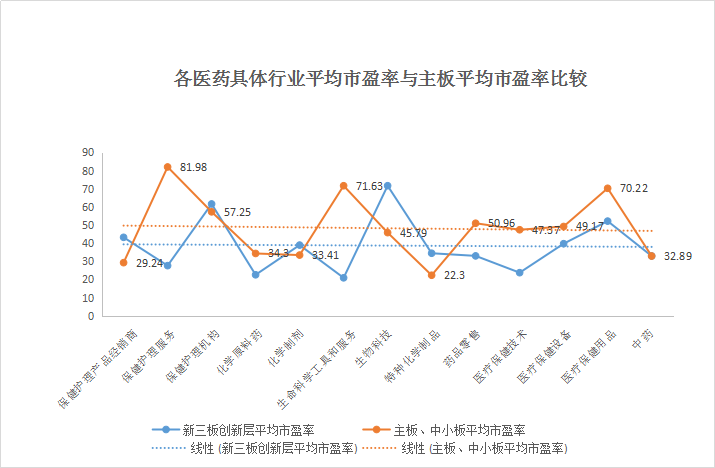
Given that overseas M&A targets are typically valued at around 10x EBITDA, there is an average valuation gap of at least threefold between domestic and international pharmaceutical assets. On one hand, domestic technology lags by “30 years”; on the other, international prices are “three times” higher. It is clear to all that a significant disparity in cost-effectiveness exists. For listed companies, this represents cross-border arbitrage, making cross-border healthcare M&A a dominant trend. As for investment institutions, having reviewed overseas healthcare projects, they are often reluctant to consider domestic opportunities.
From January to October 2015, the total value of mergers and acquisitions (M&A) by Chinese pharmaceutical companies reached RMB 100 billion, representing a year-on-year increase of approximately 80%, outpacing growth in other industries. The number of announced M&A deals totaled 260; however, only about 10% were overseas acquisitions. Below are the top 10 overseas M&A transactions in the healthcare sector in 2015:
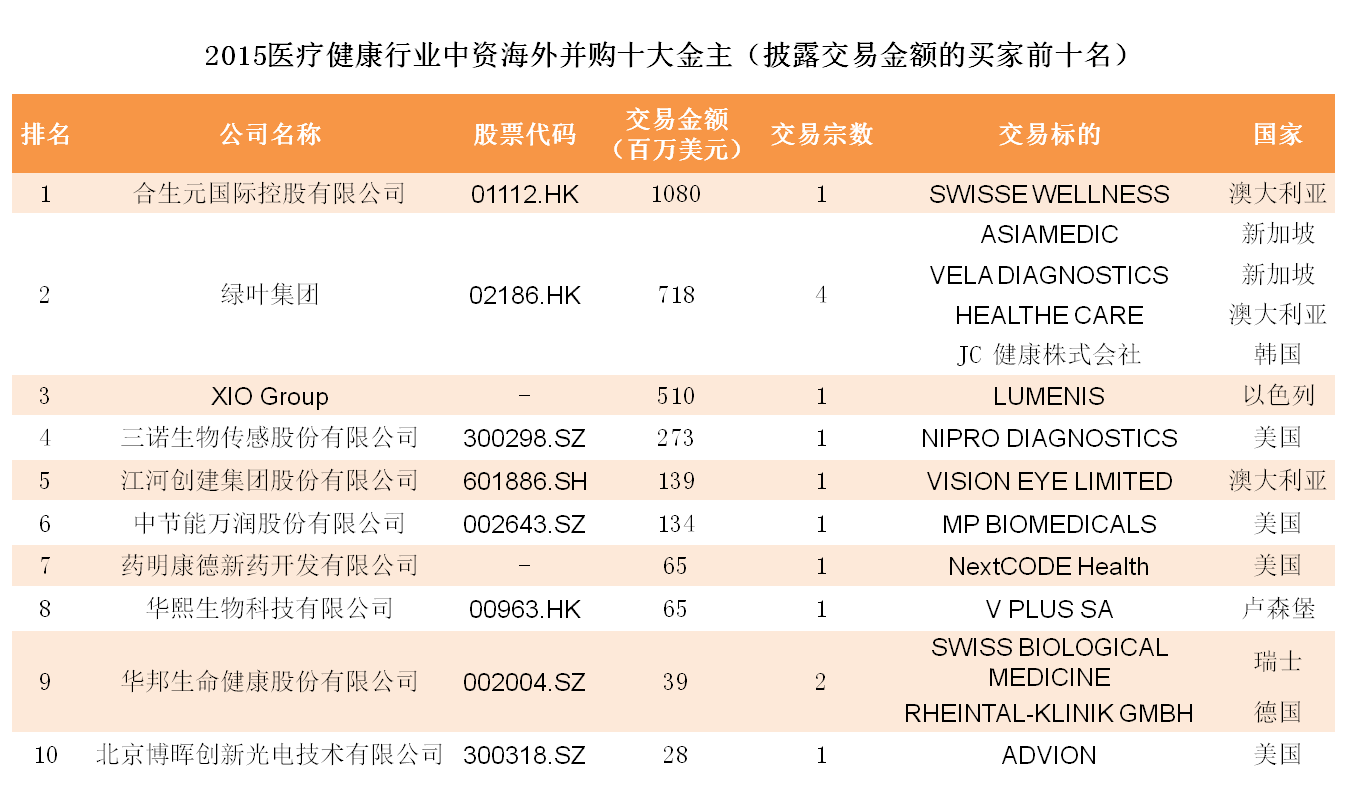
Only six deals exceeded $100 million in transaction value. In contrast, global M&A activity in the healthcare sector reached $677.5 billion in 2015, a 64% year-on-year increase, according to the latest data from Dealogic, a U.S.-based research firm. China’s healthcare M&A scale remains small, with individual targets also being relatively modest. Compared with major deals such as Pfizer’s $150 billion acquisition of Allergan in 2015, China’s overseas healthcare M&A is still in its early stages.
What Hinders Our Thinking and Action?
Many have witnessed this scenario, but only by examining our thinking can we improve our actions. The author elaborates on the current predicament and solutions from two perspectives.
Investment Mindset vs. Investment Banking Mindset
Listed companies in the healthcare sector are currently not short of cash; it is common for them to hold billions in reserves. However, with the growth of China’s domestic healthcare market slowing down, core business operations alone are no longer sufficient to support stock prices. As a result, an increasing number of listed enterprises are seeking overseas mergers and acquisitions (M&A). Yet, due to unclear M&A strategies and a lack of clarity regarding the types and scales of targets needed for corporate development, these companies often chase currently hot sectors, thereby disconnecting their actions from long-term strategic goals. On the other hand, due to insufficient international resources and professional expertise, they overly rely on prestigious foreign investment banks. These foreign banks often lack a deep understanding of the development of China’s healthcare market, offering advice based primarily on their past successful experiences abroad, while truly successful cases involving Chinese firms remain few and far between. This has resulted in much buzz among observers but very few actual transactions. The author believes that the root cause of this dilemma lies in the reliance on “investment banking thinking.” The essence of such thinking is short-term financial return, whereas the healthcare industry is characterized by long return cycles. Furthermore, as China’s overseas healthcare M&A activities are still in their early stages with limited experience, adhering to investment banking thinking will inevitably lead to significant challenges.
Would it be helpful to adopt an investment mindset? Overseas mergers and acquisitions (M&A) serve two primary purposes: “going global” and “bringing in.” “Going global” enables companies to realize their internationalization ambitions. For instance, Mindray has pursued an internationalization strategy since 2000. In 2008, it acquired the patient monitoring business of Datascope, a U.S. medical device manufacturer, becoming one of the top three players globally in this field and securing a valuable foothold in the highly competitive North American healthcare market, thereby achieving a substantive breakthrough in its internationalization journey. In 2013, Mindray further consolidated and refined its global business layout by acquiring Zonare Medical Systems, a U.S. producer of ultrasound diagnostic systems, for $105 million. Meanwhile, “bringing in” aims to introduce advanced foreign medical technologies and concepts. However, medical products are subject to an approval system in China; regardless of how mature a product is abroad, it must undergo re-approval in accordance with the requirements of the China Food and Drug Administration (CFDA), a process that typically takes several years. Evidently, both internationalization strategies and the localization of advanced foreign technologies require prolonged business efforts and the capacity to bear risks, which implies that overseas M&A in the healthcare sector must be approached with an investment mindset.
Establishing cross-border M&A funds is an effective approach to address the low success rate of overseas healthcare mergers and acquisitions (M&A) in China and the small scale of individual acquisition targets. M&A funds have a limited impact on corporate debt ratios. For listed companies, they can effectively mitigate the impact of public announcements and trading suspensions on stock price volatility. This makes them particularly feasible for Chinese healthcare enterprises with limited experience in overseas M&A. Given the high level of specialization in the healthcare industry and its early-stage development characteristics, participants in cross-border healthcare M&A funds should adopt a model comprising listed companies, securities firms, and healthcare-focused private equity (PE) firms to enhance the success rate of M&A transactions.
Deep-Rooted Thinking in the Healthcare Industry
In the second half of last year, as the secondary market entered a bear phase and many traditional industries weakened, numerous non-medical enterprises flocked to the healthcare sector. According to incomplete statistics from relevant sources, since 2015, more than 100 listed companies have entered the broader health industry. Some have undergone complete transformations through major cross-industry asset restructurings, while others have leveraged cross-sector moves to extend their core businesses or adopt a dual-core business model. The original core businesses of these listed companies venturing into the health industry are diverse, ranging from commercial trade, public utilities, real estate, and agriculture, forestry, animal husbandry, and fisheries, to textiles and apparel, machinery and equipment, chemicals, and electronic information, presenting a dazzling array of sectors. “These figures only reflect listed companies that have issued public announcements. For the majority of listed companies, those without any plans for medical sector expansion are now in the minority.” This is nearly the consensus view I have gathered from recent discussions with industry analysts at various securities firms. Conservatively estimated, nearly 1,000 listed companies are considering expansions into the medical and healthcare field. However, due to the prevailing perception that the medical industry is “complex and risky” (“deep waters”) and the scarcity of high-quality, cost-effective projects in China, it is difficult for these enterprises to realize their “medical dreams” through traditional investment approaches. Yet, with the emergence of an increasing number of professional healthcare investment institutions, this misconception about the medical industry being “too complex to navigate” will ultimately be corrected.
Whether cross-industry players are venturing into healthcare investment or healthcare companies are extending their core businesses, overseas equity investment represents an ideal pathway. The author believes that participating in cross-border healthcare funds, whether as a General Partner (GP) or a Limited Partner (LP), will provide significant opportunities for enterprises’ future healthcare strategic layouts. This is particularly true for private equity (PE) funds focused on healthcare: in addition to the aforementioned cost-effectiveness of overseas targets, differences in overseas healthcare regulations (such as those governing stem cell therapies) and the greater inclusivity of NASDAQ toward healthcare companies compared to China’s capital markets offer distinct advantages. Companies can pursue initial public offerings (IPOs) without requiring actual profits or even revenue, which undoubtedly provides an expedited exit route for healthcare PE projects. Furthermore, corporate participants in cross-border funds themselves possess the capability to facilitate exits through mergers and acquisitions (M&A), all of which significantly enhance the high financial returns of cross-border healthcare funds.
For participating corporate entities, the deeper significance lies in securing priority rights to acquire or subsequently invest in these overseas targets. This allows for extended observation of whether the projects’ growth aligns with the company’s development strategy, thereby enabling corporations to maintain full control over their entry and exit decisions. For most companies harboring “healthcare ambitions,” it is advisable to form consortia to jointly participate as General Partners (GPs) or provide subordinate capital in cross-border healthcare private equity funds. This approach facilitates a strategic transformation toward healthcare asset allocation at a lower cost. Such innovative healthcare fund projects hold substantial promise for future development.
In light of recent expectations for the short-to-medium-term depreciation of the renminbi following Brexit, RMB-denominated funds are poised to gain significant exchange rate advantages in their cross-border investment structures. These developments signal unprecedented opportunities for overseas investments in the healthcare sector. What we must do now is to shift the mindsets that hinder our progress and muster the courage to embrace innovation.