

Ping An's 'Ten Thousand Clinics' Officially Launches, Solidifying Its Healthcare O2O Model
On July 6, news of the launch of Ping An’s “Wanjia Clinics,” shared by the WeChat official account “Ping An Stories Unknown to Ping An Employees,” sent shockwaves through the healthcare industry. The focal point of widespread discussion was not merely the “launch” itself, but rather Ping An’s strategic shift away from the capital-intensive model of building and operating offline clinics in-house, toward an asset-light online franchise model. Why did Ping An transition its offline clinic operations from a heavy-asset to a light-asset approach? How will Wanjia Clinics synergize with Ping An’s existing healthcare resources? Read on for VCBeat’s analysis below.
The last time we heard news about “Wanjia Clinics” was in May this year, when Ping An Good Doctor secured $500 million in Series A financing. At the financing conference, Li Yuanxiang, Chairman of Ping An Life Insurance, remarked that the development stage of Wanjia Clinics resembles that of “Good Doctor” two years ago, when preliminary discussions were just beginning. How should we understand Wanjia Clinics and Good Doctor? A key point lies in controlling the entry points. For example, traveling from Beijing to Shanghai can be done by air, or via high-speed rail or highways by car. “Ping An Good Doctor” is akin to air travel, while Wanjia Clinics represent high-speed rail and highways.
Meanwhile, Wang Tao, CEO of Ping An Good Doctor, elaborated on the company’s 2016 development strategy, emphasizing its ambition to build a closed-loop medical O2O ecosystem through the “three-medical linkage” model integrating hospitals, physicians, and health insurance.
Nowadays, the “Wanjia Clinics” initiative has officially come to light. Although this revelation comes somewhat belatedly, its outcome appears to corroborate the statements made by Li Yuanxiang and Wang Tao. Despite Ping An’s earlier bold proclamation to invest RMB 50 billion over the next decade to establish Wanjia Clinics, the current reality falls far short of that ambition. However, a calm analysis suggests that the “asset-light” model adopted for Wanjia Clinics, as opposed to the simplistic and aggressive “asset-heavy” approach, is not merely a compromise driven by cost-control considerations.
Given that Ping An has adopted a franchise-based business model, it is inevitable to draw parallels with the food and beverage (F&B) industry. As is well known, the primary advantage of franchising in the F&B sector lies in its ability to accelerate development: rapid establishment of brand presence, technology adoption, product offerings, and operational models. By leveraging the mature experience of franchisors, operators can avoid the hardships associated with exploratory trial and error. However, the drawbacks are equally evident. Franchisees typically face substantial costs, including licensing fees, management fees, training fees, security deposits, as well as higher expenditures on equipment and ingredients, which constitute a significant financial burden. Meanwhile, franchisees forfeit the development of core competencies—such as brand building, technological innovation, and model design—effectively reducing them to mere distributors of the franchisor’s brand.
Information available on the official website of “Wanjia Clinics” also reveals that, similar to restaurant franchising, Ping An has introduced four major support services and a “Five-Standardization” medical system as its brand hallmarks. Building on these brand features, “Wanjia Clinics” offers four tiers of partnership models for offline clinics, allowing them to freely choose based on their own conditions. To maximize the brand value of Ping An’s “Wanjia Clinics,” strict adherence to the standard system established by Ping An is required.
Unlike the food and beverage industry, within the “Wanjia Clinics” franchise system, core medical technologies and equipment remain under the control of the clinics themselves. Building on standardization and branding, Ping An’s “Wanjia Clinics” provides franchisees with services including patient acquisition, clinical support, centralized procurement of pharmaceuticals and medical devices, referral coordination, and health management. Meanwhile, to incentivize clinic participation, the “Wanjia Clinics” program is currently offered free of charge (it remains unclear whether fees will be introduced in the future). Thus, according to Ping An’s ideal scenario, only two types of offline clinics will exist in the future: those affiliated with Ping An and those independent of Ping An.
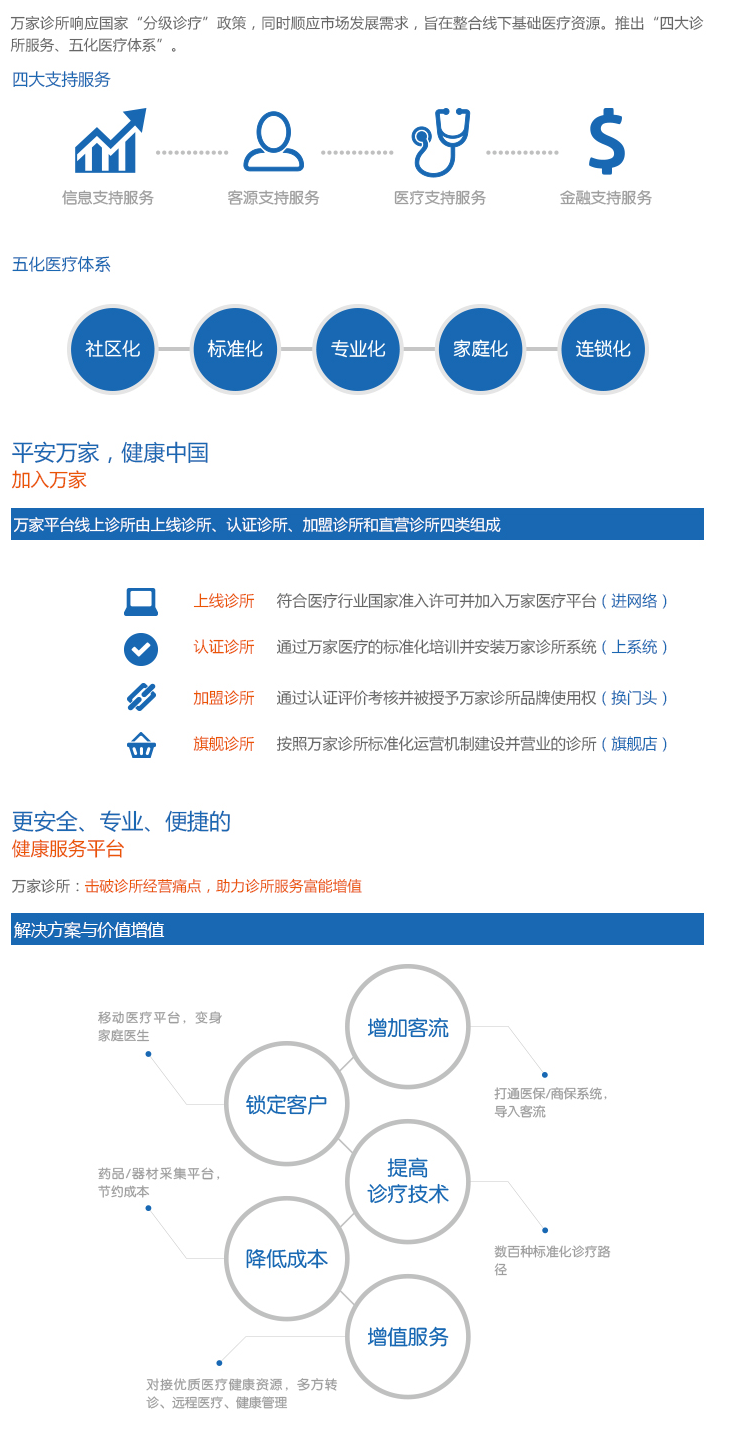
“Wanjia Clinics” Partnership Model Overview
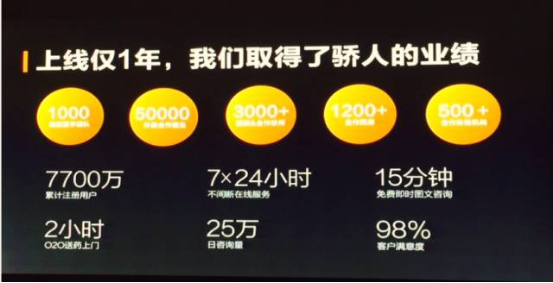
Although the platform is still in its early stages and gaining recognition in the clinic market will take time, leveraging Ping An’s undeniable appeal—backed by its substantial financial strength—it will not be difficult to achieve a certain scale in the short term. Not to mention Ping An Health’s self-built team of 1,000 full-time physicians and its network of 50,000 contracted external doctors; even considering only Ping An’s 30 million health insurance users and 1,200 partner pharmacies, these resources constitute “nuclear-grade” assets that offline clinics can only dream of. Therefore, whether the “Ten Thousand Clinics” initiative will gain significant momentum has long been determined.
At the financing conference held this May, “Ping An Good Doctor” announced that its registered users had surpassed 77 million, with daily peak visits exceeding 250,000. During VCBeat’s research, it was found that the main sources of its user growth were threefold: first, offline user resources from Haoyaoshi Pharmacy under Jointown Pharmaceutical Group and Huashi Pharmacy under Shanghai Pharmaceuticals; second, mobile users from Sogou and Baidu Mobile Assistant; and third, users redirected through social applications such as WeChat and QQ.
Overall, however, the user base of “Ping An Good Doctor” is predominantly on mobile online platforms, while offline primary care clinics—particularly those with the broadest and most frequent patient contact—have not yet been incorporated. Perhaps to better triage and direct patients, Ping An has not integrated “Wanjia Clinics” as a functional module within Ping An Good Doctor, as it did with other medical resources such as pharmacies and online consultations; instead, it operates “Wanjia Clinics” as an entirely new sub-brand.
As Li Yuanxiang stated, “Ping An Good Doctor” is the airplane, while the Wan Jia Clinics are the high-speed rail and highways. “Ping An Good Doctor” and the Wan Jia Clinics are not adversaries competing for the same market share; rather, they serve as two critical levers for Ping An to maximize its user ecosystem.
Due to the weakness of primary healthcare, China’s tiered diagnosis and treatment system has repeatedly encountered setbacks in its implementation. To break this deadlock, a comprehensive upgrade of primary healthcare—the first line of triage—is imperative. As an resource-integration platform and standard-setter, “Wanjia Clinics” should assume this responsibility and obligation. Therefore, the yet-to-be-launched Wanjia Academy is likely Ping An’s re-education system established to enhance the medical proficiency of grassroots physicians.
Meanwhile, for Ping An, gaining control over a certain number of primary care clinics and physicians would provide significant leverage in collaborations with large medical institutions that are vigorously implementing the national tiered diagnosis and treatment policy. This would effectively allow Ping An to control the entry point of the tiered diagnosis and treatment system to a certain extent.

According to Ping An’s strategic plan, the simultaneous development of online and offline channels will be the core focus in the future. The online channel aims primarily to build a traffic-entry platform, achieving the integration of medical, pharmaceutical, and information networks through products such as rapid consultation, health plans, a health e-commerce store, a health community, and home medication delivery services.
In the offline sector, with the goal of implementing services on the ground, Ping An is continuing to expand recruitment for its full-time, self-built physician team to improve the efficiency of online communication between users and doctors. Meanwhile, it is engaging in deep collaboration with vertical partners in fields such as pharmaceuticals, medical devices, health management, and nursing care, as well as with health and pharmaceutical regulatory authorities, to build the Ping An Good Doctor O2O industry chain. The launch of the “Ten Thousand Clinics” initiative incorporates primary care clinics—a segment previously untapped—into the offline component of its O2O model, representing a robust supplement to Ping An’s offline resources.
From VCBeat’s perspective, the launch of “Wanjia Clinics” has shifted industry focus toward debating the relative merits of asset-light versus asset-heavy models. However, the true core issue remains corporate development strategy. The critical questions to address are how to create synergies between new business lines and existing resources, how to seize first-mover advantages under the guidance of national policies, and how to leverage inherent strengths to establish industry standards and market leadership in emerging sectors.