Record-Breaking Investments in China's Digital Health Sector in H1 2016: Capital Flows into Eight Key Subsectors
Description:VCBeat’s quarterly investment and financing reports have previously been themed around “Internet Healthcare,” a broad concept that extends beyond the medical sector to encompass other areas of the health industry, including healthcare, wellness and preventive care, elderly care, cosmetic surgery, and fitness. These reports also cover not only internet-related technologies but also other digital information technology fields. To avoid misinterpretation, starting from this issue, the title has been changed toDigital HealthSubject term. It broadly refers to innovative fields in healthcare that are closely related to information technology and digital technology, known in English as Digital Health.
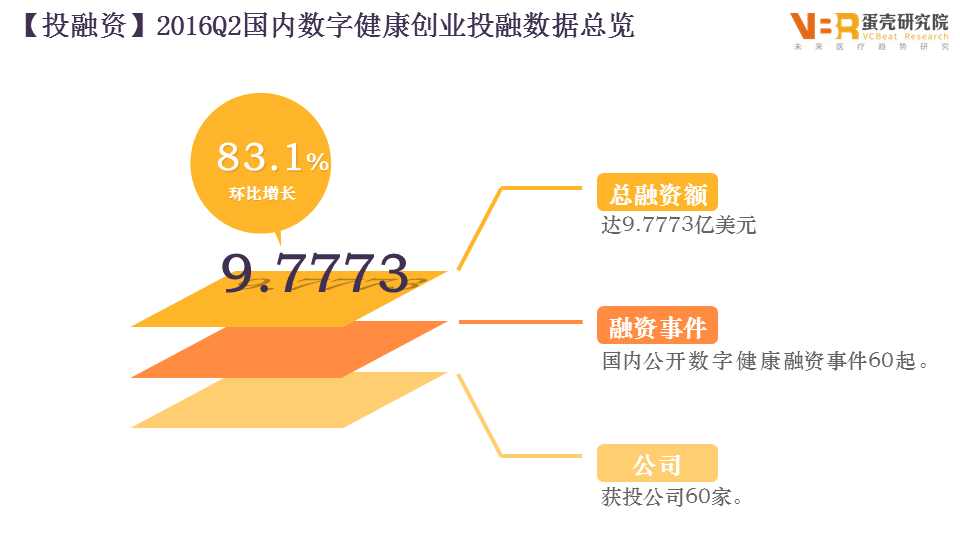
As of June 30, 2016, VCBeat Institute compiled and released the Q2 2016 China Digital Health Market Investment and Financing Report, based on publicly available data on digital health investments and financing in China. In the second quarter of 2016, there were a total of 60 investment and financing transactions, with the total funding amount reaching $977.73 million, representing an 83.1% quarter-on-quarter increase.
This provides strong data-driven evidence for the ongoing debate among industry insiders on whether digital health has entered its second half or is just getting started.
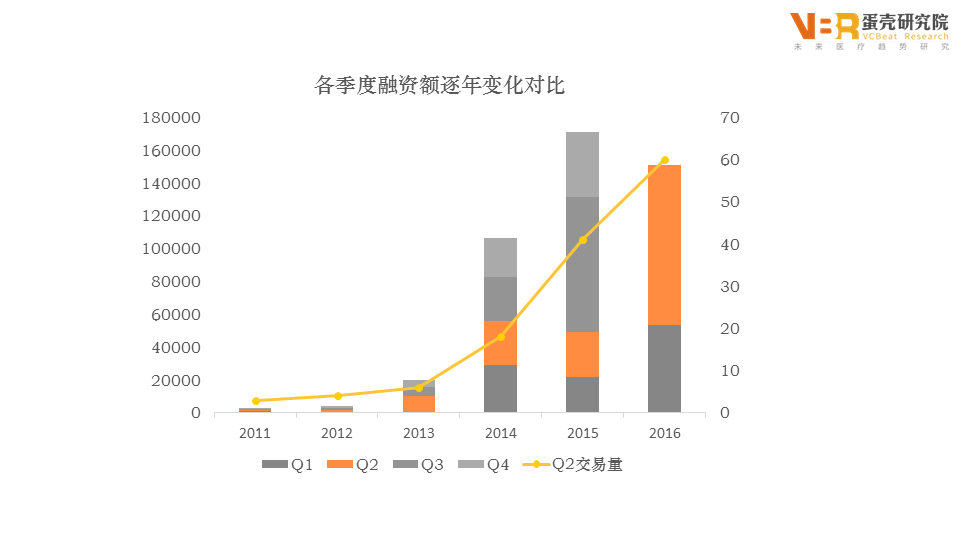
Based on an analysis of investment and financing data from the VCBeat database since 2011, 2014 marked a significant watershed in the history of digital health, with financing amounts increasing by more than fivefold year-on-year. Since then, financing has grown steadily each year, and is projected to reach a new high in 2016. Driven by technological maturity and scaled market operations, financing volumes are expected to continue rising in the coming years.
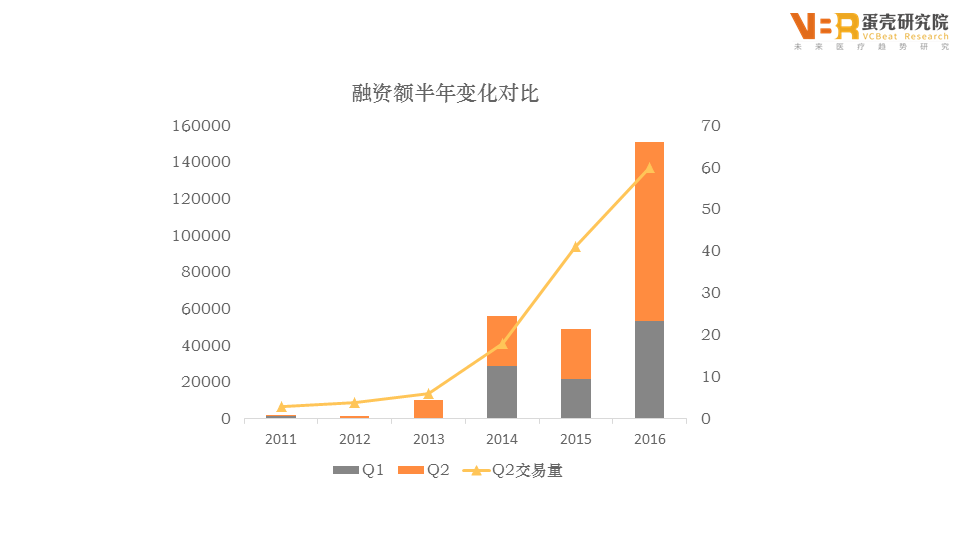
Data on investment and financing released every six months shows that in the first half of 2016, investment and financing exceeded $1.5 billion, a year-on-year increase of 208%, marking another historical high since the major surge in 2014. Into which sectors did such a large amount of capital flow?
According to the report, capital flowed into a total of 42 sub-sectors in the first half of 2016. The eight most favored sectors by investors (each with more than five transactions) accounted for 47% of the total number of transactions and approximately 30% of the total transaction value.
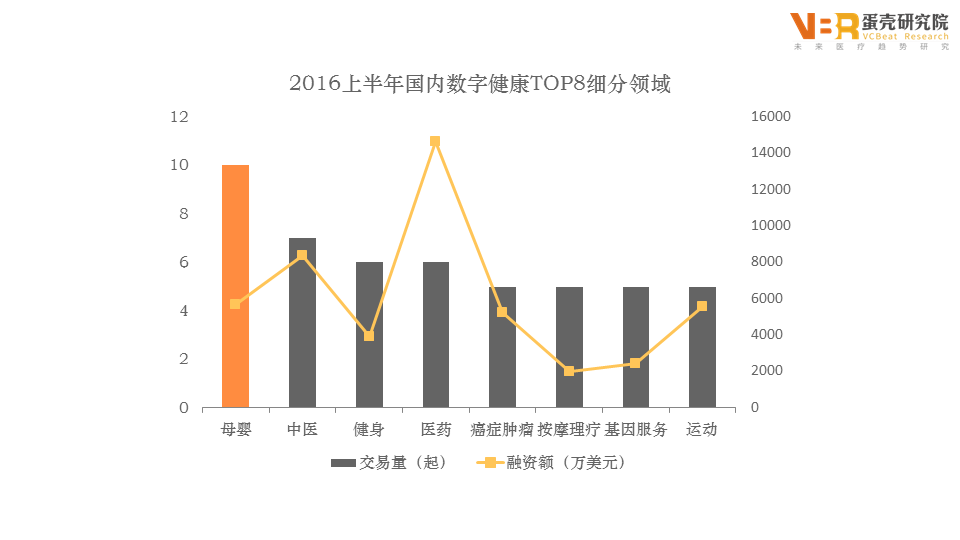
The maternal and infant market has taken the lead, attracting significant investor interest, particularly driven by the implementation of the “universal two-child” policy.
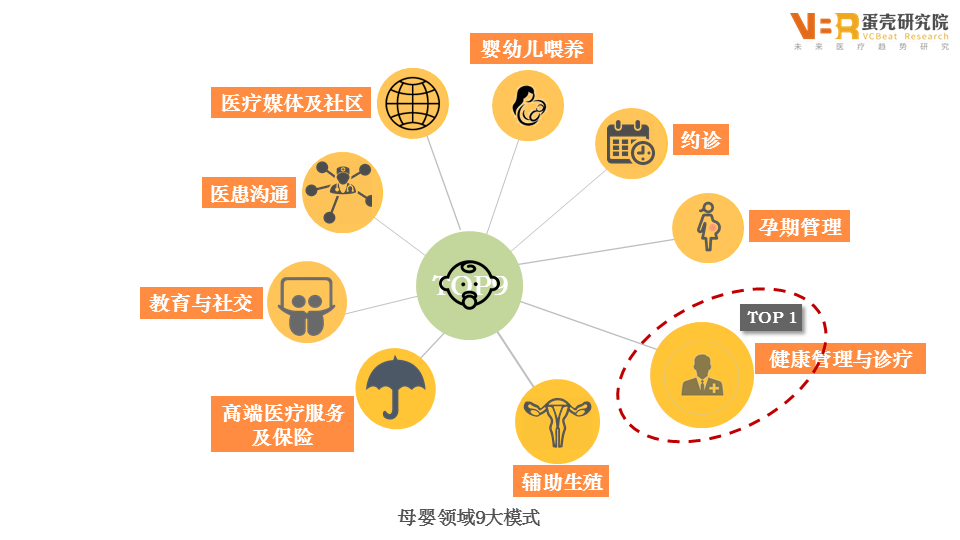
Of the 10 maternal and child health projects that secured investment (Yuguo Doctor, Parenting Q&A, Banmi Pregnancy, Rainbow Parenting, Yuxueyuan, Fengxinzi, Sunshine Women and Children, Hamigua Tech, Jiahao Tech,Mommy Knows (Highest Funding, Series B, RMB 100 Million)) covering nine major models. Overall, they all follow a “deep + vertical” strategy, providing in-depth information and high-quality services to establish competitive barriers.
Next is traditional Chinese medicine, with 7 transactions (Gushengtang (Series C, $70 million, currently the largest single financing round in China's traditional Chinese medicine sector), Junhetang, Wei Zhongyi, Xiaolu Clinic, Gancao Doctor, Kuaiwen TCM, and Jin Huatuo), with total financing reaching USD 83.55 million. The business models are categorized into five major types: doctor-patient communication, medical services, medical media and communities, appointment scheduling, and comprehensive services. In the recent report released by VCBeat"Internet Plus Traditional Chinese Medicine" Industry Venture Capital Trends ReportAs can be seen, this sector is currently quite active. It is worth noting, however, that most “Internet + Traditional Chinese Medicine (TCM)” companies primarily focus on addressing minor ailments for the general public, which does not constitute a rigid demand. Moreover, influenced by the broader environment, TCM is increasingly gaining attention from the international community. Amidst internal challenges and external pressures, how to innovate in the realm of Internet-based TCM—characterized by non-critical pain points, lack of rigid demand, and low frequency—may be a question worthy of consideration for entrepreneurs.
Tied for third place are the fitness and pharmaceutical sectors. For years, the domestic fitness industry has been characterized by inadequate infrastructure and supporting services, as well as a fragmented market brand landscape, which has consistently provided favorable entry points for internet-based players. This is also one of the key reasons why the sector has continued to attract capital attention. Projects that secured investment in the first half of the year include FitTime (Ruijian Shidai),Keep (Series C, $32 million), Lianleme, Counterattack Academy, Qingcheng Technology, Xiaoxiong Kuaipao) are concentrated in education, social networking, and vertical e-commerce. Characterized by high volume and asset-light operations, they are still in the early stages of development, leaving substantial market potential to be fully tapped.
The most concentrated segment in the pharmaceutical sector is pharmaceutical e-commerce, which is closest to monetization and has attracted the largest amount of financing among the fields most closely watched by investors (Dekai Pharmacy,Jianke.com (Series A, $100 million), Yao Pianyi, Yaopin Zhongduan Wang, Yaoshibang, and Smart Medicine Box), reaching $146.3 million. The core issue in this market lies in the fact that physicians hold prescription authority, while patients have limited bargaining power due to information asymmetry and other factors. Only with the continuous liberalization of online sales of prescription drugs and the strict implementation of controls on the proportion of pharmaceutical revenue in hospitals will pharmaceutical e-commerce enter a critical period of development.
Tied for fourth place are oncology, massage and physical therapy, genetic services, and sports. For internet-based projects in the massage and physical therapy and sports sectors, service is the core component. However, low industry entry barriers have led to largely identical business models and severe homogenization. Delivering differentiated services presents both an opportunity and a challenge.
In the field of oncology, current domestic projects in China mainly focus on precision cancer treatment, doctor-patient communication platforms, patient mutual aid and insurance, and services for oncology specialists. However, based on investment and financing transactions, technology-driven companies are more favored by capital.
Genetic Services Market (iGene, HaploX, Action Gene)(Series B, $12.5 million), decoding DNA, Starship Genomics) are focused on market-oriented, consumer-facing genetic testing. If these services can be widely promoted and popularized while technological innovation is strengthened, the stark reality could become much more promising.
Of course, the vast digital health market extends far beyond these eight most promising sectors. This market offers substantial opportunities and presents numerous challenges that urgently need to be addressed. There is a pressing need for various digital solutions tailored to China’s healthcare environment. Key areas such as internet hospitals, telemedicine, healthcare informatization, medical big data, health management, and the application of emerging technologies—including artificial intelligence (AI), virtual reality (VR), augmented reality (AR), and 3D printing—are all poised to become mainstream directions in future healthcare services.
To access the full content of the “Q2 2016 China Digital Health Market Investment and Financing Report,” please click “2016 Q2 Investment and Financing ReportPurchase the paid version. [P.S. Buyers can add the WeChat ID “moluo1111” to obtain the raw Excel data for the current season.]