

How Far Is the Future of Precision Medicine?
On July 9, 2016, the Legend Stars WILL Conference was held in Beijing. At the Precision Medicine sub-forum, attending guests engaged in insightful discussions on precision medicine and shared their respective viewpoints.
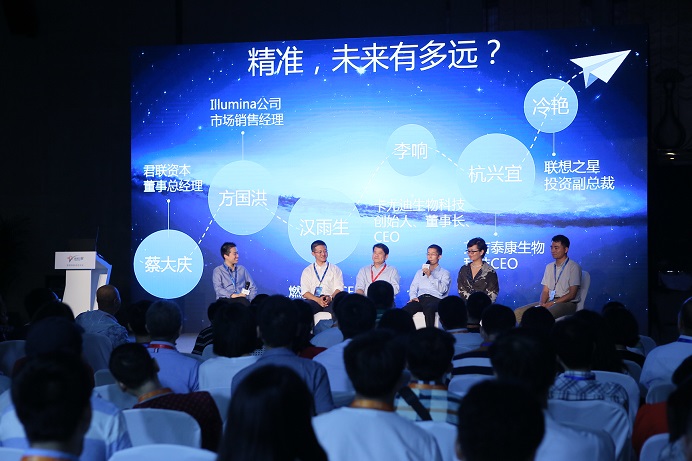
From left to right: Cai Daqing, Director at Legend Capital; Fang Guohong, Sales Manager at Illumina; Han Yusheng, CEO of Burning Rock Biotech; Li Xiang, Founder and CEO of Cayody Biotechnology; Hang Xingyi, CEO of Aiji TaiKang Biotechnology; and Leng Yan, Vice President of Investment at Legend Star.
The "three-stage" concept referred to here is not a logical syllogism, but rather indicates that precision medicine is currently in a phase of rapid growth, which may be followed by an adjustment period in the next six months to a year. In the long run, the prospects for sequencing technology-driven precision medicine are very promising. The medical revolution led by genetic technologies is actually still in its very early stages.
Amid the current capital market environment, sentiment has cooled in many niche sectors; however, the gene-related industry remains overheated, whether in terms of entrepreneurship or valuations. In reality, from the perspective of basic medical science, the correlations for many complex diseases are not yet clearly defined. I personally believe that we are still some distance away from a systematic, large-scale industry boom, so we are still on the journey. Nevertheless, the warm winds of hype have already begun to blow. It remains uncertain whether the “pigs will fly,” but there is no shortage of disruptors stirring up the market.
There is a bubble in precision medicine, and it is far from negligible. In my view, the bigger issue with this industry lies not in the high or low valuations of individual companies, but in the collective frenzy that drives investment into companies fundamentally unworthy of funding.
Every industry has its own standard multiples; one cannot define an entire industry by the multiples of a single sub-sector. Since these benchmarks are artificially established, they constitute industry norms. By assessing how many medical problems we can solve and the size of the patient population, we can calculate the market capacity. Once the market size is determined and a company’s position within the industry is identified, the company’s valuation becomes justified. Therefore, bubbles should be viewed from both positive and negative perspectives.
Centralization and decentralization are coexisting states at certain stages of industry development and levels of technological advancement. There are several key elements in the transition from centralization to decentralization.
First, there must be sufficient openness. Of course, this refers not only to the openness of the products and services themselves; when selling products or marketing services, the most important thing isIPOpenness—technological openness and business model openness. When you possess a core technology, you should adopt the mindset of enabling more people to generate greater value on this technological platform.
Second, decentralization is not an end in itself but merely a means; indeed, from a higher-level perspective, it represents a more advanced form of commercial civilization. This process entails the redistribution of technology, resources, and even capital, as well as the reallocation of benefits, while simultaneously driving reforms and enhancements in industry efficiency.
These are two distinct technologies with different application scenarios. Whether decentralized or centralized, each has its own utility depending on the specific use case. Decentralization is not contradictory; advanced sequencing enables effective detection of unknowns, offering solutions for many currently intractable and complex diseases.
Precision medicine comprises two major components. First, preventive care—treating disease before it occurs—with an emphasis on precision prevention. Next-generation sequencing can help prevent future tumor development by enabling early screening and diagnosis, making precision prevention critically important.
Second, treat the disease once it has manifested. Chinese philosophy is extensive and profound; previously, we practiced “same treatment for the same disease, different treatment for different diseases,” which can be summarized in four phrases to encompass precision medicine. With molecular biology and testing platforms, we can more precisely determine what is occurring at each stage of a tumor, thereby advancing to the next level: “different treatments for the same disease, and the same treatment for different diseases.” This is the essence of precision.