

WeDoctor's 'Chinese-Style ACO' Achieves New Milestone: 3.2 Million Health Insurance Users
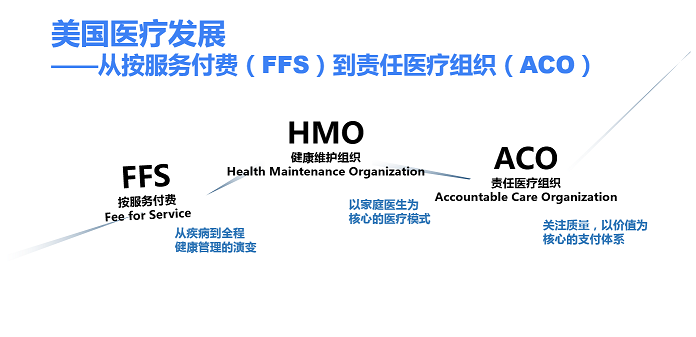
Healthcare payment in the United States has evolved through three stages. Fee-for-Service (FFS) was the earliest model and remains the predominant mode of healthcare payment in China today. Later, as healthcare providers’ excessive profit-seeking placed significant financial strain on the U.S. insurance system, the second stage emerged with the introduction of Health Maintenance Organizations (HMOs). Built around insurance entities, HMOs provide preventive health management for members through annual or monthly capitated payments.
Under this model, regardless of the treatment methods adopted by physicians, the primary objective is to control healthcare costs and avoid waste and overtreatment. However, due to the closed nature of the HMO system and its sensitivity to medical expenses, patients often fail to receive effective treatment in the early stages of illness, thereby allowing minor conditions to progress into severe diseases. To address the shortcomings of the HMO model, the third-stage ACO model was introduced under the strong advocacy of U.S. President Obama.
Unlike HMOs, the ACO model integrates health management organizations and healthcare providers into a tightly coordinated entity on the basis of cost containment. It not only assists members in developing personalized health management plans but also proactively intervenes in their health through precision medicine and other approaches. Under this framework, healthcare institutions, members, and insurance organizations can all maximize their benefits. Consequently, the ACO model has become a primary direction for the future development of healthcare systems.
However, given the vastly different soil environments, it is by no means easy to develop the U.S. ACO model in China. Practical dilemmas lie ahead, such as how to address issues between payers and providers, how to integrate resources from various parties, and how to improve the level of primary healthcare. If WeDoctor aims to successfully establish an ACO system, these challenges are formidable obstacles that must be overcome.
Armed with numerous questions, VCBeat visited WeDoctor. Through interviews with WeDoctor’s senior executives, VCBeat gradually gained a comprehensive understanding of WeDoctor’s “Chinese-style ACO” model and the series of innovative solutions it has developed to address various challenges.
In the U.S. ACO system, payers hold a dominant position relative to healthcare providers. In China, the situation is precisely the opposite. Due to the weak position of insurance payers in China, issues such as overutilization of medical services and excessive healthcare expenditures have persisted despite repeated efforts to curb them. Commercial insurers are hesitant to enter the healthcare market; although they aspire to make an impact, each venture has resulted in losses. The difficulty in implementing local reforms is, to some extent, attributable to the reluctance of commercial insurers to participate.
The U.S. Accountable Care Organization (ACO) model represents a highly market-driven business approach, in which insurers, hospitals, and physicians all operate according to market mechanisms. The core enabler of this system in the United States is its robust data infrastructure. Effectively integrating healthcare and insurance data platforms hinges on a comprehensive platform capable of precise data analytics, thereby preventing insurance fraud and controlling costs. It is on this foundation of commercial contracts and data support that U.S. entities are able to collaborate and coexist symbiotically.
Constrained by the limitations of the healthcare system, domestic companies cannot simply copy and replicate the American ACO model to develop their own. Blindly adopting the U.S. model would inevitably lead to numerous problems, with virtually zero chance of success. WeDoctor, using the U.S. ACO model as a blueprint and leveraging its accumulated advantages in the field of internet healthcare, has achieved similar results through an entirely new operational model.
Micro Medical Group is building an interconnected platform that enables seamless data exchange and open sharing between healthcare and insurance sectors. By facilitating data interoperability and sharing, this initiative will fundamentally resolve information asymmetry caused by data gaps or opacity. It will significantly mitigate insurance fraud—the primary concern of commercial insurers—and substantially enhance cost-containment capabilities in healthcare. This represents a major impetus for the insurance industry.
Furthermore, while the U.S. ACO model is largely built upon traditional healthcare institutions, WeDoctor seeks to establish its own distinctive approach through internet-based healthcare. Over the past five years, WeDoctor has made significant strides in optimizing hospital workflows, implementing tiered diagnosis and treatment via the internet, developing internet hospitals, and promoting team-based care. Leveraging internet technologies to address the shortcomings of traditional healthcare, while neither rejecting nor excluding conventional medical practices, constitutes WeDoctor’s accumulated operational playbook.
The ACO model involves the coordinated operation of healthcare payment and service delivery systems; it is difficult to successfully establish an ACO system relying solely on a single-domain oligopoly. Drawing on the ACO structural model, WeDoctor has made numerous bold attempts to integrate resources from various stakeholders.
From five major perspectives, the WeDoctor ACO system leverages an internet data platform to aggregate advantageous resources across various fields, forming a diversified and open internet healthcare ecosystem. In terms of service standards and quality control, WeDoctor, as the data integration hub, exercises comprehensive oversight. This enables the delivery of integrated and controllable services to members, thereby establishing a standardized operational model.
The U.S. ACO model imposes stringent requirements on the standard and quality of primary care. In contrast, the generally low level of primary care in China presents a practical challenge for WeDoctor. To fundamentally improve the current situation, WeDoctor has focused on enhancing physicians’ knowledge through education and established general practitioner teams to address the overall weakness of primary care in China.
WeDoctor has appointed He Chao, former president of Sir Run Run Shaw Hospital, as the head of its General Practice Medical Center. It is also collaborating with Professor Zhu Shanzhu, Chair of the Department of General Practice at Fudan University’s Shanghai Medical College, to jointly establish the “WeDoctor Academy of General Practice.” Through building a foundational training system for primary care and strengthening professional guidance from its expert team, WeDoctor aims to comprehensively elevate the quality of grassroots healthcare services, thereby laying a solid primary-care foundation for the implementation of the Accountable Care Organization (ACO) model in China.
Tiered diagnosis and treatment plays a crucial role in improving the efficiency of medical services and reducing healthcare costs. Traditional tiered diagnosis and treatment systems are often implemented through medical consortia. In contrast, WeDoctor has established a “Three-Physician Management” system, comprising health managers, primary care physicians, and specialist teams, to achieve patient triage.
Through the management of health managers and responsible physicians, WeDoctor keeps members’ common and frequently occurring diseases, as well as health management and lifestyle intervention issues, at the primary care level, while referring complex and severe cases encountered by members to WeDoctor’s team of experts. Leveraging data connectivity, the expert team feeds back treatment plans to the responsible physicians via the platform, who then provide corresponding assistance in members’ subsequent health management. Through the coordinated “Three-Physician Management” model, WeDoctor has effectively implemented tiered diagnosis and treatment for its members.
It is worth noting that WeDoctor’s expert teams also constitute a small-scale tiered diagnosis and treatment system. When members require support from top-tier specialists, they can be connected to these experts for consultation and treatment through the organizational structure of the expert teams. Overall, WeDoctor’s “Three-Physician Management” system is not a tiered diagnosis and treatment system in the traditional sense; rather, it integrates a dual-tiered diagnosis and treatment framework within its expert teams. Compared with traditional models, this approach offers greater flexibility and efficiency, thereby providing members with superior services.
The primary distinction between the ACO model and the HMO model lies in their respective priorities: HMOs place greater emphasis on cost containment, whereas ACOs prioritize improving member health outcomes and maintaining wellness. After decades of development in the United States, the HMO model has faced increasing scrutiny, largely because it has failed to adequately address patients' health issues.
The ACO model places greater emphasis on the concept of accountable physicians. Accountable physicians are responsible not only for disease management among members but, more importantly, for proactive health interventions. Based on this principle, Weiyi approaches member health management and disease prevention from three key aspects.
1. By collaborating with leading domestic gene sequencing companies, we help members achieve a better understanding of their current health status and future health risks.
2. By refining the team of health managers, establish health management models segmented by population and disease type.
3. For the general population affected by the five major chronic diseases, collaborate with relevant enterprises to establish a chronic disease management system.
Hailiying Technology is one such participant. Through Hailiying’s all-in-one health kiosk, Weiyi’s responsible physicians leverage 3G/4G IoT technology to connect health records, public health examinations, chronic disease follow-ups, medical test items (electrophysiology, biochemistry, imaging), electronic medical records, questionnaire surveys, two-way referrals, video consultations, as well as local chronic disease population management and big data statistics with expert teams. Using this tool, Weiyi has established a mobile workstation for general practitioners internally, creating a closed-loop service system for members that encompasses comprehensive health management, disease prevention, and treatment.
From the perspective of VCBeat, ACO appears to be a culmination of WeDoctor’s integrated efforts. By leveraging internet technology to facilitate the supply and allocation of medical resources, this approach helps members improve their physical health and quality of life. This strategy not only capitalizes on WeDoctor’s inherent strengths but also aligns with the management philosophy of the ACO model. Furthermore, by positioning itself under the ACO banner to define its future core business, WeDoctor is more likely to resonate with the capital market—a move that effectively kills three birds with one stone.
Although the ACO model was first proposed and implemented in the United States, its form is not static. With the rise of internet technology, the overall improvement of national healthcare standards, the optimization and transformation of medical systems, and the introduction of new policies, the ACO model will continue to evolve and iterate, giving rise to diverse variations. For Chinese enterprises developing the ACO model, it is essential to cultivate the ability to leverage their own strengths and adapt to local conditions to address various emerging challenges.
Since this goal was proposed last year, WeDoctor has amassed 3.2 million health insurance users in less than a year. This positive market response to innovation has also provided a significant boost to the development of Accountable Care Organizations (ACOs) among Chinese enterprises.