

Guangdong's First Doctor Group Secures License with a Capital-Intensive Model, Files IPO Prospectus
Since 2015, physician groups—a new phenomenon—have been emerging in large numbers across China. In February 2016, the Physician Group Alliance, jointly initiated by seven major physician groups, further fueled the momentum of this emerging trend.
According to statistics, there are currently over one hundred physician groups in China, and more than ten listed companies have established their own physician groups. For example, Hengkang Medical established the Hengkang Medical Shanghai Physician Group, and Yibai Pharmaceutical jointly invested with experts to set up the Anhui Oncology Physician Group.
In the first half of this year, several physician groups announced significant financing rounds. Notably, Dr. Zhang Qiang Physician Group, a flagship player in the industry, secured a substantial RMB 100 million in funding, dispelling earlier rumors about its failed fundraising efforts.
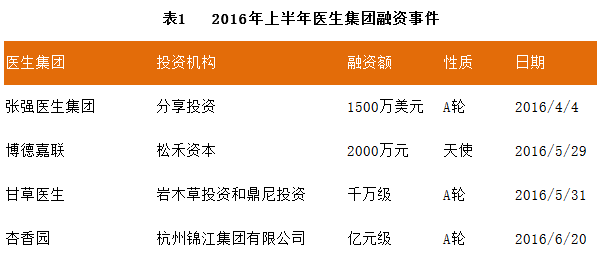
Venture capital-backed physician groups are likely largely aiming toward the securitization of physician resources. The funds raised are predominantly directed at “enclosing” physician resources, which includes directly signing contracts with renowned experts, promoting expert techniques, and cultivating more high-quality physician teams. For instance, Zhang Qiang, who has abandoned the asset-heavy model, stated that he hopes to use this round of financing to, on one hand, promote his proprietary techniques in vascular surgery to 20 provincial capital cities across China and impart them to local outstanding physicians; and on the other hand, establish approximately 10 additional physician groups in other specialties within the year, following the model of the vascular surgery physician group, thereby expanding business volume.
Such a model enables a lean and rapid expansion, yet it has also drawn skepticism. Some argue that it merely acts as a “porter” for physicians—recruiting them and then facilitating their multi-site practice at other hospitals—without addressing the core pain points faced by doctors.
So, what exactly are the pain points for physicians? Is the policy orientation aimed at balancing resources rather than concentrating them? Does the government encourage social capital without letting it run rampant? Do they seek transparent and respectable income? Autonomous practice rights? Access to professional medical assistants and business support teams? The authority to make treatment decisions based on technical merits and their own professional values? Perhaps all of the above, and even more.
For physicians in medical groups, practicing at high-end hospitals with strong reputations, such as United Family Healthcare, allows them to integrate into and benefit from patient-centered, internationally aligned hospital management systems. However, if they are limited to practicing in public hospitals or ordinary private hospitals, their practice environment sees little improvement. Lin Zihong, founder of the Guangzhou United Physician Group, stated that they are still exploring models that better reflect the value of physicians, thereby providing alternative options for the medical community.
The model and development path chosen by each physician group fundamentally reflect the founder’s understanding of the current state of the overall healthcare system and their perceived logic for change.
In Dr. Lin Zihong’s view, simply pulling physicians out of public hospitals will not resolve the current state of widespread disorder. Why are physicians, especially those in large hospitals, so busy and exhausted? While there is indeed a high patient volume and numerous additional tasks, a significant part of the problem stems from the disarray caused by “forced” hospital management.
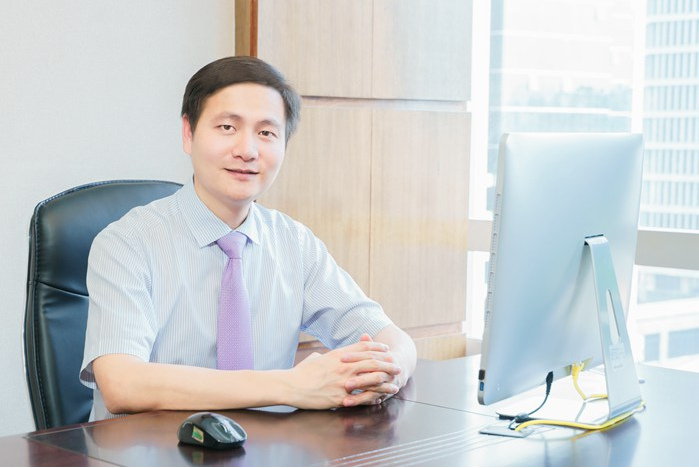
Lin Zihong, Founder of Guangzhou United Physicians Group
In 2014, Dr. Lin Zihong began organizing a group of young and middle-aged experts to explore a medical business model led by physicians themselves and centered on patient outcomes, which gradually evolved into the establishment of a united physician group.
Following the establishment of a joint physician group, Lin Zihong’s team founded two operational entities: Guangdong Weier Hospital and Guangdong Weier Industrial. The aim is to create a relatively comprehensive healthcare ecosystem by achieving full coverage of physicians, practice locations, and medical technology management platforms.
Well Group Organizational Chart
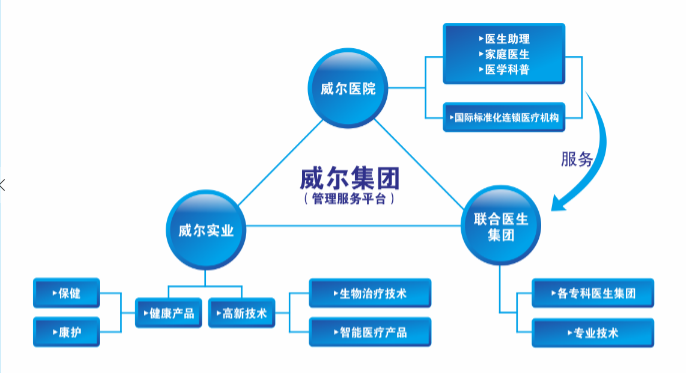
Among them, United Doctors Group advocates for tiered diagnosis and treatment and boasts a professional team of family physicians. Leveraging its unique strengths, the group provides patients with personalized, comprehensive, and high-quality one-stop medical services spanning pre-diagnosis, during-diagnosis, and post-diagnosis phases. These services specifically include internet-based healthcare offerings such as personalized pre-diagnostic screening, online health consultations, patient navigation and triage, and health management.
The founding vision of Will Hospital was to establish practice sites that embody the medical management philosophy of physician groups, encompassing both specialized medical centers and comprehensive hospitals. Since its inception, Will Hospital has adopted the accreditation standards of the Joint Commission International (JCI), the assessment criteria of the Australian Council on Healthcare Standards (ACHS), and the Evaluation and Quality Improvement Program (EQuIP) framework as its operational guidelines to ensure international standards of service.
Weier Industrial positions itself as a medical technology R&D institution, with its current business primarily focused on two major sectors: health products and high-tech solutions. This encompasses the research and development, promotion, and sales of healthcare and wellness products, biotherapeutic technologies, and smart medical devices.
Dr. Lin Zihong’s original intention in founding the physician group was to transform the current disordered state of healthcare and enable patients to receive genuine tiered diagnosis and treatment.
Since May of this year, Guangdong Province, where Dr. Lin Zihong practices, has issued three consecutive policy documents addressing the encouragement of private social capital in healthcare, tiered diagnosis and treatment, and family doctor services. However, what concerns Dr. Lin is that the current tiered diagnosis and treatment system still defines the role of physicians in primary care institutions strictly according to textbook definitions. This approach aims to train primary care general practitioners and family doctors into all-powerful “supermen,” requiring them to undertake three main responsibilities: first, disease prevention and public health education; second, early diagnosis and triage; and third, health management, including rehabilitation and follow-up visits.
In reality, even at the primary care level, general practitioners must develop in tandem with other public services and relevant specialties. “If we continue to adhere strictly to textbook definitions, I believe it will be difficult to implement and execute.” Lin Zihong candidly stated that although he, as a surgeon, can also perform the duties of a general practitioner, an individual’s time and energy are ultimately limited.
Dr. Lin Zihong believes that general practitioners should focus on early diagnosis and triage, while disease prevention and public health education should be handled by public service institutions. Postoperative rehabilitation and similar services also require support from specialized organizations; for instance, the Rehabilitation Medicine Center at Well Hospital is developed with a blueprint of chain-based rehabilitation medical institutions.
When discussing the relationship between United Doctors Group and its Well Hospital with large public hospitals, Lin Zihong stated that the two parties are not merely in direct competition but also have complementary business operations. For instance, Well Hospital’s medical team will provide specialized services to doctors at large public hospitals, optimizing pre- and post-operative care to allow physicians at major hospitals to focus their efforts on the critical treatment phases for patients with complex and refractory conditions.
Dr. Lin Zihong revealed that if these patients were managed in an orderly manner, the efficiency of major hospitals such as Guangdong Provincial People’s Hospital, Sun Yat-sen University-affiliated hospitals, and Southern Medical University-affiliated hospitals would be significantly improved. Moreover, after divesting non-core services, there would be no need to worry about patient volume or business workload.
Since its inception in 2014, the United Doctors Group and the subsequent Will Hospital have not introduced venture capital, relying primarily on investments from founders and partner physicians to support their development. Despite this, Dr. Lin Zihong’s team firmly believes that it is essential to establish the doctors’ group’s own practice sites—namely, a medical center and a comprehensive hospital.
Of course, this does not mean that Dr. Lin Zihong rejects the entry of capital. What they seek more is to establish a new physician-led healthcare model as a prerequisite, and then collaborate with investors willing to make long-term commitments based on this foundation.
In other words, the securitized exit strategies favored by venture capitalists are not aligned with physicians’ preferences. Well Hospital is a non-profit private healthcare institution. While it cannot distribute dividends, it can provide commensurate compensation to medical staff through reasonable and lawful means, ensuring that government funding and patient expenditures truly benefit healthcare professionals and are directed toward enhancing technical capabilities and services. Therefore, it is essential to establish self-built hospitals and undertake supply chain transformation.
Currently, the orthopedic sports medicine center established by the physician group in Zhujiang New Town, the core urban area of Guangzhou, is undergoing renovation. This initiative was inspired by Lin Zihong, who has a background in orthopedics, during his studies abroad.
According to Lin Zihong, there are many orthopedic and sports medicine medical centers abroad that are small in scale, with an area of only one to two thousand square meters. A few doctors can pool their resources to establish such a center, equipped with a procurement system for medical devices. As the first physical entity of Well Hospital, the Orthopedic and Sports Medicine Center in Zhujiang New Town has only six consulting rooms, but it is also equipped with operating rooms and rehabilitation therapy rooms.
Many contracted physicians, who also work at public hospitals, feel the need for practice sites outside the public hospital system to better balance their professional relationships and time. Furthermore, as physician groups are flourishing across China, United Physician Group is also considering whether to provide a larger platform that offers physicians space for private practice.
Following the positive reception of the Zhujiang New Town Medical Center, the team has decided to build another general hospital, with the site confirmed at Sanyuanli Avenue in Baiyun District, Guangzhou. Reportedly, this general hospital project is still being funded through self-financing.
Given the rapid growth of third-party medical testing companies, when asked whether the proposed hospital would collaborate with such entities to alleviate financial pressure, Dr. Lin Zihong stated that while the Health Examination Center welcomes third-party service providers to participate in its development within the hospital, the Imaging Center must be self-built; capital investment may only assist in acquiring large-scale equipment.
The primary reason lies in the depth of collaboration and communication between radiologists and clinicians, which determines the quality of raw imaging data. This constitutes the core barrier to the circulation of imaging data, rather than mere non-recognition of studies performed at other hospitals. The prerequisite for mutual recognition of results is that the obtained findings are satisfactory to physicians across all institutions.
Lin Zihong revealed that during his tenure as an orthopedic surgeon at Guangdong Provincial People’s Hospital, he collaborated with radiologists to develop imaging protocols for many cases, ensuring that imaging data maximally supported precise diagnosis. Weier Hospital aims to leverage an efficient imaging center to alleviate the current challenges of difficult appointment scheduling and poor circulation of imaging data in public hospitals.
Moreover, Dr. Lin Zihong also mentioned that scheduling for imaging services at large public hospitals is extremely tight, with patients sometimes having to wait for half a month or even up to a month. However, due to constraints on various investment indicators and limited space, it is often difficult for public hospitals to add imaging equipment as needed.
Dr. Lin Zihong also highlighted certain deficiencies in the management systems of public hospitals. Having self-built medical institutions as practice sites provides a stable foundational environment for reestablishing patient-centered, physician-led hospital management processes.
The significance of establishing self-operated practice sites for transforming hospital supply chains is self-evident; however, this impact also extends to the management of medical activities themselves. This is because many management models within public hospitals lack flexibility for adjustment.
Within the United Physicians Group, physicians will engage more deeply in the management of the group. In specialized fields including internal medicine, surgery, obstetrics and gynecology, pediatrics, orthopedics, reproductive medicine, traditional Chinese medicine, and rehabilitation, the United Physicians Group encourages physicians to establish specialty-specific physician groups operated by the specialists themselves. This does not refer to commercial operations, but rather to the formulation and management of treatment plans.
The United Physicians Group management platform is not positioned as a form of government-style regulation, but rather as genuine medical support services. It provides an advanced management system that enables physicians to work with greater ease and focus more on delivering professional medical care, rather than having to serve simultaneously as business operators and medical practitioners.
According to Dr. Lin Zihong, they are preparing to develop inpatient and outpatient management systems compliant with JCI accreditation, utilizing specialized guidelines to serve physicians, hospital administration, and healthcare regulatory authorities.
Dr. Lin Zihong revealed that during his tenure at a public hospital, he was even willing to personally fund the hiring of an assistant, though this ultimately did not materialize due to various reasons. Therefore, the United Physician Group provides physicians with physician assistants who can support them in both surgical procedures and outpatient consultations. If a physician’s workload is sufficiently high, the group can even assign a dedicated full-time assistant.
Dr. Lin Zihong also specifically highlighted the collaboration between United Doctors Group and Will Hospital with primary healthcare institutions and grassroots physicians. Currently, the Guangzhou Will Medical Science Popularization Center has been established to disseminate the expertise of highly specialized specialists from major hospitals to a broader base of grassroots physicians. This initiative aims to inform grassroots physicians about abundant opportunities for advanced training and study, including overseas programs, thereby enabling primary care patients to promptly access reliable medical knowledge and avoid unnecessary detours and misdiagnoses.
Furthermore, Weier Hospital is currently in negotiations with the Guangdong Medical Dispute Mediation Committee and the competent health authorities to introduce commercial insurance into both the physician group and Weier Hospital. By leveraging patient accident insurance and physician liability insurance, the hospital aims to address the issue of medical disturbances. In the event of a medical malpractice incident, regulatory bodies, insurers, and lawyers will be rapidly engaged to minimize disruption to the normal operations of the hospital and physicians, thereby fostering harmonious doctor-patient relationships at an institutional level.