

Professor Cai Jiangnan: Addressing China's Two Major Healthcare Pain Points Through Innovation at Three Levels
At the recently concluded Digital Healthcare China 2016 Industry Summit, Professor Cai Jiangnan from CEIBS shared his insights with attendees on the pain points, innovations, and development of China’s current healthcare system in a progressive manner. He stated that medical services are currently the weakest link, with physician-related issues at the core of this shortfall. Reforming the physician employment system is key to addressing these challenges. The multi-site practice of physicians and the development of physician-led clinics represent one pathway and lever for reform, and when combined with internet-based innovations, they constitute important means to advance such reforms.
Here are the detailed insights shared by Professor Cai Jiangnan at the conference (compiled from the transcript, with minor edits).
Since the launch of China’s healthcare reforms, there have been no fundamental breakthroughs in medical services. Today, I would like to discuss how to address the pain points in our country’s medical services. Let me begin by outlining the pain points in medical services as I have objectively observed them.
This “pain point” stems from information asymmetry among consumers, patients, and healthcare providers. It gives rise to numerous potential conflicts in areas such as acute care visits, chronic disease management, and medical costs—representing pain points from the perspective of patients and consumers. Conversely, hospitals and physicians also face significant pain points in disease treatment, physician training and employment, and hospital operations. All these healthcare service pain points can ultimately be distilled into two critical core issues.
Two Major Pain Points
One issue is the inverted pyramid structure of medical resources and services, a situation that has long persisted in China and has not only failed to ease but has continued to worsen since the new healthcare reform launched in 2009. The second issue is the persistent and increasingly exacerbated contradiction between physician shortages and waste.
Let us first examine some data on the pyramid phenomenon in healthcare services. In most countries with well-structured healthcare systems, the majority of patients with common, frequently occurring, and chronic diseases seek care at the primary level, where a large proportion of physicians also practice. Since the launch of China’s new healthcare reform, the government has advocated for strengthening primary care and directed funding toward community hospitals and rural primary healthcare facilities, while also enhancing county-level hospitals in every county. However, the reality has been quite the opposite. Over the seven years following the 2009 reforms, health insurance coverage, which was previously limited, has expanded significantly, enabling even most rural residents to afford medical care. Consequently, a large volume of patients has flocked to tertiary care institutions. Why is it that, despite the government’s emphasis on strengthening primary care, patients continue to gravitate toward higher-level facilities?
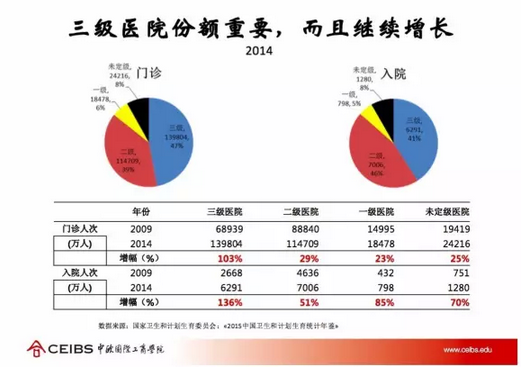
An examination of the data reveals that since 2009, the growth in the number of hospitals with more than 800 beds has surpassed that of hospitals with fewer than 500 beds. Large-scale hospitals constitute the apex of the pyramid, while primary care institutions are predominantly small-scale hospitals. A second set of data provides even clearer insights into outpatient and inpatient volumes. In terms of market share, among China’s 26,000 hospitals, tertiary (Grade III) hospitals account for only 7%. Yet, these 7% of tertiary hospitals handle nearly half of all outpatient visits (47%) and 41% of inpatient admissions. In contrast, secondary (Grade II), primary (Grade I), and ungraded hospitals—which collectively make up the remaining 93%—account for merely 8% of outpatient and inpatient volumes. This demonstrates that the apex of China’s healthcare resource pyramid dominates the entire medical market. Furthermore, since the launch of the new healthcare reform in 2009, the growth rates of outpatient and inpatient volumes in tertiary hospitals have far exceeded those in secondary, primary, and ungraded hospitals, indicating that the apex of the pyramid is expanding significantly.
Root Causes Behind Pain Points
Why is the apex of the pyramid expanding? Last year, the National Health and Family Planning Commission (NHFPC) emphasized tiered diagnosis and treatment. This year, recent NHFPC documents state that by 2020, efforts will be made to expand family doctor contract services to cover the entire population, promote resource allocation to grassroots levels, and waive fees for many primary care outpatient visits. With changes in family doctor contracting and health insurance payment models, can we truly invert the pyramid?
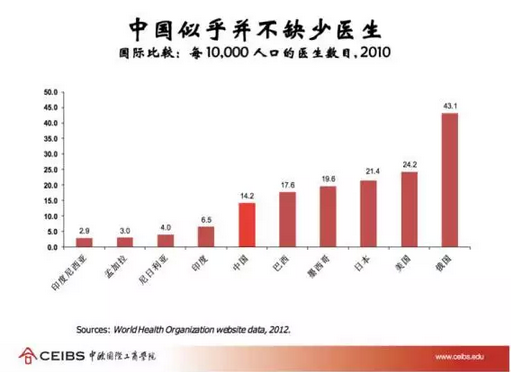
In reality, we can see that the fundamental reason behind the pyramid structure lies with physicians. We calculated the ratio of doctors to the population in the world’s most populous country. The number of physicians per 10,000 people places China squarely in the middle among the ten largest countries. Our figure is lower than that of two developing nations, Brazil and Mexico, but more than double that of India, the world’s second-most-populous developing country: China has 14 physicians per 10,000 people, compared with India’s 6.5. Based on these data, it appears that while China’s physician supply lags behind some countries, it surpasses others, suggesting a reasonably adequate situation.
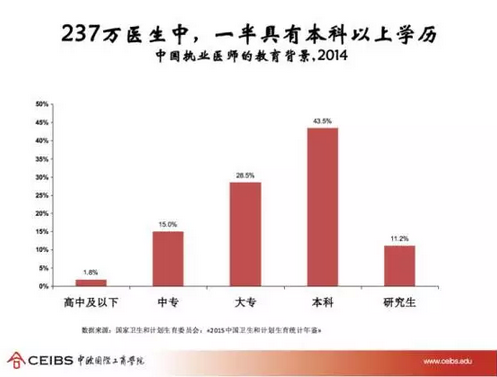
However, we found that among the 2.37 million licensed physicians, based on data from 2014, those with a bachelor’s degree or higher accounted for slightly more than 50%. Nearly half of the physicians had educational backgrounds below the bachelor’s level, such as associate degrees, secondary vocational schooling, or even below high school education. In today’s China, there are still millions of “barefoot doctors.” Where are these doctors? Most of them are at the grassroots level. Well-educated physicians are basically at the tip of the pyramid. If this situation remains unchanged, how can we invert the pyramid? I believe this is simply impossible.
Let us compare China with India. In China, half of all physicians have an educational background below the bachelor’s degree level, whereas in India, all physicians hold at least a bachelor’s degree or higher. The proportion of Chinese physicians with a bachelor’s degree or above is very close to that in India. In other words, although China’s economic development and income levels are significantly higher than India’s, the shortage of physicians in China is even more severe than in India. This is the fundamental reason underlying the healthcare system’s current inability to invert its pyramid-shaped structure.
It is also evident that China faces a shortage of millions of well-educated physicians. We identified four distinct periods since the launch of China’s economic reform and opening-up policy. For each decade, we analyzed the number of medical school graduates (representing supply) and the increase in the nation’s physician workforce during that same period (approximating demand). Based on these data, we calculated a supply-to-demand ratio.
We observed that during the first decade (1978–1987), each medical school graduate contributed to an increase of more than two physicians. Over this ten-year period, more than half of the newly added physicians were recruited from educational backgrounds below the undergraduate level.
In the second decade (1988–1997), the number of medical school graduates was slightly higher than the number of newly added physicians. In the third decade (1998–2007), this ratio surged to 7:1. During this period, China expanded enrollment in higher education, including in medical schools; however, the Ministry of Health tightened its statistical criteria for counting physicians, resulting in lower reported figures compared to the previous period.
However, there have been no changes in the statistical methodology for data from 2008 to 2014, and the ratio of medical graduates to physicians has reached 5:1. At least half of China’s medical school graduates have not entered the physician workforce. Where have the large number of medical school graduates gone?
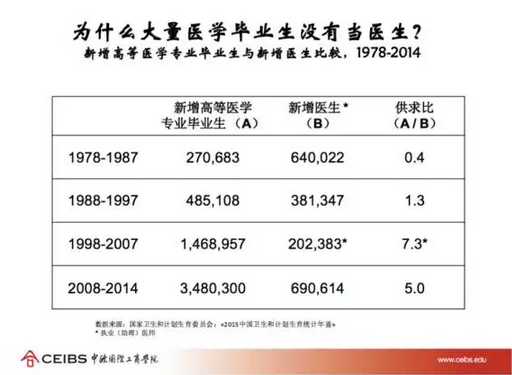
These data reveal a severe shortage of physicians in China. Here lies a stark contradiction: on the one hand, there is a critical shortage; on the other, a large number of medical school graduates choose not to practice medicine. This profound paradox may be unique worldwide. Unless this issue is resolved, discussions around internet-based healthcare, health management, and chronic disease management will ultimately hit a bottleneck, as the investment in internet-enabled pharmaceuticals, medical devices, and hardware still requires physicians to deliver care. If China’s physician shortage problem remains unaddressed, its healthcare reform will not succeed.
Linked to the physician employment system, in our country, medical students have only completed classroom education upon graduation from medical school. After graduation, they receive clinical training at community hospitals if they join such facilities, or at tertiary (Grade 3A) hospitals if they are employed by them. For classmates from Shanghai First Medical College, their career paths diverge dramatically depending on whether they work at a tertiary hospital or a community health center. Essentially, the vast majority of physicians in China exist as employees of healthcare institutions, making it difficult for them to practice at multiple sites across different institutions. This reflects the current situation in our country.
In contrast, in the United States, only 20% of physicians are employed by hospitals and medical schools. The remaining 80% practice as independent practitioners in clinics, with 32% working in small practices consisting of one or two physicians. Larger entities include physician groups, forming the overall employment structure for physicians in the U.S.
Moreover, most graduates of national medical schools go on to work in physicians’ clinics, while a subset enters teaching hospitals as residents. Nevertheless, a large proportion of primary-care clinic physicians maintain ongoing ties with teaching hospitals. The relationship between high-caliber physicians and hospitals is characterized by a competitive, two-way contractual arrangement: physicians may sign contracts, practice in clinics, and devote a portion of their time to teaching, research, clinical care, and surgery at teaching hospitals, thereby establishing a flexible relationship between specialists and hospitals.
Under this physician employment system, the majority of doctors are freelancers, with only a small fraction serving as formal employees. In such a context, medical school graduates face no hesitation about practicing in clinics, where their income may even be higher, while still retaining opportunities to perform surgeries and utilize equipment at large hospitals. Under this system, expert resources are not monopolized by any single hospital but are instead societal resources that allow for multi-site practice. This approach can truly address the career prospects of the majority of physicians in our country, rather than forcing them to abandon their medical careers simply because they cannot secure positions in top-tier (Grade 3A) hospitals.
Innovation at Three Levels and Reform of the Physician Employment System
The issues faced by physicians reflect deeper problems within the healthcare system. Whether it involves increasing government investment, expanding medical insurance coverage, or promoting so-called physician contract services in the current stage of healthcare reform, these are not the core issues. The fundamental issue lies with physicians themselves in China.
How Can We Innovate in the Face of Pain Points? Addressing physicians’ challenges requires innovation across three dimensions: technological innovation, business model innovation, and further institutional and mechanistic innovation, including policy innovation. There are numerous avenues for technological innovation; China’s technological advancements have been progressing rapidly, and the gap with developed countries can be narrowed most easily in this regard. Coupled with business model innovation, these form two complementary pillars. However, when it comes to addressing physicians’ issues, there is an even greater need for institutional, mechanistic, and policy innovations. Let us elaborate on this.
Reform of the Physician Employment System: Addressing Two Key IssuesThe reform of the physician employment system involves two main aspects. First, regarding the existing workforce, it is necessary to promote multi-site practice for physicians in public hospitals. Second, concerning new entrants into the market, efforts should be made to encourage physicians to establish their own clinics, particularly private ones. As recently observed, DXY’s clinic model—specifically, branded, high-quality chain clinics—represents the future direction for physician-owned clinics in China. In China, the public has long been accustomed to seeking medical care at large hospitals. If individual physicians open standalone clinics, they may struggle to build brand recognition and initially find it difficult to establish patient trust. Therefore, we believe that what the country particularly needs is not clinics catering exclusively to high-end patients, but rather those serving the broad middle-class population.
The rise of physician groups has been a notable trend since last year. However, after the initial surge of interest, questions remain as to whether physician groups can constitute a truly viable business model. This may be constrained by certain shortcomings and limitations in policy. Another factor is the development of internet healthcare, which will not be elaborated upon here.
In my summary, the "Three-Medical Linkage" within the healthcare system encompasses pharmaceuticals, health insurance, and medical services. Medical services represent the weakest link, with physician-related issues being the core pain point. The employment system for physicians is key to addressing these challenges. Promoting multi-site practice among physicians, along with the development of physician-led clinics and medical groups, serves as a critical approach and lever for reform. Integrating internet-based innovations has become an important means of advancing this reform.
Source: DXY Forward