

DXY Launches Paid Q&A Platform 'Lai Wen Yi Sheng' to Monetize Its 20 Million C-End Users
Recently, DXY launched “Ask the Doctor,” a paid Q&A product in the healthcare sector, to meet patients’ needs in more diverse doctor–patient scenarios; meanwhile, it provides DXY’s physician users with a platform for personal brand building and value monetization.
“LaiWenYiSheng” is developed on the WeChat platform. After users follow the “LaiWenYiSheng” WeChat Service Account, they can select doctors by department to ask questions and pay at a price they deem reasonable.
After the doctor provides a response, the user may voluntarily choose to make the answer public or keep it private. If the user chooses to make the answer public, other users can pay 1 yuan to view it. If the question remains unanswered for more than 24 hours, the fee will be refunded via the original payment method.
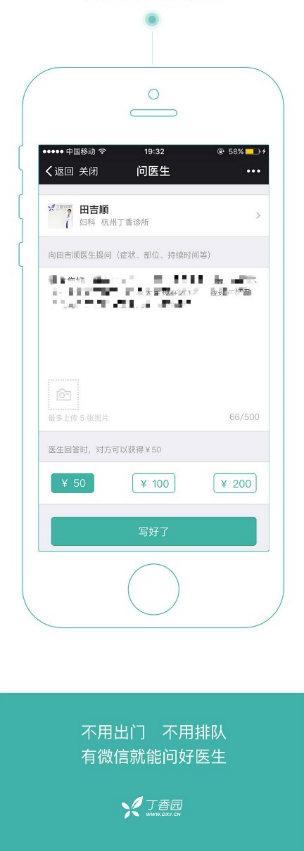
This model of paid Q&A with answer sharing originated from a small pilot initiative previously undertaken by DXY.
“Ask a Doctor” lead Chu Yang introduced that in May this year, his team discovered “Da Gong,” a one-on-one paid Q&A platform. DXY conducted small-scale internal testing on “Da Gong” and found that patients were willing to pay for medical consultations, while doctors were also interested in answering questions. Based on these findings, DXY initiated product planning for “Ask a Doctor” in June this year and launched the service within one month. Currently, “Ask a Doctor” remains in the testing phase.
Chu Yang, head of “Ask a Doctor,” told VCBeat that DXY had already established a strong brand image online through “Dingxiang Doctor” (WeChat + Official Account) and accumulated 20 million consumer-end users. While providing general medical and health knowledge to users via the Dingxiang Doctor platform, DXY recognized that there remains substantial demand for personalized health consultations between searching for popular science medical information and seeking offline medical care. Therefore, it launched “Ask a Doctor” as a connector between online and offline services.
Meanwhile, as a value connector in the healthcare sector, DXY aims to establish more direct and trustworthy relationships between physicians and patients, facilitating value exchange through paid Q&A services.
Zhang Jin, CEO of DXY, stated at the launch of the “Ask a Doctor” initiative: “In an era rife with fraudulent medical advertisements and misleading patient-navigation information, the cost for users to verify the credibility of information sources is prohibitively high. Through the DXY Doctor platform, we have accumulated high-quality medical and health information, and we connect reputable physicians with patients via personalized Q&A services. This approach provides physicians with channels for monetizing their expertise and building their personal brands, while offering patients reliable consultation services.”
The biggest challenge for the paid Q&A model of “Ask a Doctor” lies in how to ensure the quality of doctors’ responses, guarantee their timeliness and enthusiasm, and achieve seamless integration between online and offline services.
1) How to ensure the quality of doctors' answers?
Chu Yang stated that during the internal testing phase, DXY would strictly control the number of physicians on the “Ask a Doctor” platform. Li Tiantian, founder of DXY, has emphasized on multiple public occasions that the core of healthcare lies in the quality of care. “Ask a Doctor” currently operates on an invitation-only basis, setting the registration threshold for physicians at attending physicians from Grade 3A hospitals or those with equivalent qualifications. During the internal testing phase, the participating physicians were primarily drawn from DXY’s professional physician user base and integrated with DXY’s physician credentialing system. Currently, there are 1,000 physicians on the “Ask a Doctor” platform.
In addition to strictly controlling the number of participants, DXY has also developed its own screening system to evaluate physicians. “Professional physician users on DXY leave digital footprints across platforms such as DXY Forums, Dingxiangke, and Dingxiangtong. Based on these footprints, DXY has established an algorithm for evaluating physicians,” Chu Yang told VCBeat.
2) How to ensure the timeliness of doctors' responses?
Chu Yang introduced that “Ask a Doctor” was not designed as a conversational interface, but rather as an email-based communication channel with physicians. “Compared to real-time online Q&A, asynchronous communication better leverages the fragmented time available to both patients and doctors,” Chu Yang stated. “DXY believes that the role of physicians is irreplaceable, and online medical consultations can only meet the needs of a subset of patients.” Certain medical needs cannot be addressed online; for instance, patients experiencing acute conditions will inevitably prioritize visiting hospitals or clinics.
On the “Ask a Doctor” platform, patients typically receive responses from physicians approximately one hour after submitting their questions; nonetheless, patient satisfaction remains relatively high, primarily due to the assured quality of the physicians’ answers.
3) How to ensure doctors' enthusiasm in answering questions?
Notably, the "Ask a Doctor" feature operates on a model where patients voluntarily select and pay a fee to physicians in exchange for consultation responses. Physicians have the autonomy to set their own fees, within a range of RMB 10 to RMB 500 as established by DXY. The minimum price floor is intended to discourage physicians from attracting users through excessively low pricing, while the maximum price ceiling aims to prevent physicians from placing undue emphasis on financial gain.
From Chu Yang’s perspective, the need for building a physician’s personal brand is more important than financial returns; this is the primary motivation for doctors on the “Ask the Doctor” platform to answer patients’ questions. “Healthcare remains a service industry, and physicians ultimately rely on their professional expertise and service capabilities to achieve greater career development.”
If physicians build their reputation and influence among patient groups through the “Ask a Doctor” feature, the next step is to enable patients to transition directly to offline consultations. In this way, DXY’s online pool of 20 million users can potentially be monetized.
However, Chu Yang stated that DXY would not initially engage in patient navigation or medication guidance services, but would instead focus on providing an information-matching platform to facilitate offline medical consultations for patients. For instance, patients could prioritize selecting physicians from their own city for online consultations via the “Ask a Doctor” platform.
It is reported that DXY does not take any commission from the fees paid by patients to doctors on the “Ask a Doctor” platform. All patient Q&A interactions are private by default; if users choose to make them public, they retain full control over this decision. Furthermore, patients can receive certain compensation for doing so. For instance, if a patient chooses to make a Q&A thread public and another user pays RMB 1 to view the content, RMB 0.5 is allocated to the patient who shared the Q&A, and RMB 0.5 goes to the doctor who provided the answer.
“If dozens of people view the related questions, the costs incurred by patients who share their Q&A are effectively covered,” said Chu Yang. As for whether a revenue share from doctors’ income will be implemented, Chu Yang stated that it is not likely to be considered for quite some time: “Our pace of commercialization is relatively slow.”