

Nianjia Health Files IPO Prospectus After Burning $7M, Targets Grassroots Healthcare with Electronic Health Records
Li Pengsheng, founder of Nianjia Health Medical, had deep roots in the electronics industry, specializing in ECG monitoring and focusing on export markets. Due to the downturn in foreign trade, he sold his factory in 2010. He then pivoted to the domestic market to pursue internet healthcare, but burned through half a billion RMB of his own and investors’ capital, plunging his startup into a temporary trough. It was not until late 2015 that Li seized the service gap in residents’ electronic health records, breaking ground in the “Internet + Healthcare” sector by establishing pilot markets in Maoming and Xinyi cities in Guangdong Province.
As the founder of Nianjia Health, Li Pengsheng brings 30 years of experience in the electronics and information technology industry. After selling his factory in 2010 to pivot into internet-based healthcare, he developed several smart medical hardware products based on internet concepts. However, despite the promising “Internet+” narrative, Li struggled significantly; he found it nearly impossible to drive hardware sales, maintain user stickiness, or effectively collect and analyze health data. According to Li, nearly half a billion RMB from his own funds and those of investors was burned through over six years, leading him to question the viability of the B2C internet healthcare model.
Subsequently, he conducted a comprehensive review of healthcare reform policies in recent years, noting the potential for synergies between the development of resident health records, the growing trend of family doctor contracting services, and his own smart hardware and health cloud technologies.
“Smart Hardware + Health Cloud” Addresses the Pain Point of “Falsified” Health Records
On June 28, the National Health and Family Planning Commission, in conjunction with the Ministry of Finance and the State Administration of Traditional Chinese Medicine, issued the "Notice on Doing a Good Job in the Implementation of the 2016 National Basic Public Health Services Program." The notice required that, at the county (district, city) level, the standardized rate of electronic health records for residents reach over 75% in 2016. Meanwhile, the "Notice" also pointed out that the per capita subsidy standard for basic public health services would be increased from 40 yuan to 45 yuan in 2016.
In fact, as early as 2009, the Chinese government had already issued relevant policies and allocated funds to launch the nationwide construction of resident health records. Moreover, the subsidy standards for public health service projects, including health records, have increased year by year: rising from RMB 15 to RMB 25 in 2011, further increasing to RMB 30 in 2013, and reaching RMB 45 by 2016.
However, the implementation of resident health records has long been subject to scrutiny. According to a 2014 report in Inspection Daily, the Bureau for Prevention of Duty-Related Crimes of the Anyang Municipal People’s Procuratorate selected seven larger, well-equipped community health service centers for investigation. It found that among the 12 public health services, all but vaccination had failed to be effectively implemented, with widespread issues including inaccurate records, fabricated information, and fake examinations, registrations, and services.
That same year, media reports cited a community physician in Guangzhou who revealed that more than half of the over 40,000 health records in his jurisdiction had been fabricated, with some residents having health records created by primary healthcare institutions without their knowledge.
In 2015, Legal Weekend reported on the falsification of residents’ health records in Hunan, Fujian, and other regions, as well as issues involving false claims and misappropriation of related subsidy funds.
Behind such widespread falsification lie two main factors: first, the outdated methods for collecting health records, with primary care facilities relying predominantly on manual handwriting, resulting in low efficiency; second, a “Great Leap Forward”-style rush triggered by local competitions to meet health record coverage targets. Ensuring the authenticity of health records has become a persistent concern for government regulatory authorities.
After realizing that health records had become a hot potato, Li Pengsheng returned to his hometown of Maoming for investigation and found that government health authorities, community health centers, township hospitals, and village clinics were all greatly troubled by this issue. Consequently, Li Pengsheng launched a transformation plan targeting the grassroots medical market, using “health records” as the entry point to establish a health database for residents at the grassroots level.
Taking the implementation plan for the “Health Cloud” home-based medical and elderly care smart service platform signed between Nianjia Health and Maoming City as an example:Nianjia Health has designed a transformation solution for the “Standardized Internet-Enabled Smart Clinic,” with its primary function being the rapid establishment of standardized electronic health records (EHRs) for residents within the clinic’s service area. This is achieved through paperless health data collection and upload tools, such as the “Nianjia All-in-One Smart Health Examination Device” and the “Family Doctor Smart Follow-up Kit,” thereby comprehensively improving both the collection rate and accuracy of health records.
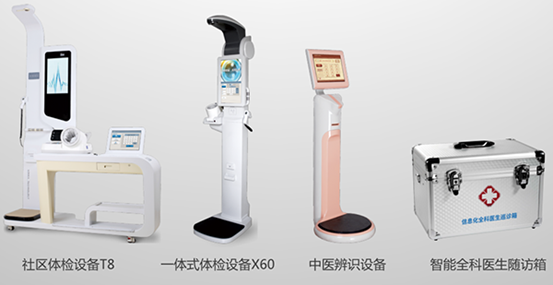
Smart Data Collection Device for Health Records
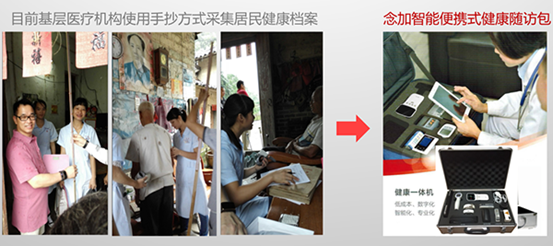
On-site Data Collection for the Nianjia Health Cloud Platform
For patients with key chronic conditions, customized intelligent monitoring terminal devices will also be provided to enable dynamic monitoring and management. Of course, general chronic disease patients may also undergo health check-ups when convenient, with data uploaded in a timely manner to establish dynamic health monitoring records.
Nianjia Health utilizes standardized smart terminal data collection devices to enable the standardized acquisition, one-click upload, and cloud storage of residents' basic health data. Based on this infrastructure, it has established a "Health Cloud" platform, thereby creating a health service ecosystem grounded in comprehensive local resident health data. For instance, Nianjia can analyze dynamic resident health data to generate chronic disease management plans, which are then supervised and implemented by contracted physicians at primary healthcare institutions. Relevant health data can also be shared with family members via a mobile app.
For clinics, establishing an innovative standardized medical system and ensuring a well-regulated, high-quality care environment can enhance patient reputation, thereby boosting public trust in primary care clinics and improving patient conversion rates.
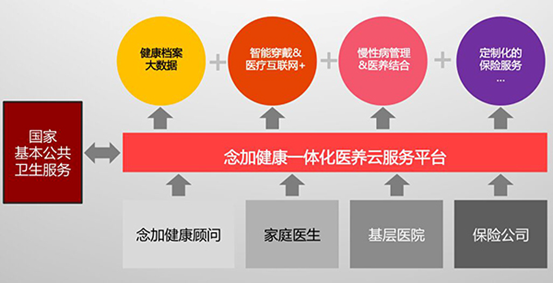
Nianjia Health Cloud Platform Model
For the government, the primary objective is to achieve genuine dynamic management of residents’ electronic health records. Furthermore, the Health Cloud Platform provides a unified public health service platform for grassroots clinics and family contract physicians, thereby expanding service coverage and scope. Leveraging big data analytics based on the cloud platform is expected to provide data-driven support for disease prevention and control as well as public health decision-making in Maoming City, ultimately reducing public health expenditures.
Tripartite Joint Establishment of "Standardized Internet-Enabled Smart Clinics"
Of course, the most pressing concern remains: who will bear the costs of establishing “standardized internet-enabled smart clinics”? While “internet-enabled smart clinics” address the critical pain point of an incomplete business model in internet healthcare, thereby completing the final loop of the value chain, the asset-heavy approach of building proprietary clinics is not favored by investors. In the absence of substantial profitability for platforms, self-built clinics entail high cash burn and significant risks.
Nianjia Health’s solution is the “Standardized Internet-Enabled Smart Clinic,” jointly established by the government, primary care clinics, and Nianjia Health. Through equipment support, resource coordination, and loan guarantee assistance, the three parties collaboratively upgrade clinics into “Standardized Internet-Enabled Smart Clinics.”
Specifically, with government-provided interest subsidies on special loans and guarantees provided by Nianjia, clinic owners can secure loan support with installment repayments. After undergoing “standardized internet-enabled smart” upgrades, clinics will gradually establish health records and become eligible for financial subsidies!
Nianjia Health provides basic equipment, reducing the initial capital burden for clinic owners, while installment repayments on loans significantly alleviate their financial pressure. Furthermore, Nianjia Health will expand sales of related health service products, with clinics serving as offline sales and service outlets eligible to receive profit-sharing commissions.
Moreover, the various other revenue models established by Nianjia Health will provide profit-sharing opportunities for clinics affiliated with its Health Cloud Platform. In April this year, Nianjia Health entered into a strategic partnership with Huimeng, an insurance intermediary, to jointly create a “Precision Marketing Platform for Health Insurance Based on Resident Health Big Data.” Leveraging its internet platform and offline network of affiliated clinics, Nianjia Health will serve as new offline service points for precise channel distribution of Huimeng’s insurance products.
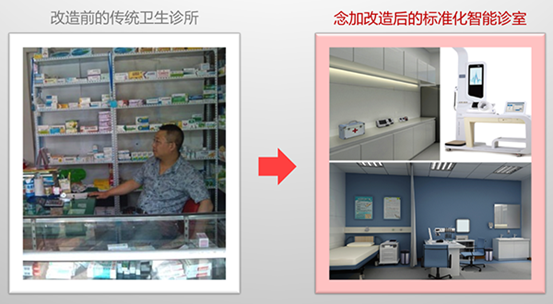
Standardized Smart Consultation Rooms with Conceptual Upgrades
Nianjia Health secured tens of millions of RMB in Pre-A round financing from investors including Saima Capital in 2015. In October of the same year, it also received investment from the Shenzhen Municipal Science and Technology Innovation Commission, becoming a “mobile health service enterprise” key supported by the Shenzhen Municipal Government.
Zhang Linli, Vice President of Sai Ma Investment, stated to VCBeat that they have reviewed numerous mobile health projects. Nianjia Health possesses extensive experience in navigating challenges within the internet healthcare sector. Following in-depth research into relevant policies and market dynamics, the company identified pain points in government administration and launched a solution that leverages its core strengths and can be implemented rapidly, making it a venture worth watching.
According to Li Pengsheng, the company has signed agreements with dozens of community health centers and clinics in Maoming City as part of the first batch slated for renovation. Following the establishment of this urban primary healthcare model market, Nianjia Health has also ventured into the rural primary healthcare market in Xinyi, Maoming, signing agreements with more than ten village clinics for renovation in the initial phase.
Li Pengsheng also stated that, nowadays, Nianjia Health places greater emphasis on initiating commercialization efforts at an early stage of its projects, which serves as one of the litmus tests for validating the rigidity of the demand targeted by the project.
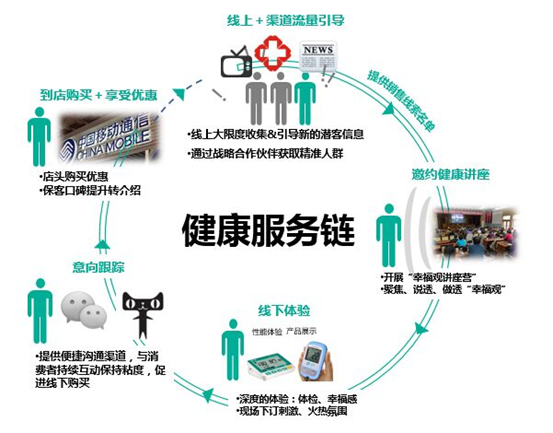
Nianjia Health and China Mobile Collaborative Marketing Closed-Loop Flowchart
In addition to its collaboration with insurance companies, Nianjia has also reached relevant cooperation agreements with China Mobile and China Unicom. China Mobile and Nianjia Health aim to provide residents with greater value and more choices through bundled marketing collaborations, thereby enhancing customer stickiness to the telecom operators and fostering remote familial care among users’ households. For instance, customized 4G mobile phones are provided for the elderly, featuring a dedicated “Doctor” shortcut key that enables one-touch access to contracted physicians in their local communities, all at highly affordable rates.
In terms of the cooperation model, both parties will formulate reasonable sales policies to incentivize social partner outlets to sell smart terminals and provide necessary services to residents, thereby enhancing convenience for the public. The operator (China Mobile) will fully leverage its own sales force to promote health-related smart terminals, raising residents’ awareness of healthcare and elderly care services. Furthermore, both parties will capitalize on their respective strengths to accelerate collaboration in the informatization of healthcare sectors, including basic public health service programs, chronic disease health management, and the integration of medical care with elderly care.