Can a Chess-Playing AI Also Diagnose Diseases? RxThinking Founder Deng Kan on Building an AI 'Family Doctor'
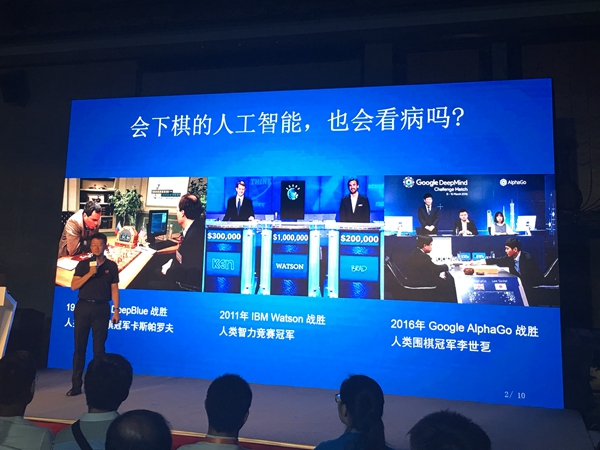
Dashu Yida CEO Deng Kan is interpreting the application and correlation between artificial intelligence and healthcare.
The term “artificial intelligence” has been generating significant buzz recently, likely due to Google DeepMind’s AlphaGo earlier this year, which defeated world champion Lee Sedol in Go, a board game widely regarded as the pinnacle of human intellectual competition. Several years prior, IBM’s “Deep Blue” supercomputer had already defeated Garry Kasparov, the world chess champion. In 2011, IBM Watson rose to prominence by beating Ken Jennings and Brad Rutter, two former champions, on the popular U.S. quiz show Jeopardy!, once again demonstrating AI’s ability to surpass humans in intellectual contests.
Interestingly, while many view artificial intelligence merely as a technology or tool for entertainment, the broader question is whether it can tackle major challenges related to people’s livelihoods. Both IBM and Google have converged on the same answer: healthcare. Notably, after its victory in Go, Google DeepMind’s AlphaGo swiftly pivoted to collaborate with the UK Department of Health to develop an AI-powered “family doctor.”
Why Have Both IBM and Google Leveraged Artificial Intelligence to Enter the Healthcare Sector? This Primarily Involves Issues at Two Levels:
First, Healthcare is a major livelihood issue, involving substantial social benefits and significant economic interests;
Second, There are numerous livelihood issues, so why is AI being applied to healthcare rather than to education or finance? Frankly speaking, the application of AI in healthcare offers significant technical advantages and can yield immediate, tangible results.
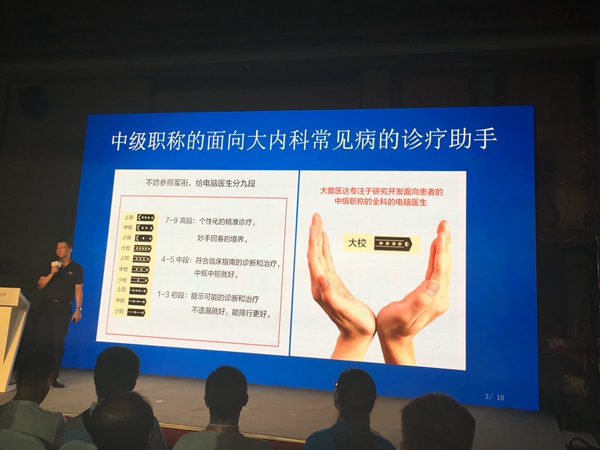
Interpreting healthcare through technology refers to a finite set: there are only a few thousand diseases in total, with fewer than 200 being common. These common diseases account for over 85% of clinical visits. Therefore, if AlphaGo were applied to these 200 common diseases to serve as an intelligent “family doctor,” it would operate within four defined scopes.
The first limitation is the intermediate professional title. AI will not challenge senior professional titles; it is targeted at physicians with intermediate professional titles working at the grassroots level.
The second limitation is that the AI is designed for internal medicine and does not perform surgeries. It covers conditions such as headaches, fever, gynecological and pediatric disorders, as well as common cancers, totaling 200 diseases;
The third limitation is that AI is only suitable for common diseases and lacks the capability to handle complex and rare conditions. So, what should be done when such cases arise? After computer-based identification confirms a case as complex or rare, DeepMind’s approach can be summarized in one phrase: “honorable surrender.” Once a condition is deemed too complex and beyond its processing scope, with no confidence in achieving a successful outcome, AlphaGo will inform you that it cannot handle the case and advise you to seek immediate medical attention at a hospital.
The fourth limitation concerns auxiliary tools. Much like driving a car, the role of artificial intelligence is not that of a Tesla or a self-driving vehicle, but rather akin to a Baidu navigation system. AI provides guidance on what actions to take, but the ultimate responsibility for decisions remains with the physician and the patient themselves; AI merely offers recommendations.
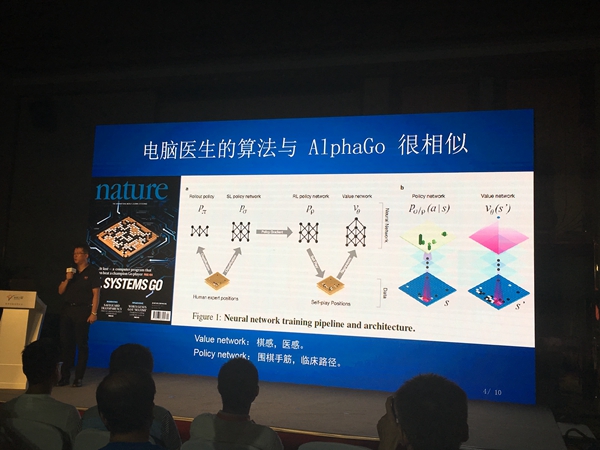
The “Computer Doctor” being developed by Dashu Yida employs a technological framework entirely consistent with that of AlphaGo. Why is this the case? Because both are derived from the principles established by DeepMind and deep learning. Globally, only a handful of pioneers have shaped this methodology, resulting in highly congruent underlying philosophies and approaches.
AlphaGo’s technical framework employs two deep neural networks to aid in decision-making. The first is the Value Network, which evaluates the board position by assigning a score to a given state, thereby more accurately assessing the advantages or disadvantages of a child node; in the medical context, this corresponds to “clinical intuition.” The second is the Policy Network, which scores each child node to identify the most promising one that warrants prior expansion—often referred to as tesuji or joseki in Go; in healthcare, this corresponds to clinical pathways.
However, although the technical frameworks are largely consistent, significant differences become apparent when examining specific technical details. These differences are mainly reflected in two aspects:
First, in chess, every move made by the opponent is visible on the board, with each action clearly discernible. However, during patient consultations, hidden information frequently emerges. What exactly is the underlying pathology of the disease? Even senior physicians may struggle to determine it.
Secondly, chess is a game of certainty: a loss is a loss, and a win is a win. In contrast, even the attending physician cannot be certain whether the prescribed medication will be effective, as there is an element of probability involved.
Therefore, although the “Computer Doctor” shares a technical architecture closely resembling that of AlphaGo, it poses greater technical challenges.
Beijing Dashu Yida Technology Co., Ltd.’s “Computer Doctor” operates within four defined scopes. Does this limit its target audience and market size? The answer is no. According to statistics, Baidu records 1.7 billion daily searches by Chinese internet users for medical-related information. This vast user base is sufficient to support the commercial viability of the “Computer Doctor.” Among these user queries, the main concerns fall into four categories:
The first category occurs in the time slot before morning work hours, during which internet users frequently inquire about the causes of symptoms such as dizziness, nausea, diarrhea, and yellowish or greenish stools, questioning whether these could indicate a serious illness. The key term here is “possibility.” If there is a possibility of a severe condition like stroke, one must immediately set aside work and go to the hospital; if it is merely suggestive of diabetes, waiting another day may be acceptable. The ultimate value outcome of such symptom-checking or light consultations is triage guidance, with the conclusion being either which hospital to visit for treatment or whether it is safe to delay care.
The second category involves users who, after noon, gradually share various laboratory test results, clinical indicators, and medical images, with netizens increasingly inquiring about specific symptoms. We are often puzzled by such queries: Why do they not seek hospital care despite having test results? Why do they still turn to Baidu for advice? In essence, these users harbor some distrust toward the diagnostic conclusions and treatment plans provided by hospitals, and they are seeking a second medical opinion.
The third category comprises issues that can arise at any time, including in the early hours of the morning. Examples include questions such as, “Why is my leg still swollen after surgery? Is this normal or abnormal?” and “Why has a certain indicator doubled compared to the day before yesterday during my pregnancy? Is this normal?”
The fourth category is related to money and falls under economic issues. Netizens might say, “The medication you prescribed works very well, but it costs me over 10,000 yuan per month, which is really unaffordable. Could you switch me to a slightly cheaper alternative?” or ask, “Can part of the cost of this medication be reimbursed through medical insurance?”
How does the “Computer Doctor” address these four types of issues? By collecting hundreds of millions of electronic medical records for common diseases, the “Computer Doctor” primarily focuses on diagnosing 197 common conditions, leveraging the diagnostic and therapeutic principles of AlphaGo.
A notable technical challenge worth mentioning is big data denoising, which involves eliminating data irrelevant to diagnosis. Hundreds of millions of electronic medical records (EMRs) for common diseases constitute the foundational layer of big data. Taking diabetes as an example, by comparing N diabetes EMRs, a commonality emerges: all contain “metformin.” Thus, diabetes becomes associated with this medication, while other drugs with lower occurrence rates show weaker associations. By analogy, correlated diagnostic and treatment protocols for 197 common diseases have consequently been developed.
Leveraging an advanced technological foundation, the “Computer Doctor” can address three of the four major categories of common issues mentioned above, excluding economic concerns.
After you communicate symptoms such as headache and numbness in the limbs to the “AI Doctor,” it will ask in return whether you are experiencing nausea. This follow-up question stems from your initial inquiry: based on keywords like “headache” and “limb numbness” that you provided beforehand, the “AI Doctor” hypothesizes potential diagnoses. Since each condition is typically accompanied by other associated symptoms, the artificial intelligence system matches corresponding results and poses targeted follow-up questions.
In the first step of diagnosis, the “AI Doctor” primarily identifies potential suspected diseases by continuously describing symptoms.
Step 2: The “AI Doctor” will clarify which examinations you have undergone, such as X-rays or MRI scans, to establish a definitive diagnosis.
Step 3: The “computer doctor” not only tells you the answer, but also explains how it arrived at that judgment;
Step 4: Monitor whether you are progressing normally through the recovery process after taking the medication.
According to Deng Kan, for the most prevalent conditions among the 21 common respiratory diseases, the diagnostic accuracy of the “AI Doctor” has reached the level of senior physicians. Meanwhile, by the end of this year or early next year, the “AI Doctor” will participate in a competition akin to AlphaGo’s chess matches, using real-world clinical cases to evaluate its diagnostic capabilities.
Legend Stars, founded in 2008, currently manages two angel investment funds with a total capital of approximately RMB 1.5 billion. In 2015, it was ranked among the top three best angel investment institutions in China by Zero2IPO Group and China Venture. As the early-stage investment and incubation arm of Legend Holdings, Legend Stars leverages over 30 years of entrepreneurial experience and resource accumulation from Legend to provide entrepreneurs with distinctive services combining angel investment and in-depth incubation, serving as a “super angel” by their side.
This article is primarily intended for the guest speakers at the second session of Xiangyi Hui’s MED TED themed speech event, a sub-forum of the Legend Star WILL Conference.