

Cdoc, a U.S. Subsidiary of China's WeWenzhen, Files IPO Prospectus After Successfully Entering American Communities with Video Telehealth Platform
In the internet sector, China and the United States are advancing side by side, with companies from these two countries accounting for all ten spots among the world’s most valuable internet firms—four from China and six from the U.S. However, in the field of mobile health, a significant gap remains. It can be said that China’s mobile health development has largely drawn upon the U.S. model; when the time dimension is removed, the development curves of the two countries exhibit remarkably similar trends. Under these circumstances,The “reverse export” of domestic mobile health brands will become a landmark event marking the onset of independent innovation in China’s mobile health sector.
In July 2016, Sichuan JunYi F&T Technology Co., Ltd. integrated the business operations of the U.S.-based company CyberMed, replicating its “Wei Wenzhen” telemedicine service platform model in the United States to create a U.S.China’s Cdoc Becomes First Domestic Mobile Healthcare Brand to Expand into Overseas Markets

The First Chinese Mobile Health Brand to Launch in the United States
Cdoc integrates the video consultation model of WeiWenzhen with CyberMed’s existing electronic medical record (EMR) system, connecting industry stakeholders including patients, pharmacies, hospitals and clinics, testing institutions, and insurance companies.
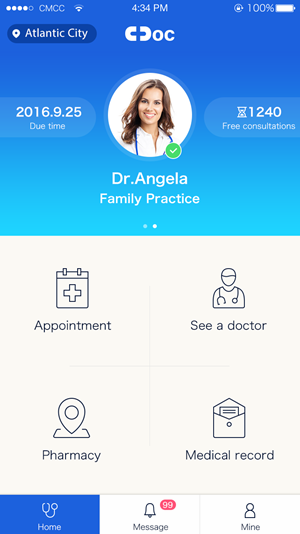
Cdoc’s system integrates the online and offline service capabilities of U.S. hospitals and clinics, covering electronic medical records (EMR), e-prescriptions, online physician consultations, medical billing and insurance, smart device data collection, and family physician services, thereby implementing a full-process O2O model for online healthcare. The company plans to deploy its system in 200 hospitals and clinics by the end of 2016, engage 1,000 physicians, achieve 500,000 user downloads, and handle 1,000 daily online consultation transactions.
In the United States, the online medical consultation model is more mature than in China. The entire process of a routine primary care visit that does not require an in-person examination—from health inquiries and disease diagnosis to issuing electronic prescriptions—can be completed online. To ensure more thorough doctor-patient communication and higher diagnostic reliability, many U.S. telehealth service providers offer video consultation services.
Cdoc provides video consultation services and has realized an application scenario of online-offline collaborative consultations through three main products: a mobile app, a physician work platform, and offline consultation sites. As the first Chinese mobile health brand to expand overseas, what are its competitive advantages?
One of the Core Advantages: Video Consultation Technology
Cdoc’s video consultation technology originates from Sichuan JunYi F&T Technology Co., Ltd. Its subsidiary product, “Wei Wenzhen,” is a mobile healthcare management platform based on online audio-video consultations. Its terminals include mobile apps, offline kiosks, and TV set-top boxes, covering scenarios such as hospitals, pharmacies, communities, rural areas, and households. The video technology employs Intel Atom processors to achieve more realistic and intelligent image processing and transmission, thereby improving consultation efficiency.
Core Advantage #2: Mature Foundation System
Cdoc’s system is built upon CyberMed’s years of established online and offline service capabilities and its mature partnerships with U.S. hospitals. Founded in 2011 by Dr. Ying, a former scientist at Bell Labs, CyberMed is a company serving the U.S. medical IT industry. It has successfully helped multiple Federally Qualified Health Centers (FQHCs) and physician practices implement electronic health record (EHR) systems, achieving standardized, digital management of healthcare quality. More than one hundred laboratories and substance abuse treatment centers have adopted CyberMed’s electronic insurance billing and reimbursement system.
It has been certified under the Meaningful Use (MU) 2011 and 2014 standards and is one of the four electronic health record (EHR) systems recommended by New York City. Its core business includes:
1) EMR: Electronic Medical Record
2) Clinic Process Optimization Design
3) Medical Bill Insurance Reimbursement
4) Medical, laboratory, and electronic prescription data exchange services
5) Telehealth Physician Online Consultation Services
In China, although mobile healthcare started relatively late, it has developed rapidly. In particular, 2014 witnessed an explosive boom in the sector, attracting major investors, pharmaceutical companies, and entrepreneurs. Within mobile healthcare applications, remote consultation has evolved from initial text-based or image-uploading formats to video communication. This advancement in consultation models has effectively enhanced user experience. Meanwhile, the more direct communication enabled by video allows both doctors and patients to achieve more accurate disease assessments, thereby reducing misdiagnosis.
As the first mobile health brand in China to implement video consultation capabilities, Weiwenzhen has successfully replicated its model and technology within U.S. communities, distinguishing itself from numerous other video consultation platforms and enterprises. This achievement not only signifies that China’s mobile health sector has begun to demonstrate independent innovation capabilities but also represents international recognition of the development of Chinese mobile health. This “reverse export” of the brand is poised to propel video consultations to the forefront of the industry, becoming a new focal point for active exploration and innovation by many online hospitals and entrepreneurs in the mobile health space.