QDChip Files IPO Prospectus: Revolutionizing Future Healthcare with Quantum Dot Spectrometers
Jie Bao, Founder and CEO of QDChip; Doctoral Supervisor at the Department of Electronic Engineering, Tsinghua University; Principal Investigator at the California Institute of Technology; one of China’s Top Ten Emerging Tech Figures in 2015; Scientist of the Year (China) in 2015. Dr. Bao earned his bachelor’s degree from Tsinghua University and his Ph.D. from Brown University, and conducted postdoctoral research at the Massachusetts Institute of Technology.This article is edited from Bao Jie’s speech at the Legend Star WILL Conference and is exclusively published by VCBeat (WeChat: vcbeat).

May 10, 2011Day,Armenian astronomer Garret and his research teamInPublished in Nature, the world’s leading academic journalof itsLatest ResearchDiscovery, TeamA star named HD 82943 was found to have swallowed one of itsGranulePlanet,The process is equivalent toThe Sun swallows the Earth. ThispieceStarvolume approximately equal toSunConsistent Volume, andItThe swallowed planet has a mass approximately twice that of Jupiter, the largest planet in the solar system.andThe star HD 82943 is approximatelyDistanceEarth78 light-years.
ObservationThisThe tools of the process areLocated in Chile's "Atacama" DesertEuropean Southern ObservatoryofUltra-Large Telescope Mirror AssemblyIn response to this phenomenon, the data actually recorded by scientists consist of isolated data points. So how do scientists infer that planetary engulfment has occurred from these isolated data points?
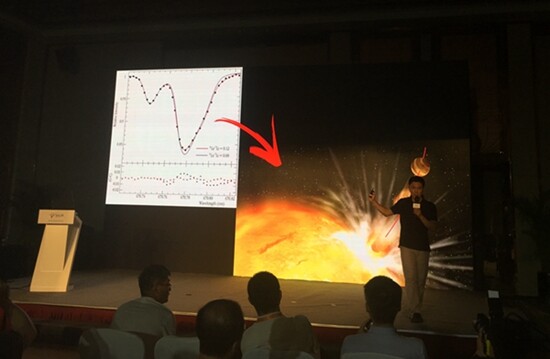
QDChip CEO Bao Jie Explains the Principle of Determining Planetary Ingestion Through Spectral Analysis
Understanding this phenomenon requires considering the issue from the perspective of elements.Lithium has an isotope,This isotopeHaving one fewer neutron than normal lithium,called lithium6. Lithium-6Extremely fragile,WhenStars Generate Temperatures of Tens of Millions of DegreesofHigh TemperatureTime,ItDurationVery brief, usually completely disappears within a few million light-years of star formation. HoweverWhenScientists observe the spectrum emitted by the star HB82943Time,FindingsLithium-6andLithiumElement (Lithium7) The ratio is as high as 3:25, which is significantly higher than the normal level.
Planets themselves do not emit light or heat, nor do they generate significant amounts of thermal energy.。After extensive argumentation and deduction, scientists hypothesize that inHB82943The presence of abundant lithium-6 on the surface is attributed to the star having engulfed its planets. Based on a ratio of 0.12, it can be inferred that the number of planets consumed is approximately twice that of Jupiter’s mass equivalent.
RegardingIn the case of HB82943 engulfing a planetMentioned the concept of "spectrum,"SpectrumYesPolychromatic LightAfter passing through a dispersion system (such asPrism、Grating)Spectroscopyafter, byDispersionOpenMonochromatic LightByWavelength(or frequency), arranged in sequence, fully known as the optical spectrum。The spectrum is the most precise and authentic way to describe the color composition of light.
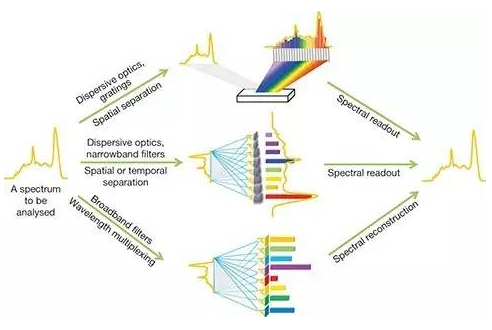
Schematic Diagram of the Working Principles of Three Types of Spectrometers
Light can interact with matter; when a beam of light passes through differentofChemical substances, substances willwithLight undergoes interaction,andInteractions alter the spectra of these light beams, and the nature of this alteration depends on the intrinsic properties of the matter.Strongly Associated,Moreover, each element interacts with light in a specific manner, meaning that elements possess unique characteristic spectra.ThereforeHumanPassableCharacteristic SpectrumIdentification of Substances。
Spectroscopy, in addition to helping humans understandIn addition to the phenomenon of extraterrestrial objects being consumed at a distance of 78 light-years, it can also be applied to the detection of human health conditions.. For example, human bloodChinaRich in hemoglobin, which absorbs oxygen in the lungs and transports it via the bloodstream to all parts of the body for consumption by tissue cells. Hemoglobin exists in two states: oxygenated and deoxygenated.Corresponding to the two statesChemical SubstancesDifferent, and therefore will haveDifferentSpectrum。
By measuringTheseSpectrum, HumanCan be understoodOxyhemoglobin and deoxyhemoglobin inHumanProportion in the body,It can be further determined through the proportionBlood Oxygen Content, MeasurementOutBlood Oxygen Levels Over TimeofChanges canMeasured asHeartbeat, respiration,and determine the human bodyHealth Status.
In addition to assessing blood oxygen levels,UrinecontainsHuman Bodyrichness ofMetabolic waste,Each substance corresponds to a specific spectrum,PassedSpectral measurement can identify the specific types of metabolic waste products, thereby enabling the assessment of human health.Recent and Long-Standing Diseasesorpotential health threats, etc.
Spectral detection methods can also be applied to food and pharmaceutical testing.As a city with an actual population exceeding 40 million, Beijing every dayApprox.20,000 trucks loaded with foodTransport to Beijing,By Time, with 10 trucks queuing per minute to enter Beijing,Moreover, the use of spectroscopic analysis for spot-checking food safety is an indispensable measure.
Spectrum asHumansMeans of Understanding the Composition of the WorldAlreadyWidely Applied. AndSpectrumThe instrument is bulky and expensive.,limits its scope of application. About 5 years ago,Prof. Jie BaoProposed quantum dot spectroscopy technology,This technology can accomplishMiniaturization and Sensorization of Large-Scale Spectroscopic Instruments,And thisThe most distinctive feature of the technology is its ability toCombined with sensors in cameras and smartphone cameras,BaLarge-scale spectrometer equipment is converted intoMiniaturized Sensors.
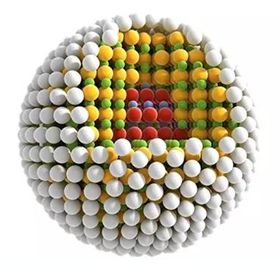
Schematic Diagram of Quantum Dot Grains
Quantum dots are extremely tiny nanomaterials, measuring only one ten-thousandth to one hundred-thousandth the diameter of a human hair.Size, usuallyWhenA Macro Materialits color does not change when its volume and size are altered, because color is its intrinsic state。However, when a materialthe dimensions areHair strandof1 in 10,000 to 1 in 100,000Time,ThisThe color of the material changes with its size.Evolution ProcessPrecision down to the addition of each individual atomorRemoving even a single atom wouldCauses Color Change。
Because the spectrum itself consists of finely differentiated colors, scientists can interpret the spectral colors using the extensive color library provided by quantum dot materials.
Another characteristic of quantum dots is that they can be processed, shaped, and integrated in a liquid state. Leveraging this feature, various such materials can be integrated into familiar hardware forms, such as smartphone cameras, thereby transforming bulky spectral instruments into sensors embedded within smartphone cameras. These quantum dot spectral sensors can be miniaturized to the size of a pinhole, significantly reducing costs while maintaining professional-grade performance.
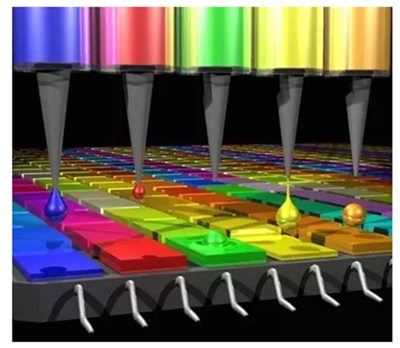
Schematic Diagram of Colloidal Quantum Dots Printed onto the Surface of an Image Sensor
The fabrication process of the micro-spectrometer is as follows: First, the quantum dot solution undergoes specialized processing. Then, due to its minute scale, it can be printed onto a substrate like ink in a printer, forming an arrayed thin film. Finally, this quantum dot thin film is integrated with the detector array used in smartphone cameras, conceptually constituting a spectrometer.
By redefining and redesigning the structure and algorithms of spectrometers, a miniature spectrometer has been developed. Under current conditions, the minimum size of this miniature spectrometer can reach approximately 1 cubic millimeter.
When micro-sensors are integrated into smartphones, users can leverage the camera to analyze food, pharmaceuticals, and personal health metrics; furthermore, these sensors can even be implanted in the human body to monitor various health indicators.
The sensing capabilities of spectroscopy can also be applied to the detection of pollutants and water quality in farmland, as well as to the monitoring of food production, processing, and transportation processes—a level of oversight that can be achieved at the consumer end. By integrating the Internet and big data analytics, it is possible to uncover inevitable causal relationships within seemingly isolated, distant, or even incomparable events, thereby reducing losses in both production and daily life.
QDChip is dedicated to overcoming the technical bottleneck that makes it difficult to acquire spectral information in real time using traditional instrumentation. By integrating novel nanocrystal materials—quantum dots—with imaging photosensitive elements, the company has developed a chip-sized, low-cost, and portable quantum dot spectral sensor, thereby enabling material composition analysis and detection using portable devices such as smartphones.
During his undergraduate studies, Bao Jie conducted research on nanomaterials and nanotechnology under the supervision of Academician Li Yadong. For his doctoral thesis, Dr. Bao investigated molecular dynamics using femtosecond ultrafast lasers. As these studies were primarily fundamental in nature, Dr. Bao aims to pursue applied research during his postdoctoral fellowship.
Bao Jie stated, “The research group I was part of during my postdoctoral studies was one of the earliest in the world to work on quantum dots. In recent years, researchers in the group have been dedicated to studying the applications of quantum dots in various fields, such as solar cells, displays, photodetectors, and biological labeling.”
Bao Jie worked and lived in the United States for many years. He has always had a strong interest in the commercialization of new technologies, hoping to apply them to real-life scenarios.
Humans can extract information from data, which can be transformed into knowledge to help them gain wisdom. In the face of vast and complex data, numerous sensors can assist humans in capturing information. Bao Jie stated that spectral sensors will soon become an indispensable solid foundation for the pyramid of wisdom.
Legend Star, established in 2008, currently manages two angel investment funds with a total capital of approximately RMB 1.5 billion. In 2015, it was ranked among the top three best angel investment institutions in China by Zero2IPO Group and China Venture respectively. As the early-stage investment and incubation arm of Legend Holdings, Legend Star leverages over 30 years of entrepreneurial experience and resource accumulation from Legend to provide entrepreneurs with distinctive services combining angel investment and in-depth incubation, serving as a “Super Angel” for entrepreneurs.
This article is intended for the guest speakers of the MED TED themed speech event, the second session of Xiangyi Hui, a sub-forum of the Legend Stars WILL Conference.