

Is the Right Time for Big Data Startups? Insights from BlueRun Ventures Forum

Zhu Tianyu joined the China office of BlueRun Ventures in 2009.
He has over ten years of experience in venture capital, business development, and management consulting.
His areas of focus include the Internet, mobile Internet, new media, and e-commerce.
He led the Series A investments in Meilishuo, Changba, and Qufenqi.
At the BlueRun Big Data Forum, Zhu Tianyu, Partner at BlueRun Ventures, delivered a speech on big data entrepreneurship.
Below are the PPT content and the transcript of the live presentation.▼:


The content consists of three parts:
First, timing is one of the most critical factors in many startups.
Second, reflections on addressing the potential challenges in the field of big data entrepreneurship.
Third, BlueRun’s existing strategic layout and considerations, as well as the startup opportunities it prioritizes.

The timing for entrepreneurship in the big data industry hinges on two fundamental aspects: first, endogenous demands arising from within the industry itself, and second, policy-driven incentives. Together, these two factors constitute the current window of opportunity for big data startups.
From the perspective of internal industry demand, enterprise services must be prioritized. Over the past decade or more in China, the dividends from consumer internet services, represented by the internet sector, are nearly exhausted.
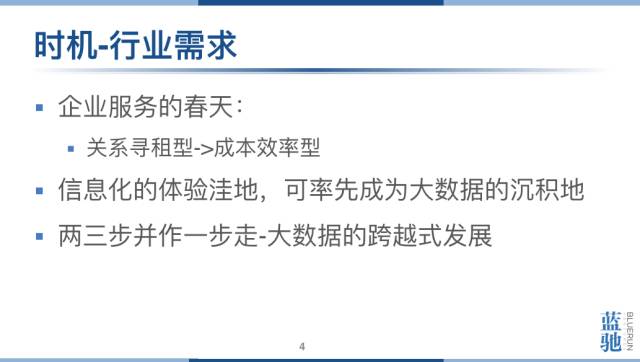
However, the spring of enterprise services has arrived, as the timing for startups in the big data industry is more favorable than before.
Over the past two to three decades of reform in China, while efficiency has improved across various industries, most sectors within the economy still operate with relatively extensive growth models and lack refined management. Only the internet industry has truly achieved operational sophistication.
A significant factor is that many industry-leading enterprises in China’s economy, such as mega state-owned enterprises (SOEs) and firms under the supervision of the State-owned Assets Supervision and Administration Commission (SASAC), lack sufficient drive for efficiency. This insufficient motivation among industry leaders has resulted in companies across various industry chains failing to prioritize efficiency as a core objective of corporate development.
Consequently, many enterprises engage in rent-seeking activities rather than pursuing refined operational management. Admittedly, numerous private enterprises have already achieved a high level of operational sophistication. Nevertheless, it is evident that the broader economy still exhibits significant deficiencies in both user experience and operational efficiency. This landscape currently heralds a golden age for big data applications.
From the perspectives of the administrative cycle and supply-side dynamics, the current administration places significant emphasis on the dividends generated by corporate efficiency improvements. Leading state-owned enterprises are already under considerable pressure, which may cascade to small and medium-sized enterprises (SMEs) in the mid- and downstream sectors, potentially fostering the emergence of more companies focused on cost-efficiency.
━━━━━
"Corporate Depressions Become the First to Accumulate Big Data"
━━━━━
Information-poor enterprises have become the first to accumulate big data. The current administration has designated big data as a national policy, and the State Council has issued numerous guidelines for its development. While big data, as referenced in these policies, is inherently an issue of informatization, significant gaps remain in enterprise-level informatization.
For example, whether enterprises truly operate and manage their businesses in a data-driven manner, whether digital elements within enterprise business processes can be effectively utilized, and whether data is genuinely leveraged for efficiency optimization—the answer is no.
These gaps also represent opportunities for startups. The starting point for big data ventures largely begins with informatization; however, relying solely on informatization is far from sufficient. The progressive advancement at each level will be discussed later. For instance, hospital case data has not been well processed, but if advanced technologies are employed to capture and integrate this data into a “Medical Brain,” the growth rate could potentially surpass that of big data initiatives in other industries.
This is leapfrog development, similar to China’s rollout of stored-program-controlled (SPC) telephone exchanges starting in the 1990s. At that time, the United States had accumulated decades of telephone infrastructure assets, yet China’s adoption of SPC telephony advanced even more rapidly than that of the U.S. This exemplifies strategic judgment in seizing industry opportunities.
In certain industries that are significantly lagging, it is even possible to leverage highly innovative and disruptive technologies to directly seize market opportunities, outpacing competitors and accumulating more data. These are several key characteristics of the current endogenous demands within the industry.
Moreover, policy is a bottom-up demand. As mentioned earlier, the underlying implication of big data is informatization, yet many regions have not adequately implemented it. There is still a long way to go for domestic data to truly reach the level of big data, but it must begin with informatization.
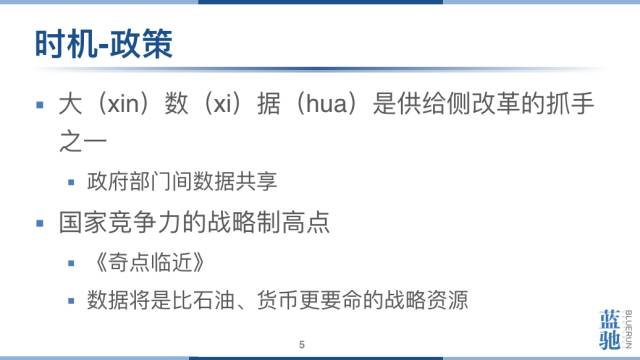
This includes the 2015 Outline for the Development of Big Data, which emphasizes intergovernmental data sharing. There is immense room for growth in this area. The reason for elevating data to such a high strategic priority is that it represents a strategic commanding height for national competitiveness.
“The Singularity Is Near” depicts that as artificial intelligence matures and the operations of all economies become rooted in digitalization, big data may profoundly reshape the existing political, military, and even economic landscapes. One inference is that data will become a more critical and potent strategic resource than oil or currency as we know them today. Governments have also clearly recognized that failing to cultivate this sector of the economy now could result in falling behind in data acquisition capabilities.
Back when China first joined the WTO, there were discussions about whether foreign capital’s control over pork and soybeans would also lead to its control over consumer prices. In fact, a similar analogy can be made: big data is also a critical strategic high ground at the political level.
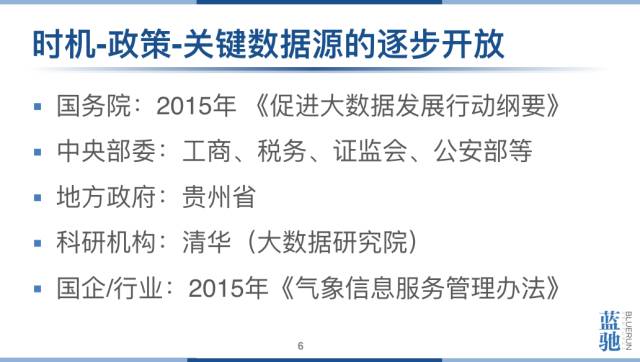
This underscores the current administration’s high priority on this matter. As national policies are implemented, local governments provide corresponding structural support and coordination. With the advancement of these policies, we are witnessing the opening up of key data sources. The State Council has first issued a top-down action plan, followed by efforts to promote data sharing among central ministries, research institutions, state-owned enterprises, and other stakeholders. Many startups have already begun exploring open data initiatives in collaboration with departments such as the State Administration for Market Regulation, the State Taxation Administration, the “Three Commissions and One Bank” (the China Banking and Insurance Regulatory Commission, the China Securities Regulatory Commission, the National Financial Regulatory Administration, and the People’s Bank of China), the Ministry of Public Security, and the energy sector.
In 2015, the China Meteorological Administration issued the “Measures for the Administration of Meteorological Information Services,” marking the first time that meteorological data was made openly available. The commercial meteorological services sector represents a substantial market; it is highly mature abroad and is essential for industries such as aviation and maritime navigation.
When this data becomes available, it presents the best opportunity for entrepreneurs. Thus, driven by both industry demand and policy support, bottom-up forces are propelling the industry forward.

Next, I would like to share the challenges we may encounter in big data entrepreneurship.
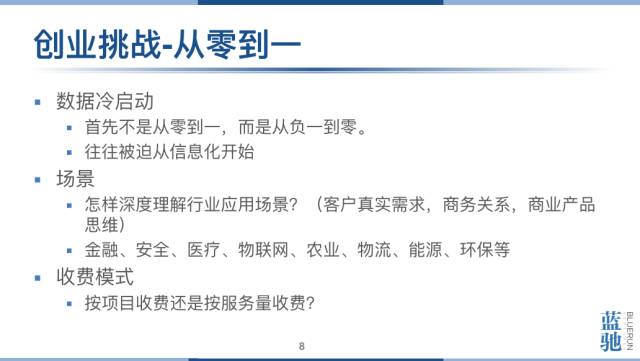
First, we must recognize the three levels of challenges. Big data startups primarily need to address the issue of data cold start. It is often said that building a business from 0 to 1 is arduous. However, for big data ventures, the challenge extends beyond going from 0 to 1; it is fundamentally about moving from -1 to 0, which constitutes the problem of data cold start.
Without data, or the ability to access it, how can big-data startups emerge and create value? Take Zhuang Chengchao of Qunar as an example. In the early days of his venture, he wondered whether the path he had chosen was overly arduous. Qunar initially partnered with TravelSky, the core of China’s Global Distribution System (GDS), which employed numerous PhD holders from Tsinghua University and Peking University. However, as a state-owned enterprise, TravelSky lacked the incentive to truly excel in this area. Consequently, when Qunar sought to build its own search engine, it found that TravelSky’s foundational infrastructure—critical to any search engine—was severely inadequate. Qunar had to develop numerous patches and overcome many formidable challenges before it could successfully integrate flight ticket information into its search engine, thereby leveraging industry data to pursue its desired business objectives.
Looking further back, when the online payment industry first emerged in China, many companies aimed to replicate PayPal. However, after six months to a year of operations, they realized that the primary task in China was to help banks make up for their technological deficiencies. In contrast, the U.S. banking system had already begun its gradual transition to electronic and information-based systems in the 1950s and 1960s. By the 1980s, its informatization was highly mature, enabling an immediate and efficient shift to internet-based services with the advent of the internet in the 1990s, followed by the rise of mobile internet.
In China, these stages may need to be compressed into one or two steps. This extraordinary leapfrog development presents significant challenges for entrepreneurs, but it also offers substantial opportunities. If you can identify such gaps and recognize these exceptional leapfrog opportunities, you will position yourself at the forefront of the industry. Data cold starts are often forced to begin with informatization, requiring arduous and labor-intensive efforts to acquire data before embarking on the path of data alchemy.
━━━━━
How to Monetize Data?
━━━━━
It is not enough to simply have data in order to make money. A critical factor is understanding the application scenarios of industry clients. Data itself does not generate value; value is created by solving customers’ problems. So, where do users’ true needs lie? Are the needs of frontline staff, department heads, and company executives the same? Can they all clearly articulate their needs? Sometimes they cannot, or they can but are reluctant to do so. The ability to elicit these unspoken insights is what truly uncovers their underlying needs.
This differs from consumer-facing or B2C businesses. In B2C, the target is individual consumers—a relatively straightforward segment where success hinges on delivering an exceptional user experience. In contrast, serving enterprise clients (B2B) presents far greater challenges.
The internet industry has been supported by a large number of commercial product managers. The key challenge lies in whether, after acquiring data and requirements, they can transform them into well-designed products that deliver an excellent user experience for enterprises or create compelling value propositions that encourage enterprises to pay. Defining industry-specific application scenarios is arguably even more difficult than cold-starting with data. Typical application scenarios are likely to emerge first in sectors such as finance, security, the Internet of Things (IoT), agriculture, and logistics.
With scenarios and commercial products and services in place, what is the next-level pricing model? For enterprise services, should charges be based on projects or on service volume? The more common approach is project-based pricing, where a data service is provided—similar to SaaS—and enterprises pay accordingly. But is this the true essence of the big data business model? Could charging be based on service volume instead?
When enterprises purchase data projects, can they obtain useful outcomes, create new value, or generate results that compel them to pay? This may involve a one-time data verification, similar to credit approval or creditworthiness checks, or a specific query search. Under a pay-per-service model, the revenue-generating capability differs significantly from that of a project-based pricing model, and this truly reflects the value of monetizing big data services. Therefore, this presents further challenges and food for thought.
The three levels just mentioned are issues that every entrepreneur should consider. However, for investors, the focus is undoubtedly on selecting the companies with the best growth potential and highest value from among numerous startup projects.
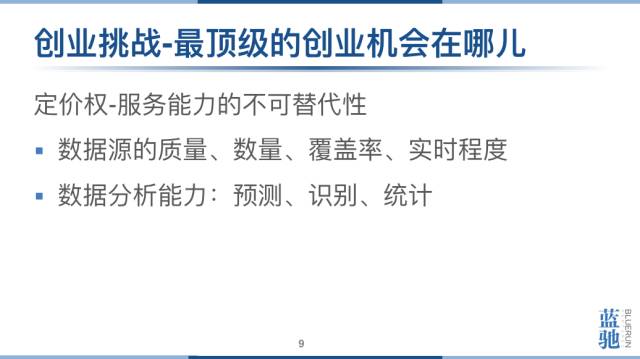
Previously, the term “unicorn” was frequently used, but recently it has been approached with caution, even becoming a negative label. So where do entrepreneurial opportunities lie? Let us introduce a new concept: pricing power. What is pricing power? Simply put, it means you set the price, and customers still buy your product or service. Pricing power does not merely refer to the ability to set prices; rather, it reflects a company’s premium capability relative to its customers and upstream/downstream partners. Crucially, this bargaining power must be irreplaceable. When a company achieves this level of pricing power, it inevitably becomes a highly sought-after target for investors.
Returning to the big data sector, what are the characteristics of business models that truly possess strong pricing power? Here, we will discuss two aspects, as the data business ultimately boils down to two things: selling data and selling data services. For those selling data, the quality, quantity, and coverage of data sources are all critical, as scale is essential.
Many entrepreneurs claim, “I’ve collected interest tags for millions of users,” touting it as big data. In reality, there are technical standards that determine at what point data becomes a truly valuable source, and each individual can make this assessment. Beyond this, the timeliness of real-time data updates is also a key factor, determining whether the data source is static or dynamic.
How to Acquire Dynamic Data Sources? What kind of relationship should be established with upstream data providers to ensure that data sources are not merely static, limited to their current quality and volume, but rather dynamic, capable of continuous iteration and evolution in both quality and quantity? In terms of data analytics capabilities, most practitioners are familiar with statistical analysis, such as retrieving data to generate charts, or performing more advanced cross-analysis and visualization.
However, statistics represent only the most fundamental level of data application. At a more advanced stage, data is utilized to build models that generate early warnings. For instance, in medical imaging, an alert may be triggered if findings are consistent with early-stage cancer. Similarly, in credit scoring, predefined rules can flag anomalies in an individual’s data, leading to an alert and denial of credit extension. This process constitutes identification.
This represents a somewhat more advanced level within statistical modeling, yet it still falls within the intermediate stage. The next tier involves predictive capabilities—forecasting future events and identifying emerging issues that have not yet been recognized. Entrepreneurs must consider which level they should strive toward in building their core competencies. To what extent can data sources support these dimensions? At what stage can one attain the “crown jewel,” or the most lucrative segment of this sector? These are critical questions warranting careful consideration.
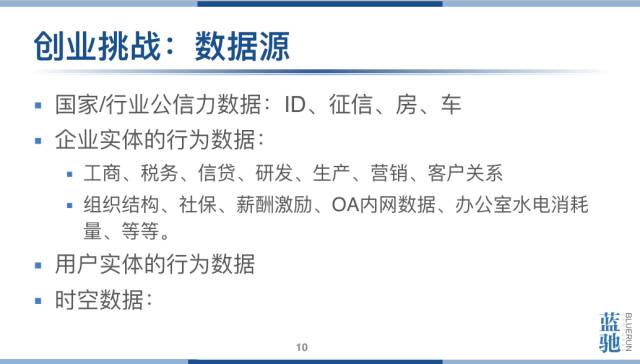
Briefly mention the data sources, such as the national industry and public credibility tier data currently visible, including identity, credit reporting, real estate, and vehicle ownership. Focus on enterprise entities and user entities. Regarding user entities, despite years of emphasis on user behavior, the value generated has been limited due to insufficient data dimensions. As noted, temporal and spatial data represent areas previously lacking in our user datasets. The key questions are: who possesses this temporal and spatial data, where can such data be found, and is it updated in real time?
Regarding the entity data of enterprises, if we view an enterprise as a user, what kind of personality and characteristics does it have? How can we use this perspective to identify an enterprise? In the future, many assessments will involve judging both individuals and enterprises. Can behavioral data measure these attributes? Such data may exist in various aspects, such as every link in the enterprise’s value creation process: from R&D to production, to customer service. It may also involve upstream and downstream suppliers, as well as all stakeholders, including industrial and commercial administration, taxation, and credit agencies. Internally, how does the enterprise treat its employees and interact with them? Even office utility consumption, such as water and electricity, could contribute to profiling the enterprise’s image data, though this is not exhaustive. However, we aim to introduce a concept: regarding behavioral data of enterprises, what might be the potential data sources? We need to broaden our thinking.
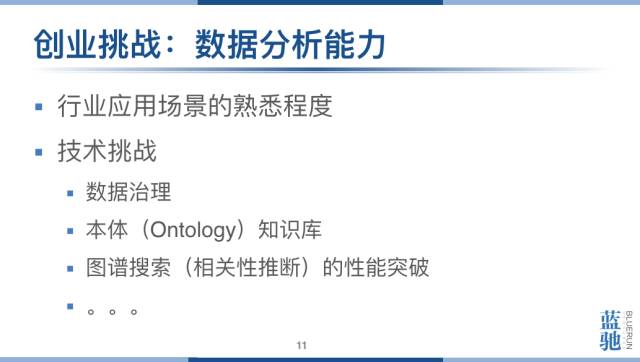
As for data analysis, scenarios are more important than technology. Familiarity with industry scenarios determines the capability to build big data services.
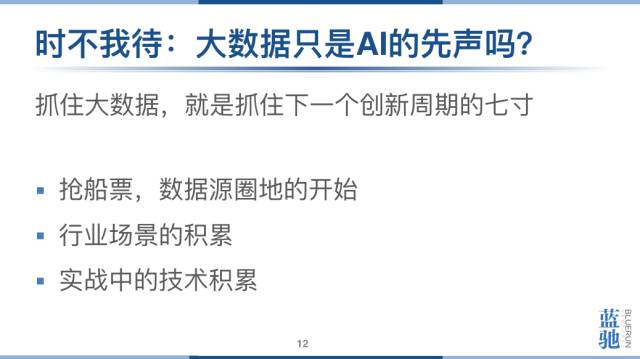
Seizing big data is key to mastering the next innovation cycle. In the Chinese market, it is essential to start from the foundational level of data sources, addressing areas with low levels of informatization. Capturing big data also means strategically positioning oneself in the future arena of artificial intelligence (AI). AI relies on data accumulation, and through this process, companies also accumulate genuinely effective technologies.
━━━━━
Summary Share
━━━━━
There are three keywords:
First, from -1 to 0 addresses the issue of cold-starting data. Behind every keyword lies an actual question, not merely the keyword itself. When considering the phase from -1 to 0, you should ask yourself which questions are relevant.
Second, the scenario. It is not merely a matter of data; only by achieving a profound understanding of the clinical scenarios and gaining deep insights into customer needs can one truly establish their own products and business models, and achieve profitability.
Third, pricing power. These three keywords target entrepreneurs at different stages. The transition from -1 to 0 is what early-stage entrepreneurs should focus on right now. For those who are already underway, the question is whether they have previously overlooked specific scenarios and whether there are better ways to gain insightful knowledge about these scenarios. For entrepreneurs aiming to reach the next level, it is crucial to consider how to secure robust data sources, how to build technological barriers, and how to truly deliver high-quality products and services.