Corporate Venture Capital Gains Prominence in Healthcare: Focus on Emerging Technologies and Digital Health
In terms of the number of active CVCs, investment amounts, and transaction volumes, corporate venture capital (CVC) investments across all sectors of healthcare are showing an upward trend.
At the Health Evolution Summit (HES) held in the second quarter of 2016, the organizers conducted a survey among the 27 corporate venture capital (CVC) firms in attendance. The survey focused on the investment objectives and areas of interest of CVCs, as well as changes in capital dynamics since 2008. VCBeat has excerpted selected portions of the report.
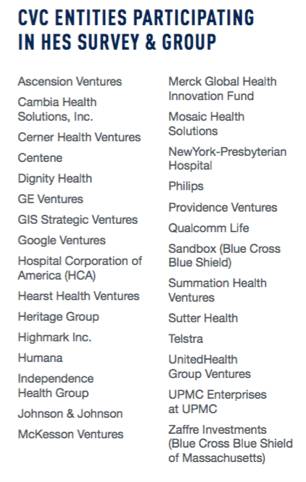
The figure below shows the corporate venture capital firms involved in this survey, including some U.S. healthcare service providers, as well as publicly listed pharmaceutical and medical device companies such as GE, Johnson & Johnson, Merck, and Philips.
Current Status of CVC in Healthcare
According to the latest report by PwC and the National Venture Capital Association (NVCA), corporate venture capital (CVC) firms invested in a total of 905 projects within the U.S. startup ecosystem in 2015, accounting for 21% of all venture capital deals. The transaction volume exceeded $7.5 billion, representing 13% of total venture capital investment amount. Deal activity rose for nine consecutive quarters, reaching 23.5% of the total in the first quarter of 2016, just below the previous peak of 24.1% recorded prior to the 2008 financial crisis. In the first quarter of 2016, CVC’s share of venture capital investment value reached 20.6%, marking the strongest performance in the 21 years of NVCA’s tracking records.
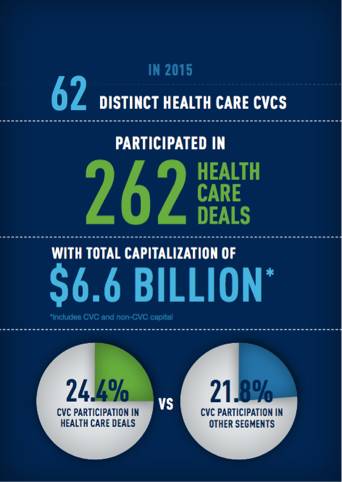
In particular, healthcare has emerged as a new focal point for corporate venture capital (CVC) in enterprise innovation. In 2015, venture capital deal volume in biotechnology, healthcare services, and medical technology accounted for 24.4%, compared with 21.8% across all other sectors combined. The digital health sector has only gradually gained momentum in recent years; from 2013 to 2015, one in every five active investors was a CVC. According to estimates by the global corporate consulting firm Rick Beberman Consulting, CVC investments in healthcare-related ventures exceeded $6.6 billion in 2015.
Diverse Investor Base
Many traditional non-healthcare institutions, such as Google, Qualcomm, and Hearst, have begun to actively engage in the sector. Approximately 61% of these entities were established after 2008, with 27% founded within the past two years. An interesting trend is the rise of separate funds; whereas most corporate venture capital (CVC) investments were previously managed on corporate balance sheets, there are now dedicated funds overseen by specialized investment teams.

The figure above illustrates the backgrounds of the surveyed corporate venture capital (CVC) firms and their years of investment experience. It is evident that healthcare providers and payers are the most active, with the majority having less than five years of investment experience.
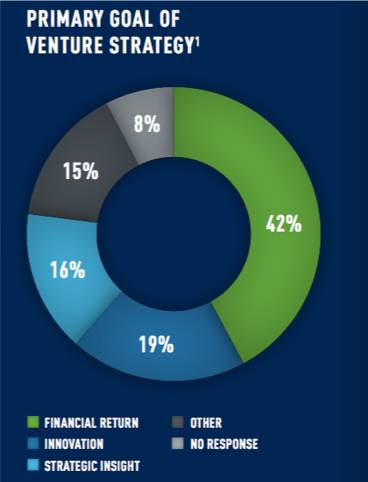
The chart above illustrates the distribution of primary objectives in CVC investment strategies, with 42% attributed to financial returns. However, in reality, all surveyed CVCs agree that investments are futile if they are not aligned with the corporate strategy of the parent company.
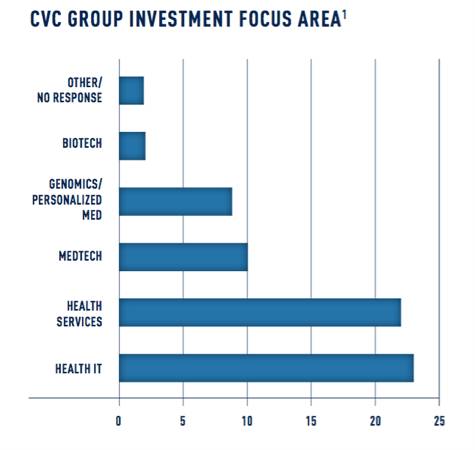
As shown in the figure above, CVC’s areas of focus are primarily concentrated on emerging technologies, particularly Health Information Technology (HIT), digital health applied to medical services, medical technology, and personalized medicine.
The survey also found that most respondents indicated their investments are focused on companies that can enhance the core business of their corporate groups. Compared to long-term evolution of business models, short-term strategic returns are relatively more attractive to CVCs.
Direct Investment on the Rise: Rejecting the Role of Passive LP
Traditionally, most corporate venture capital (CVC) arms, particularly those within the payment and healthcare sectors, have tended to act as limited partners (LPs), rarely engaging in direct investments. However, today, a significant number of healthcare companies are showing interest in directly investing in startups. Few remain willing to serve as LPs in external funds. Surveys indicate that 61% of respondents stated they engage exclusively in direct investments and no longer participate as secondary investors.
CVCs have long been regarded as secondary investors in the investment community. However, 95% of respondents now state that they possess extensive venture capital experience, along with combined advantages in operational expertise and investment tracking.
Members of the VBR WeChat group can download the original English version of this white paper from the shared files. Those who have not yet joined the group, please scan the QR code below:

【B.T.W. Proprietary Industry, Hard Ad Placement, Jubilation】