Can We Manage Diabetes More Intelligently and Precisely? — Huang Xiaomin, Founder and CEO of LenoMed

Kailian Medical
High-end Medical Device R&D, Production, and Sales Company
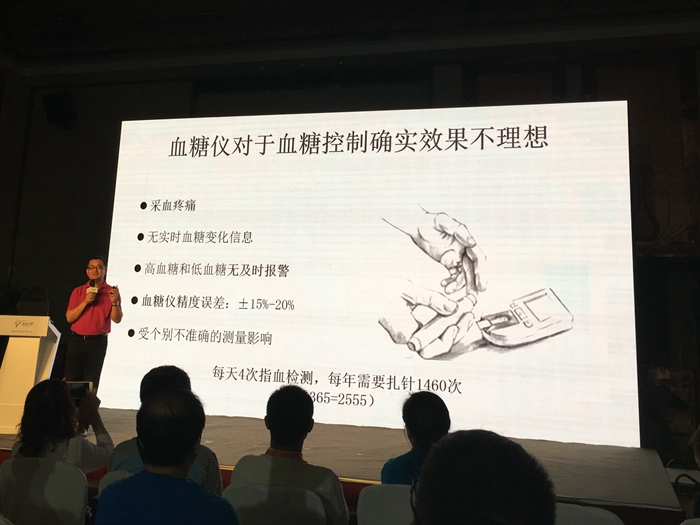
Huang Xiaomin, Founder and CEO of Kailian Medical Technology, is sharing insights on diabetes management.
China is home to over 100 million individuals with diabetes. While the severity of this condition is widely recognized, most physicians lack the time to provide comprehensive patient management. Consequently, the vast majority of patients administer insulin injections and take antidiabetic medications at home on their own, while attempting to manage exercise and diet independently. This inevitably leads to cases where blood glucose levels spiral out of control. Is there, then, an intelligent approach that can precisely assist patients in managing their blood sugar? The keynote address delivered by Huang Xiaomin, Founder and CEO of Kailian Medical, at the Legend Star WILL Conference may well point the way forward for diabetes patients.
Diabetes management is a highly prevalent topic, with numerous management tools available on the market and many hospitals offering lectures dedicated to diabetes care. Therefore, we must first clarify the fundamental aspect of diabetes management. Most people tend to focus on “hyperglycemia,” equating diabetes simply with elevated blood glucose levels. Since hyperglycemia can lead to various complications, including cardiovascular disease, blindness, renal failure, and neurological and vascular disorders, controlling blood glucose levels remains the primary concern for patients.
However, hypoglycemia has been largely overlooked; many patients with diabetes are even unaware that it is a complication of the disease. Compared with the risks associated with hyperglycemic complications, hypoglycemia poses a greater threat, potentially leading to cognitive decline, loss of consciousness, and even death.
According to research by the U.S. Food and Drug Administration (FDA), thousands of traffic accidents in the United States are associated with hypoglycemic symptoms each year, resulting in a significantly high number of fatalities. Furthermore, a third-party report indicated that an analysis of five fatal traffic accidents caused by severe hypoglycemia revealed that all incidents were linked to impaired consciousness due to sudden-onset hypoglycemia. Meanwhile, a diabetes care report from the American Diabetes Association (ADA) highlighted that hypoglycemia is a critical contributing factor in motor vehicle accidents.
Therefore, we believe that the correct approach to diabetes management should be to achieve a balance between hyperglycemia and hypoglycemia.
Diabetes management encompasses two key components: diagnosis and treatment. In the diagnosis of diabetes, HbA1c, or glycated hemoglobin, is commonly used. HbA1c reflects the average blood glucose levels over the preceding 90 days; an HbA1c level below 7% indicates excellent glycemic control. However, there are two potential concerns:
1、If a patient experiences significant fluctuations in blood glucose levels, HbA1c may remain within the normal range even when averaging out recurrent episodes of hyperglycemia, thereby masking the underlying condition;
2、Frequent hypoglycemic episodes may yield favorable HbA1c results, yet patients can experience asymptomatic or unaware hypoglycemia, which HbA1c fails to detect.
As one of the most critical monitoring methods in diabetes management, the penetration rate of capillary blood glucose monitoring in China has remained at only around 15% for many years. What are the underlying reasons? It is conceivable that requiring patients to perform finger-prick tests four times daily would be extremely painful. If lifelong reliance on this invasive method were necessary, few individuals would likely adhere to it. Furthermore, when patients measure capillary blood glucose in the fasting state or two hours postprandially, the absence of a real-time glucose trend curve means that the single-point value cannot reflect glycemic fluctuations during the preceding or subsequent 30 minutes. Consequently, hypoglycemic and hyperglycemic events cannot be predicted. Hypoglycemia typically occurs nocturnally, a time when routine glucose monitoring is impractical.
Another issue is the accuracy of blood glucose meters. The standard set by China’s CFDA is ±20%, while the CE standard is ±15%. When operational errors are factored in, home monitoring results are inevitably insufficiently accurate, which is why hospitals do not accept patients’ self-testing results. If all tests were conducted in hospitals according to clinical standards, hospitalized patients would require four fingerstick blood samples per day, amounting to 1,460 punctures annually. The consequences of such frequent punctures over a decade are easy to imagine.
Under conventional diabetes management, even with multiple daily fingerstick blood tests, we can only obtain blood glucose values at a few discrete time points. This approach leaves the fluctuating trends of blood glucose entirely unknown and provides no early warning for hyperglycemia or hypoglycemia at any given moment. If we manage a chronic disease based on incomplete and discontinuous information derived from isolated data points, inherent problems will inevitably arise.
Imagine if we could obtain continuous blood glucose readings for patients with diabetes, similar to an electrocardiogram (ECG), thereby accurately capturing the fluctuation curve of blood glucose levels over a 24-hour period. The resulting data would be exceptionally rich, elevating the diagnostic precision for hypoglycemia and hyperglycemia to a new height.
The solution offered by Kailite’s CT-100 sensor technology is Continuous Glucose Monitoring (CGM). Paired with a portable data system or smartphone, this wearable medical device continuously monitors patients’ blood glucose levels 24 hours a day. The system operates via a hair-thin biosensor implanted subcutaneously to perform real-time dynamic glucose monitoring, displaying a blood glucose reading every three minutes. This yields 480 continuous glucose measurements per day over a seven-day period, providing a comprehensive overview of glucose patterns. Through a smartphone application, users can access blood glucose values and fluctuation trends. Data are transmitted in real time to the cloud for analysis, leveraging the extensive dataset to assist patients in managing their condition.
This sensor can be worn on the arm or abdomen and is implanted subcutaneously in parallel to continuously monitor glucose concentration in subcutaneous interstitial fluid. According to the latest clinical trial results, the Mean Absolute Relative Difference (MARD) can be kept below 10%, enabling more accurate blood glucose data acquisition than traditional blood glucose meters.
Continuous monitoring over seven days generates a vast amount of data. By superimposing blood glucose curves and applying algorithms, critical insights can be derived, including glycemic variability, the frequency of hyperglycemic and hypoglycemic events, and blood glucose fluctuation analysis. This approach even enables the calculation of the Low Blood Glucose Index (LBGI) and, through specific algorithms, the estimation of HbA1c levels.
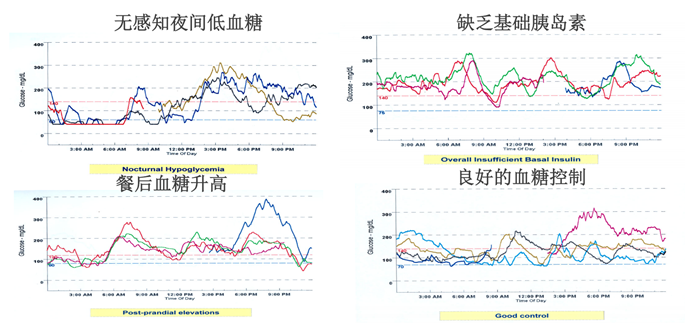
Several Typical Diabetes Atlases
The vast amount of data generated by Continuous Glucose Monitoring (CGM) can be used to create various glucose profiles. In blood glucose monitoring and personalized intelligent management, episodes of hyperglycemia and hypoglycemia occur from time to time. If a profile indicating asymptomatic nocturnal hypoglycemia is identified, physicians can readily access this information and initiate appropriate treatment. If glucose levels exceed the target range of 70–140 mg/dL, supplementation with basal insulin may be sufficient; once blood glucose returns to the normal range following supplementation, no additional treatment is required. Furthermore, continuous CGM monitoring aids patients in differentiating and assessing conditions such as the Somogyi effect (characterized by nocturnal hypoglycemia followed by pre-breakfast hyperglycemia).
CGM not only addresses individual cases but also delivers broader impact. It can generate distinct glycemic profiles for patients with type 1 diabetes, type 2 diabetes, or other forms such as latent autoimmune diabetes in adults (LADA), create corresponding profiles for diabetic patients across different ethnic groups, and even establish a comprehensive diabetes database platform.
Furthermore, CGM can also be utilized for the screening and diagnosis of diabetes. In many cases, diabetes cannot be definitively diagnosed through fingerstick blood sampling or fasting venous blood draws in the morning; however, continuous monitoring enables a more accurate assessment. This approach also facilitates screening among individuals in a sub-health state. For patients at risk, it supports comprehensive management across lifestyle, diet, and exercise, as well as final therapeutic efficacy evaluation. In essence, CGM truly enables comprehensive disease management for diabetes.
Diabetes represents a major disease category and a significant burden, consuming substantial medical resources in both developed and developing countries. Given the superior performance of continuous glucose monitoring (CGM) systems, Huang Xiaomin holds high expectations for this technology. While introducing CGM to reporters, he also demonstrated the testing devices. Notably, the entire team has been conducting experiments on themselves, leaving a deep impression.
Huang Xiaomin candidly acknowledged that continuous glucose monitoring (CGM) in China still faces numerous challenges. First, CGM applications in China are primarily concentrated in hospital settings, dominated by Medtronic devices. However, the Medtronic equipment currently available in China is designed exclusively for hospital use, leaving a gap in the domestic market for consumer-grade products suitable for non-hospital settings. Second, there is the challenge of cost. In the United States, all patients with type 1 diabetes and a subset of those with type 2 diabetes are covered by insurance, whereas such expenses are not covered by medical insurance in China. Using Medtronic devices for continuous glucose monitoring in China costs RMB 1,000 for a three-day period. A single biosensor, which costs only USD 60–80 in the United States, is priced at RMB 1,000 in China, making it accessible to only a small fraction of the population.
Regarding the future of its CGM products, Huang Xiaomin hopes to achieve accuracy on par with DexCom’s devices, but at a price point comparable to that of fingerstick blood glucose testing, and he looks forward to the rapid commercialization of this technology.
Legend Star, established in 2008, currently manages two angel investment funds with a total size of approximately RMB 1.5 billion. In 2015, it was ranked among the top three best angel investment institutions in China by Zero2IPO Group and CVSource, respectively. As the early-stage investment and incubation arm of Legend Holdings, Legend Star leverages over 30 years of entrepreneurial experience and resource accumulation from Legend to provide entrepreneurs with distinctive services combining angel investment and in-depth incubation, serving as a “super angel” for entrepreneurs.
This article is intended for the guest speakers of the MED TED themed keynote event, Session II of Xiangyi Hui, a sub-forum of the Legend Stars WILL Conference.